
Alexandre Kantorow, piano
Thursday, April 23, 2026, 7:30pm
Hertz Hall
This performance is made possible in part by Art Berliner and Marian Lever.
Cal Performances is committed to fostering a welcoming, inclusive, and safe environment for all one that honors our venues as places of respite, openness, and respect. Please see the Community Agreements section on our Policies page for more information.
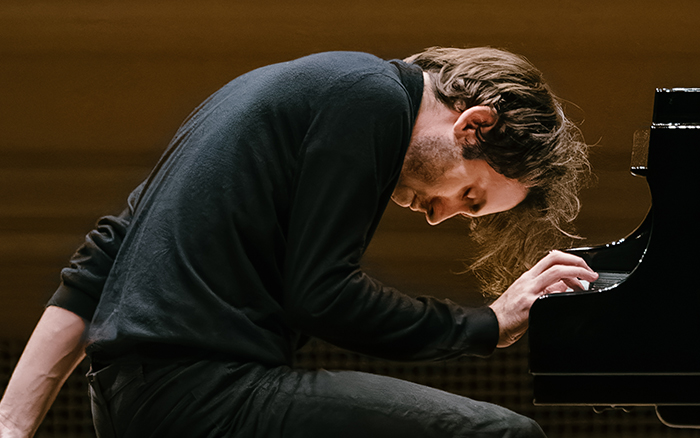
FRANZ LISZT (AFTER BACH)
Variations on “Weinen, Klagen, Sorgen,
Zagen,” S. 180
Franz Liszt essentially invented the tradition of the solo piano recital, declaring the instrument to be “the microcosm of music.” In his hands, the piano became capable not only of orchestral grandeur but of spiritual introspection, historical reflection, and radical transformation. Liszt’s technical brilliance and magnetic stage presence redefined virtuosity at a moment when the piano itself was becoming central to 19th-century musical life.
That public persona belonged chiefly to the early phase of Liszt’s career. In 1847, he withdrew from the life of a touring virtuoso and turned increasingly toward composition, teaching, and the advocacy of new music. Still, for all his championing of revolutionary voices and his own daring experiments in form and harmony, Liszt revered the past: Bach stood as a towering presence in his imagination. Liszt’s engagement with the Leipzig cantor took many forms. He prepared numerous piano transcriptions of organ works, recasting them for the modern concert instrument and reimagining their sonority in characteristically Lisztian fashion. Yet he also went further, composing wholly original works inspired by Bach’s musical ideas rather than simply arranging them.
The Variations on “Weinen, Klagen, Sorgen, Zagen” belong to the latter category. The point of departure is an early cantata (BWV 12) from 1714 composed during Bach’s years in Weimar—the same city where Liszt had taken up a post as Kapellmeister in 1848. The cantata’s title is taken from the opening chorus, which names “weeping, lamentation, worry, dread” as “the Christian’s bread.” It reflects the Gospel text appointed for the day, in which Jesus tells his disciples that though they will grieve on earth, their sorrow “will turn into joy.”
In 1859, Liszt first turned directly to this material for a relatively brief solo piano piece he titled Prelude after J. S. Bach (S. 179), in which he seizes upon the descending chromatic bass line from the cantata’s opening chorus and isolates it as the structural foundation of a passacaglia-like meditation. This musical gesture was a long-established emblem of lament in Baroque musical rhetoric; Bach also employed it with particular gravity in the “Crucifixus” of the B minor Mass, a precedent Liszt would have known well.
The year 1859 also brought personal tragedy: Daniel, the youngest of Liszt’s three children with the Comtesse Marie d’Agoult, died that December at the age of 20. Three years later, when his daughter Blandine died from complications of childbirth, Liszt returned to this material on a far larger scale for the Variations on “Weinen, Klagen, Sorgen, Zagen,” S. 180. An organ version followed in 1863 (S. 673) and has become a mainstay of the repertoire, more frequently encountered than the piano original.
Liszt begins with a dramatic introductory span before presenting the “Weinen, Klagen, Sorgen, Zagen” motif. This four-measure chromatic descent in the bass provides the foundation for a vast, passacaglia-like sequence of variations. The “lamenting” idea is ceaselessly reworked across shifting registers and subjected to ever more searching harmonic intensification and increasingly varied textures.
A freely flowing fantasia, suggestive of recitative, bridges the way to another reference to Bach’s cantata: the consoling chorale “Was Gott tut, das ist wohlgetan” (“What God does is well done”) that concludes BWV 12. In the closing pages, elements of the lamenting motif reappear and are absorbed into the chorale’s radiant F major, binding suffering and consolation into a single, exalted conclusion. In this way, Liszt retraces the journey Bach had taken—echoing the Gospel promise that sorrow “will turn into joy”—but recasts it through a distinctly Romantic lens.
NIKOLAI MEDTNER
Piano Sonata in F minor, Op. 5
When Nikolai Karlovich Medtner was born in Moscow in 1880, Russian musical life was producing pianist-composers of extraordinary charisma and imagination. Rachmaninoff and Scriabin, only slightly older, would come to embody very different responses to the instrument’s expanding possibilities—one steeped in grand Romantic rhetoric, the other drawn toward mystical flights. Medtner, though their contemporary, chose a markedly different path.
Born into a family of German immigrants and trained at the Moscow Conservatory—where his uncle taught piano—he absorbed the discipline of the Austro-German tradition as deeply as the inheritance of Russian culture. Though a pianist of formidable ability, Medtner turned away from the life of a touring virtuoso, devoting himself instead to composition and cultivating a reputation for reserve, even reclusiveness. Deeply religious and spiritually serious, he regarded music as a bearer of ethical as well as aesthetic truth.
After leaving Russia in 1921, Medtner lived in Germany and France before eventually settling in London. He found himself increasingly out of step with Modernist currents and held the legacy of the sonata in particularly high esteem. Yet in recent decades, his music has undergone a notable revival, with pianists increasingly drawn to its intellectual rigor, harmonic subtlety, and emotional depth. Beethoven stood at the center of Medtner’s artistic imagination, alongside Bach and Brahms. Like Beethoven, he returned repeatedly to the genre as the vehicle for some of his most sustained thoughts, composing a total of 14 piano sonatas across his career.
The Piano Sonata in F minor, Op. 5, completed in 1903, already reveals Medtner’s allegiance to the great sonata tradition. Cast in four movements, it combines contrapuntal rigor with a deeply personal expressive world. The first theme has a rhythmic ingenuity that evokes Bachian invention and invites development. Against this stern opening stands a second, Schumannesque theme of striking lyric warmth. Lore around the composer has associated it with Anna Bratenshi—a violinist who was married to his older brother but would later become Medtner’s wife. The contrast between the austere first theme and this expansive lyrical idea generates much of the movement’s expressive tension. In the development and recapitulation, Medtner ingeniously interweaves the two, binding introspection and passion into a unified argument.
The Intermezzo that follows unfurls a different variety of restlessness through an obsessive motivic idea that resembles an unanswerable question. After a false ending comes an unexpected coda that insistently repeats the “question” motif, adding to the air of ambiguity. This in turn yields to the distinctly different sound world of the Largo divoto, which nods to Medtner’s Russian side; solemn chordal progressions carry a distinctly Russian inflection, at moments suggesting the resonance of Orthodox chant.
The finale, cast in sonata form, reworks threads from the preceding movements into a cumulative design rich in contrapuntal texture. Central to its architecture is the transfiguration of the lyrical second theme from the opening movement, which guides the sonata to its hard-won affirmation.
FRÉDÉRIC CHOPIN
Prelude in C-sharp minor, Op. 45
In his cultivation of the miniature piano forms most closely associated with his name, Chopin achieved a fusion of technique, content, and style that secured his preludes, études, mazurkas, and nocturnes a lasting and central place in the repertoire. As the Chopin scholar Jean-Jacques Eigeldinger has suggested, composers such as Beethoven before him and Liszt and Ravel after him sought to give the piano a symphonic character, whereas Chopin’s pianism does not emulate the orchestra of its era.
The 24 Preludes, Op. 28 (1839), already represented an artistic summa when Chopin was still in his twenties. Two years later, in 1841, during his summer at Nohant with his partner George Sand, Chopin composed an additional prelude, published separately as Op. 45 and dedicated to one of his students. Unlike the concentrated miniatures of Op. 28—the C-sharp minor Prelude from that set (sometimes called The Night Moth) is brisk and exceedingly brief—the later C-sharp minor Prelude entails a much broader scale. Its length—comparable to the so-called Raindrop Prelude—and its mood of gentle resignation (or is it ecstasy?) suggest something closer to an improvised nocturne.
Here melody and accompaniment seem to merge, creating what Mieczysław Tomaszewski described as the impression of a “notated improvisation.” The music does not announce a fixed formal plan but appears to unfold continuously from its opening idea, sustained by subtle harmonic shifts and an atmosphere of rapt inwardness. Although the notoriously self-critical Chopin struggled to perfect the Op. 28 set, he allowed himself to express a rare measure of pride in this later Prelude, writing to his copyist, “It is well modulated, and I can send it without anxiety,” and selecting Op. 45 for inclusion in an album intended to raise funds for the Beethoven monument in Bonn.
CHARLES-VALENTIN ALKAN
La Chanson de la folle au bord de mer, Op. 31, No. 8
Charles-Valentin Alkan, who was born into a Jewish family in Paris in 1813, came of age as the piano was rapidly becoming the defining instrument of European musical life. The public virtuoso recital was taking shape, and new instruments from firms such as Érard and Pleyel were expanding the keyboard’s range and sonority. The city would soon become a proving ground for prodigies such as Liszt and Chopin.
Alkan, their slightly younger contemporary, was admitted to the Paris Conservatoire at an early age and soon became regarded as one of the most formidable pianists of his generation. Yet his response to the culture of public virtuosity around him was idiosyncratic. After an early burst of acclaim, he withdrew for long stretches from the public stage, cultivating a reputation for reclusiveness that only deepened his mystique.
La Chanson de la folle au bord de la mer (“The Song of the Madwoman by the Seashore”) is the eighth of Alkan’s 25 Preludes, Op. 31, written in 1844–45 and published in 1847. The cycle engages the precedent of Chopin’s Op. 28 from 1839 in its comprehensive traversal of the keys. Yet the scale and character of Alkan’s preludes are markedly different—more expansive and at times overtly programmatic, with several carrying devotional or sacred associations.
This haunting music plays off the stark contrast between relentless chords deep in the bass—a ceaseless, inescapable undertow, with an echo of tolling funeral bells—and a plaintively simple melody that unfolds in the right hand, as if whistling in the dark.
In a sudden frenzy, the obsessive repetition accelerates and swells to a climax before coming to an abrupt halt. The opening pattern then begins again, implacable as before.
ALEXANDRE SCRIABIN
Vers la flamme, Op. 72
Alexander Scriabin began his career as a charismatic pianist and contemporary of Rachmaninoff, composing keyboard miniatures that emulate the piano poetry of Chopin. But he came to embrace an increasingly mystical conception of art, envisioning the artist as a kind of high priest presiding over a world-transforming apocalypse—nowhere more fully imagined than in his unfinished Mysterium, conceived as a vast, multi-sensory ritual intended to usher in a state of cosmic, transfiguring love.
One of Scriabin’s early advocates, the critic Boris de Schloezer—whose sister became the composer’s muse and second, common-law wife—described a recurring trajectory in his mature works as “a uniform succession of states—languor, longing, impetuous striving, dance, ecstasy, and transfiguration.” By 1914, when he composed Vers la flamme, Op. 72, Scriabin had long since abandoned traditional key signatures and conventional tonality. The work (the title translates to “Toward the Flame”) remains one of his most beguiling creations, part of the reduced output of his final years. Its focus is fixed almost entirely on the state of ecstasy toward which all striving is directed.
The piece grows from a simple two-note opening gesture, gradually accumulating tension through subtle rhythmic agitation and ever-denser textures. Scriabin transforms the trill from a mere ornament into a figure of incandescent energy, the keyboard shimmering with flame-like vibration even as the harmony grows increasingly unstable. It culminates in an apotheosis of blistering trills which, as his biographer Faubion Bowers wrote, “becomes consumed in its own flames.”
LUDWIG VAN BEETHOVEN
Piano Sonata No. 32 in C minor, Op. 111
What could come after Beethoven? That despairing question has fueled intense Oedipal reactions to a figure whose presence remains overpowering even now, more than 250 years after his birth. The icon and iconoclast seem inextricably bound together. But Beethoven himself must have pondered: what on earth could come after the mighty Hammerklavier Sonata, Op. 106, completed in 1818. Not surprisingly, a hiatus in the composer’s piano sonata production followed that mammoth work. When Beethoven returned to the genre in 1820, he seized it to create enigmatic sonatas that seem radically to refute the models of a vanished era—the very models he had altered and expanded into new paradigms.
The final trilogy of piano sonatas (Opp. 109, 110, and 111) breaks free of the Classical lineage, in form and content alike, while remaining profoundly aware of the musical past. These momentous works bring to the foreground primary questions of musical expression that transcend style and historical era. What does it mean for a piece of music to begin? How does it find its ending? What is the relation between musical expression and the silent void from which it emerges?
In the final trilogy, the center of gravity shifts decisively to the concluding movements. Though assigned separate opus numbers, Beethoven conceived Opp. 109–111 as linked; in 1820 he proposed to his publisher Adolf Schlesinger “a work consisting of three sonatas.” Their completion extended to 1822, culminating in Op. 111, in which Beethoven returns to C minor. But he traverses terrain that both embraces and pushes beyond the stagy emotionalism of such landmark C minor scores as the Pathétique Sonata and the existential defiance of the Fifth Symphony.
Opus 111 opens with thunderous Maestoso chords before the curtain rises on an Allegro con brio ed appassionato of tempestuous energy. Thomas Mann, in Doktor Faustus, compared the second theme to “ravaged and tempestuous skies … brightened as though by faint glimpses of light.” Yet the decisive opposition in Op. 111 lies not so much between the thematic ideas here as between its two movements. The philosophical and even theological speculation prompted by the dichotomy between Op. 111’s two movements has proved inexhaustible. Hans von Bülow spoke of “Samsara and Nirvana,” while Wilfrid Mellers suggested a metaphysical polarity of “becoming and being.” Maynard Solomon observed “an aura of the holy” surrounding the time-stopping moments in many of the late works—moments located “beyond the frontiers of ordinary experience.”
“Here it comes!” announces the fictive musicologist Wendell Kretzschmar in Doktor Faustus, performing Op. 111 from memory, as he reaches the second movement. The Arietta—the slow movement that completes the final sonata and, with it, the cycle of 32—takes the form of variations, a procedure that became increasingly meaningful to Beethoven in his late period. The theme is of a guileless simplicity that might have been snatched from a child’s song—yet is “destined to vicissitudes for which in its idyllic innocence it would seem not to be born,” as Kretzschmar remarks.
Beethoven subjects the theme to increasingly daring rhythmic reimaginings: wild syncopations anticipate the vitality of boogie-woogie, and the pulse seems to levitate. Other variations suspend time altogether in passages of hushed, almost angelic serenity. Even a device as commonplace as the trill becomes an agent of transcendence. For Mann, this music evokes “black nights and dazzling flashes … crystal spheres wherein repose and ecstasy are one and the same”—music “vast, strange, extravagantly magnificent … quite truly nameless.”
Thomas May is a writer, critic, educator, and translator. Along with essays regularly commissioned by the San Francisco Symphony, the Juilliard School, the Ojai Festival, and other leading institutions, he contributes to the New York Times and Musical America and blogs about the arts at www.memeteria.com.
About the Artists

After a truly remarkable six months that began last September and have seen nonstop presentations of the finest in music, dance, and theater at UC Berkeley, Cal Performances’ 2025–26 season moves into the home stretch in the coming weeks, and our final presentations offer an array of music and dance programs sure to appeal to a wide variety of interests.
Our dance series concludes in grand style, with two weeks of the very best in contemporary dance. The beloved Alvin Ailey American Dance Theater returns for its annual Zellerbach Hall (ZH) residency (Apr 7–12), its first Berkeley performances under new artistic director Alicia Graf Mack. With brand-new commissions from next-generation creators and beloved works by Ailey himself, this revered institution continues to embody the values and vision of its founder through performances of exceptional power, beauty, and grace. And just one week later, The Joffrey Ballet—another powerhouse American dance ensemble—arrives with Midsummer Night’s Dream, choreographer Alexander Ekman’s surreal and daring work set during Midsommar, the traditional Scandinavian summer solstice festival (Apr 17–19, ZH). You would have to search far and wide to find two weeks packed with a more impressive dance lineup than what you’ll see on the Zellerbach stage this month.
In classical and early music, we’ll enjoy the return of superstar director and viol player Jordi Savall and his acclaimed Hespèrion XXI, La Capella Reial de Catalunya, and special guests (Apr 21, ZH); sublime French pianist Alexandre Kantorow, making his Bay Area recital debut in a fascinating program of thoughtfully curated keyboard music (Apr 23, ZH); the ever-popular The Tallis Scholars with their brilliant Mysteries and Miracles program (Apr 24, First Church, Berkeley); and a pair of special concerts featuring three celebrated performers—Cal Performances’ 2026–27 Artist in Residence, pianist Víkingur Ólafsson (Apr 29, ZH), and soprano Renée Fleming with pianist Inon Barnatan in a very special duo recital (May 3, ZH).
The curtain falls on the 2025–26 season with Lara Downes and Friends performing This Land: Reflections on America (May 9, ZH). In the stirring and eclectic presentation, Downes—a celebrated pianist, NPR host, and California native—joins an all-star cast including folk legend Judy Collins, Grammy-winning singer and poet Tarriona “Tank” Ball (of Tank and the Bangas fame), the Invoke Quartet, and the Oakland Interfaith Gospel Choir for an inspiring selection of music spanning more than a century and reflecting on our capacity for empathy and community as we approach our nation’s 250th birthday.
Finally, I hope you’ll join us in late April, when we announce our thrilling 2026–27 season (if you’re reading this after that announcement, make sure to check out all the late-breaking details on our website). One major detail has already been made public—the Maria Manetti Shrem and Elizabeth Segerstrom California Orchestra Residency, when Cal Performances and the Philharmonic Society of Orange County will welcome the return of the world renowned Vienna Philharmonic and conductor Yannick Nézet-Séguin, this time accompanied by guest soloists Elīna Garanča, Christiane Karg, and Yuja Wang, during spring 2027. And I can promise you many more welcome and exciting surprises when full season details are announced.
I close by offering my heartfelt thanks to you, our audience. Your ongoing support and
enthusiasm truly fuel all of our many activities. Without you, a season like the one now drawing to a close would simply not be possible. All of us here at Cal Performances wish you a wonderful summer and look forward to seeing you again in September.

Jeremy Geffen
Executive and Artistic Director, Cal Performances