
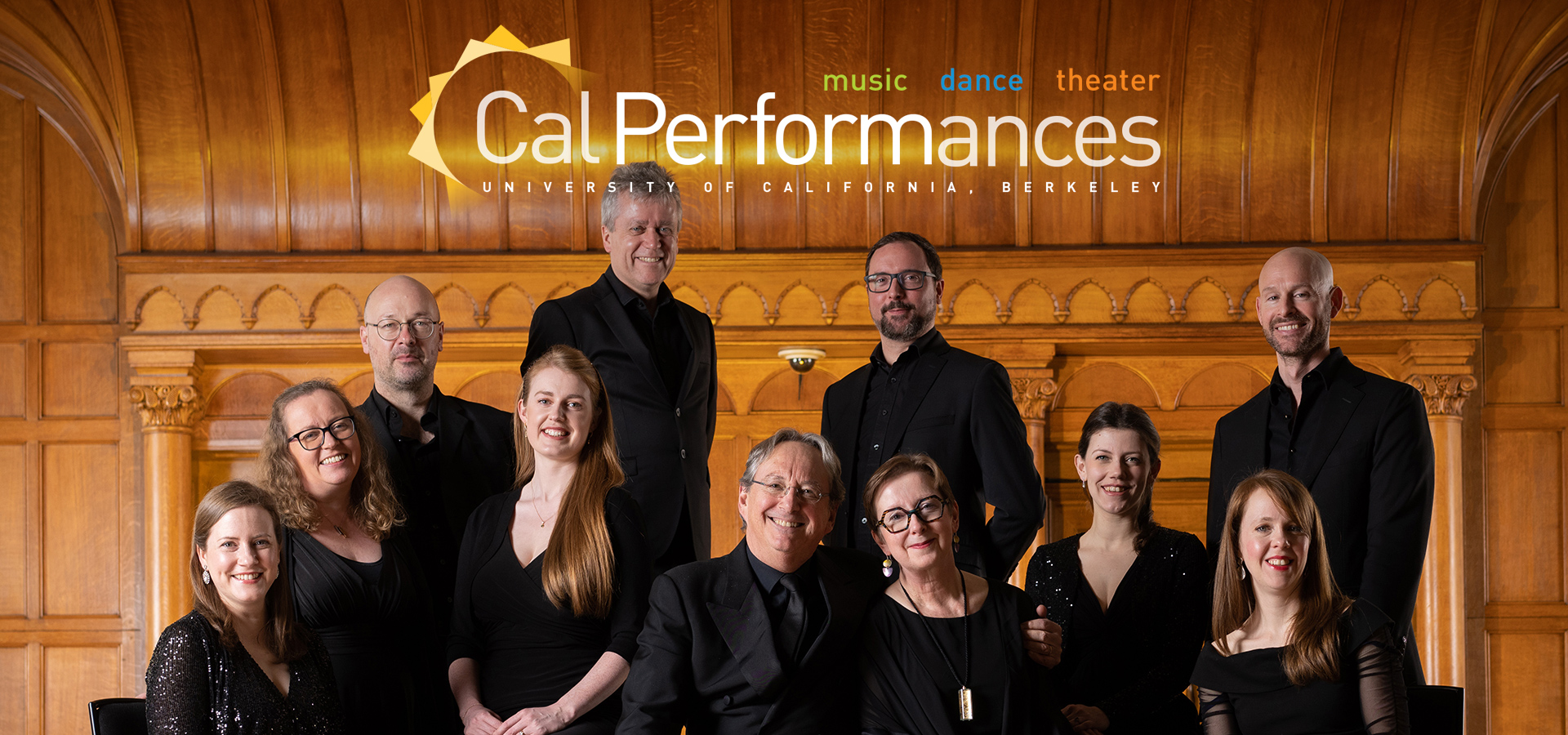
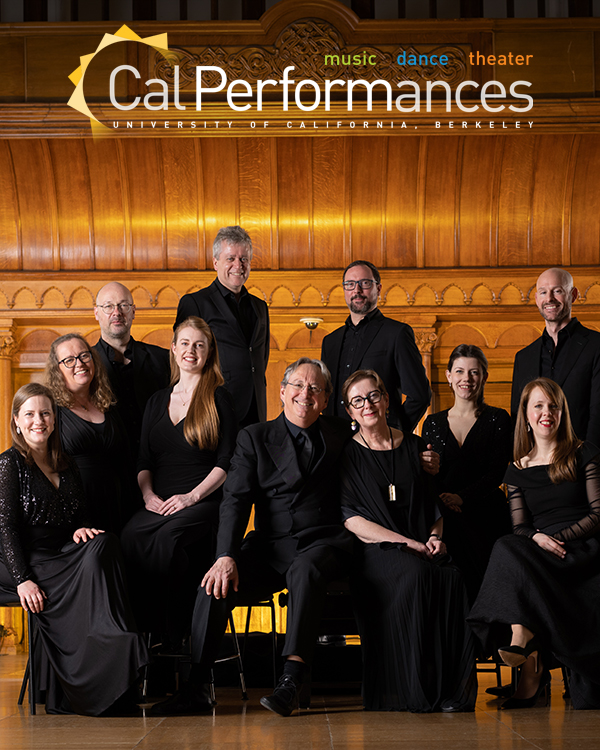
The Tallis Scholars
Friday, April 24, 2026, 8pm
First Church, Berkeley
Cal Performances is committed to fostering a welcoming, inclusive, and safe environment for all one that honors our venues as places of respite, openness, and respect. Please see the Community Agreements section on our Policies page for more information.
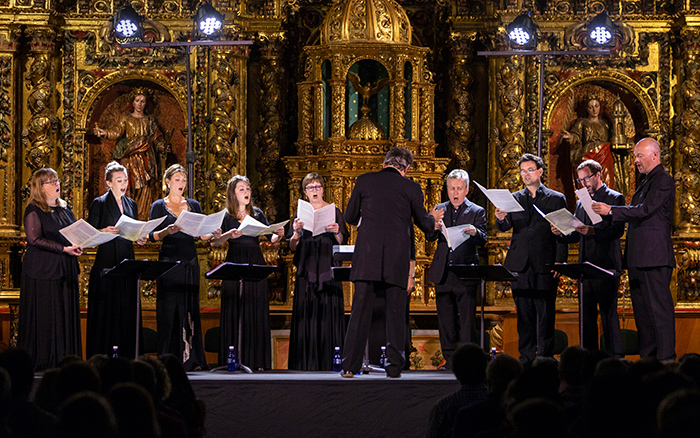
The miracles which Jesus is said to have performed fall into roughly two categories: those in which he heals people or removes their demons; and those in which he exerts control over nature. For the Gospel writers, these acts prove Christ’s divinity by demonstrating his power over the whole of God’s creation. This program explores music that narrates, celebrates, and glories in these miraculous signs.
One of the “great” mysteries of the Christian faith is that of Christ’s birth, not in a palace as befitting his royal birthright, but in a stable, with animals mutely watching. Giovanni Gabrieli, master of the Venetian school of polychoral music, restores some royal splendor to his double-choir setting of O magnum mysterium. It begins with three repetitions of the opening apostrophe, in one choir, then another, then both, gradually revealing the grand sonority for which the composer was renowned.
The first half of the program features a throughline in the form of Victoria’s Missa O magnum mysterium. For this setting of the “Ordinary” texts of the Mass, the Spanish composer Victoria took elements of his own version of this motet as a jumping-off point. They share the same plangent minor mode, as well as motifs such as the descending fifth, which in the Sanctus becomes the beginning of a swirling arabesque. The Agnus Dei is particularly special, adding a second “cantus” part in strict canon with the first.
Giaches de Wert came from obscure Flemish origins to become one of the leading court musicians in northern Italy. He was particularly highly regarded as a madrigalist, and his experience finding dramatic musical responses to text is amply illustrated by these two miraculous motets. Indeed, the latter is so daring that one might suspect it was intended as a sacred madrigal” for domestic performance, rather than belonging to a dignified church service.
Egressus Jesus narrates one of the more enigmatic Gospel passages, in which Jesus refuses to cure the Canaanite woman’s daughter until she has asked him four times. The large canvas of seven different voice-parts allows for different groupings of voices to represent the different characters and emotions of the story. After an opening narration for lower voices, the cry of the Canaanite woman enters in the sopranos, and Jesus’ silence in response is depicted in meandering melisma. The disciples interrupt, in the manner of a passion chorus or turba. Finally, when the woman’s persistence has won her a miraculous cure for her daughter, the full texture is deployed as Jesus heralds her faith (“O mulier…”).
In 2025, Peter Phillips, with the backing of Miller Theatre in New York, asked the English composer Matthew Martin to write a triptych of Marian antiphons. The first of these—Salve regina—was premiered in New York last December. Felix namque is the second of the three, first sung on this tour; the third will premiere this coming December. Felix namque was commissioned by Princeton University and was specifically written for double choir, so the University Glee Club would sing one choir and the Tallis Scholars the other. In subsequent performances the Tallis Scholars have taken both choirs. The music is closely based on the plainchant melody of Felix namque (which can be clearly heard) alongside an unforgettable motif repeating the words of the title.
The next motet belongs to the celebration of the Feast of the Presentation of Christ in the Temple, also known as Candlemas. Videte miraculum is a setting of the responsory appointed for Vespers on the eve of that feast. The text is concerned with bearing witness to the mystery of the Virgin birth. Tallis casts his piece in a form common at the time, giving the ancient plainchant melody to one voice, slowing it down, and constructing a polyphonic edifice around it.
Gallus, also called Handl, was conversant in a wide variety of styles. His motet Mirabile mysterium engages in wildly chromatic harmony, suggestive of the famously outrageous harmonies that would later be written by Gesualdo. The arcane and other-worldly harmonic language is a perfect match for the cryptic text. At the point that God is made man—“Deus homo factus est”—the voice parts plunge by an octave and a half, a highly unusual and dramatic device.
Guerrero’s motet Maria Magdalene was published in 1570, with a text drawn from various sources, including the Biblical narrative of the titular Mary (and “the other Mary”) discovering the empty tomb on Easter Sunday and learning of Christ’s miraculous victory over death. It makes use of the composer’s favored sonority: two equal soprano parts atop a smoothly expressive polyphony. At the moment the angel begins to speak to the women, the music broadens out wonderfully, before a sequence of alleluias brings the piece to its joyous conclusion.
The contemporary style of Estonian composer Arvo Pärt owes much to the hieratic soundworld of Renaissance music. Tribute to Caesar was originally designed as a companion piece to another of Pärt’s works, The Woman with the Alabaster Box, and like that piece it takes a passage of scripture and decorates it like an illuminated manuscript, using Pärt’s characteristic tintinnabuli technique. The Pharisees are subtly characterized with a dark, dissonant minor tonality, which grows gradually more insistent. The composer contrasts their attempted trickery with Jesus’ more measured responses. Though not technically one of his miracles, Jesus’ clever evasion of the Pharisees’ trap leaves them “marveling” at his words.
Pärt wrote Virgencita as a ‘present’ to the people of Mexico, in advance of a visit there. “The happy anticipation of being in Mexico very soon and the name Guadalupe left me no peace,” he wrote. The text is specifically addressed to Our Lady of Guadalupe, the object of veneration at the shrine commemorating her miraculous appearances centuries before. Pärt treats his subject with the utmost reverence, establishing a chordal sonority of gentle dissonance, and building towards an impassioned climax before subsiding.
—James M. Potter, 2025
About the Artists


After a truly remarkable six months that began last September and have seen nonstop presentations of the finest in music, dance, and theater at UC Berkeley, Cal Performances’ 2025–26 season moves into the home stretch in the coming weeks, and our final presentations offer an array of music and dance programs sure to appeal to a wide variety of interests.
Our dance series concludes in grand style, with two weeks of the very best in contemporary dance. The beloved Alvin Ailey American Dance Theater returns for its annual Zellerbach Hall (ZH) residency (Apr 7–12), its first Berkeley performances under new artistic director Alicia Graf Mack. With brand-new commissions from next-generation creators and beloved works by Ailey himself, this revered institution continues to embody the values and vision of its founder through performances of exceptional power, beauty, and grace. And just one week later, The Joffrey Ballet—another powerhouse American dance ensemble—arrives with Midsummer Night’s Dream, choreographer Alexander Ekman’s surreal and daring work set during Midsommar, the traditional Scandinavian summer solstice festival (Apr 17–19, ZH). You would have to search far and wide to find two weeks packed with a more impressive dance lineup than what you’ll see on the Zellerbach stage this month.
In classical and early music, we’ll enjoy the return of superstar director and viol player Jordi Savall and his acclaimed Hespèrion XXI, La Capella Reial de Catalunya, and special guests (Apr 21, ZH); sublime French pianist Alexandre Kantorow, making his Bay Area recital debut in a fascinating program of thoughtfully curated keyboard music (Apr 23, ZH); the ever-popular The Tallis Scholars with their brilliant Mysteries and Miracles program (Apr 24, First Church, Berkeley); and a pair of special concerts featuring three celebrated performers—Cal Performances’ 2026–27 Artist in Residence, pianist Víkingur Ólafsson (Apr 29, ZH), and soprano Renée Fleming with pianist Inon Barnatan in a very special duo recital (May 3, ZH).
The curtain falls on the 2025–26 season with Lara Downes and Friends performing This Land: Reflections on America (May 9, ZH). In the stirring and eclectic presentation, Downes—a celebrated pianist, NPR host, and California native—joins an all-star cast including folk legend Judy Collins, Grammy-winning singer and poet Tarriona “Tank” Ball (of Tank and the Bangas fame), the Invoke Quartet, and the Oakland Interfaith Gospel Choir for an inspiring selection of music spanning more than a century and reflecting on our capacity for empathy and community as we approach our nation’s 250th birthday.
Finally, I hope you’ll join us in late April, when we announce our thrilling 2026–27 season (if you’re reading this after that announcement, make sure to check out all the late-breaking details on our website). One major detail has already been made public—the Maria Manetti Shrem and Elizabeth Segerstrom California Orchestra Residency, when Cal Performances and the Philharmonic Society of Orange County will welcome the return of the world renowned Vienna Philharmonic and conductor Yannick Nézet-Séguin, this time accompanied by guest soloists Elīna Garanča, Christiane Karg, and Yuja Wang, during spring 2027. And I can promise you many more welcome and exciting surprises when full season details are announced.
I close by offering my heartfelt thanks to you, our audience. Your ongoing support and
enthusiasm truly fuel all of our many activities. Without you, a season like the one now drawing to a close would simply not be possible. All of us here at Cal Performances wish you a wonderful summer and look forward to seeing you again in September.

Jeremy Geffen
Executive and Artistic Director, Cal Performances