
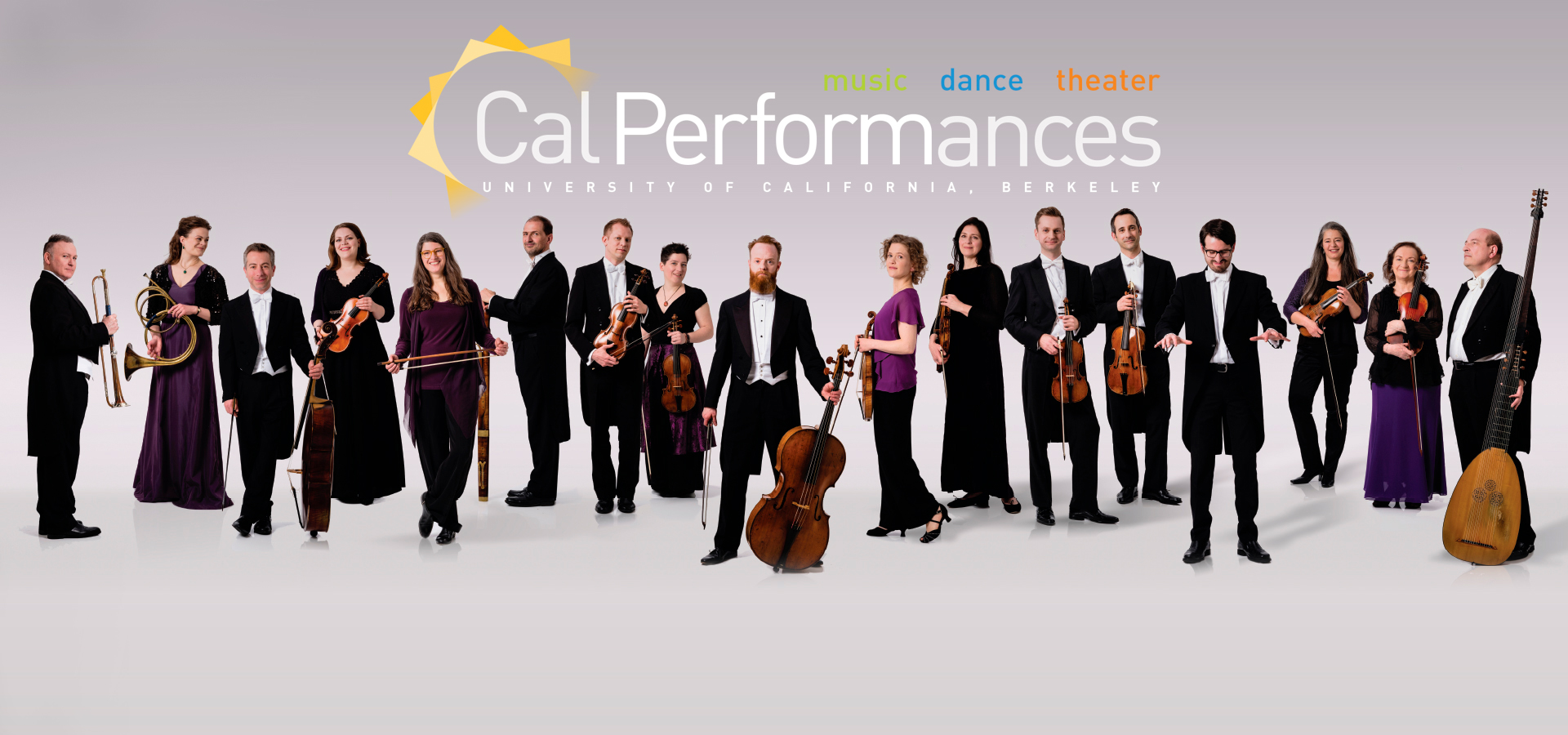
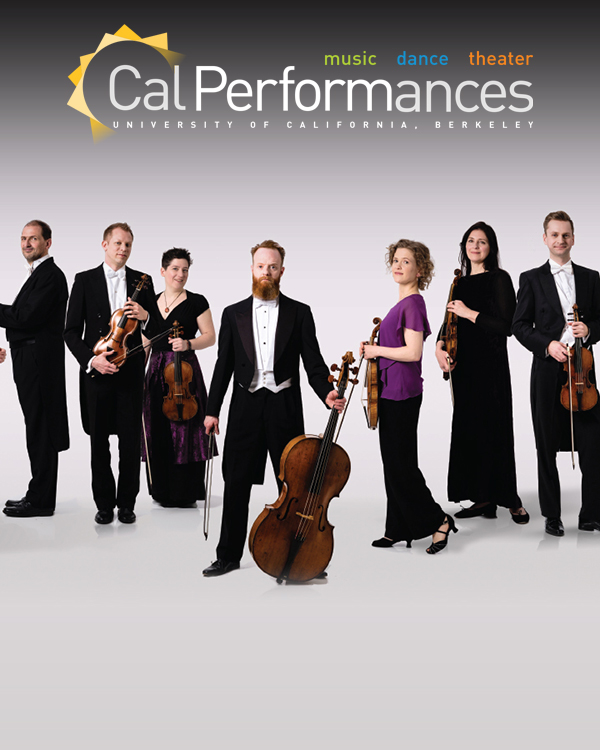
The English Concert
Harry Bicket, artistic director and harpsichord
Sunday, March 8, 2025, 3pm
Zellerbach Hall
There will be one 20-minute intermission partway through Act II, approximately 90 minutes into the performance.
The performance will last approximately three hours and five minutes, including the intermission.
This performance is made possible in part by The Lynne LaMarca Heinrich and Dwight M. Jaffee Fund, The Estate of Ross E. Armstrong, and an anonymous donor.
Cal Performances is committed to fostering a welcoming, inclusive, and safe environment for all one that honors our venues as places of respite, openness, and respect. Please see the Community Agreements section on our Policies page for more information.
Pursuing a creative career in early 18th-century England was a perilous enterprise requiring courage and political skills to rival one’s artistic excellence. Certainly, this was George Frideric Handel’s lot for much of his nearly five decades at the top of London’s musical/dramatic world. In the 1720s and especially the 1730s, he had battled rival opera companies, often supported by a changing cast of royal supporters. By the end of the 1730s, he had abandoned his illustrious career in Italian opera and moved on to another realm of vocal music: English-language oratorio usually setting texts from the Bible.
Handel’s triumphs in this new genre steadily mounted: Saul and Israel in Egypt (both 1739), Messiah (1742), and Samson (1743). Except for Messiah, first performed in Dublin, his oratorios were premiered at the opening of the Lenten concert season in London and designed to appeal to that audience’s love of moral edification combined with vocal splendor.
Meanwhile, backed by the Prince of Wales and many members of the nobility, Lord Middlesex’s opera company was trying to establish itself on the London scene and importuning the composer to write new operas for them. However, Handel had no interest in working with a company he felt was below his standards, and despite demands from the Prince of Wales representing George II, he refused to compose for them.
For the beginning of the Lenten season of 1744, Handel hurled out a defiant challenge to Middlesex in the form of a brilliant new hybrid work in English—Semele. A bold departure from his sacred oratorios using Biblical texts, this was a thoroughly secular, even pagan story about the classical deity Jupiter and his fatal affair with a beautiful, utterly self-absorbed mortal Semele. As a Lenten offering, it shocked its proper British audiences, for it was as dramatic as any of Handel’s Italian operas and indeed now is usually staged as an opera. Charles Jennens, the librettist for Messiah, snippily called it: “No Oratorio, but a bawdy Opera!”
While Handel aficionados argued about Semele, the Middlesex opera company couldn’t survive the competition and suddenly collapsed, announcing it would mount no operas in 1745. Not cowed by the Semele controversy, Handel decided to take an even riskier gamble: he would book the King’s Theatre in Haymarket, the scene of many of his former triumphs and now vacated by the Middlesex. There he would double the length of his season to 24 performances, running from Autumn 1744 to Spring 1745 and showcasing two new works—the sacred oratorio Belshazzar and another secular drama from Greek mythology, Hercules.
More morally edifying than Semele, Hercules told of the last days of the mythical strong man who had performed stupendous feats and triumphed over every foe he fought against. Having returned home to Trachis after defeating the rival city Oechalia, he finds he is no match for his passionate, but jealous wife Dejanira, who convinces herself he is having an affair with Iole, the beautiful Oechalian princess who is among his captives. This marital spat leads to an agonized—though unintended—death for Hercules and a breakdown for Dejanira. Thus, the fatal flaw of jealousy is the crux of the tragedy and its moral message.
Considering his disparaging remarks about Semele, Handel would not use his regular librettist Jennens for this “musical drama” (who instead scripted Belshazzar) and turned to another literary clergyman, the Reverend Thomas Broughton, a learned Classical scholar and translator who drew on Sophocles’ tragedy Women of Trachis and the ninth book of Ovid’s Metamorphoses for the libretto. As Handel scholar Paul Henry Lang writes: “He tightened the conflict by peeling off everything extraneous to the drama of jealousy. … In Sophocles’ play, Hercules does commit adultery with the captive princess Iole; by making both innocent, the tragic passion of Dejanira is enhanced.” Though Hercules is the titular role, Dejanira in Broughton and Handel’s setting is the true protagonist.
Handel assembled a cast made up of his most trusted performers: bass Henry Reinhold as Hercules; tenor John Beard (who created the role of Jupiter in Semele) as his son Hyllus; and French soprano Elisabeth Duparc as Iole, the source of Dejanira’s jealousy. The pivotal role of Dejanira—Handel’s greatest mezzo-soprano role—was given to a newcomer, Miss Anastasia Robinson. Handel was especially eager to engage the services of Susanna Cibber, a singer also renowned for her skills as a tragic actress; for her, he built up the male alto role of the herald Lichas, adding many da capo arias* to what was originally a minor part. (After Cibber left Handel’s company, the composer cut Lichas’ arias back and even recommended the part be eliminated.)
Sadly, Hercules’ premiere at the King’s Theatre on January 5, 1745 was perhaps the greatest disaster of Handel’s career. Sales for this lofty hybrid were weak, with only half the hall filled. And on opening night, Mrs. Cibber was too ill to sing. A minor singer had to speak many of her recitatives in order to maintain the flow of the storyline and, to make matters worse, was himself too hoarse to be heard much of the time, leading to derisive laughter from the audience. Even though Cibber recovered for the second performance, negative scuttlebutt made ticket sales even worse. Thus, one of Handel’s greatest creations got off to a nightmarish start and only in the 20th century began to receive the applause it deserves.
Having already lost a lot of money earlier in the season, Handel now realized the folly of his gamble and announced in London’s Daily Advertiser that he was closing his ambitious season early. He eloquently expressed the profound sorrow this failure had given him in his announcement: “As I perceived, that joining good Sense and significant Words to Musick was the best Method of recommending this to an English Audience; I have directed my Studies that way, and endeavour’d to show, that the English language, which is so expressive of the sublimest Sentiments, is the best adapted … to the full and solemn Kind of Musick. I have the Mortification now to find that my Labours to please are become ineffectual.” The composer added that he begged his subscribers to forgive his need “to stop short before my losses are too great to support.”
The response to his candor was extraordinary. One subscriber after another begged him to continue the season and told him to hold onto their money. So, after a little delay, Handel continued with his other new oratorio, Belshazzar, which was a heartening success.
A Closer Listen
Today, Hercules is rightfully considered to be one of Handel’s greatest masterpieces. Though originally performed without sets or costumes, it is a powerful tragic work and in its musical innovations point ahead to Christoph Willibald von Gluck’s reform operas to come in the 1760s. In fact, Gluck was an admirer of Hercules, even though he sought to crush the reign of Baroque opera’s da capo arias. In keeping with its story, Hercules is more streamlined than Handel’s Italian operas and tends to de-emphasizes da capo arias in favor of accompanied recitatives for its most important vocal moments. Writes Lang: “The pace of this oratorio is slow; largos predominate, as do tonalities in the minor mode. The harmonic language is bold, often heavily chromatic, and the accompanied recitative, which is used profusely, reaches an intensity, as well as dimensions, heretofore unknown to the Baroque.” Unfortunately, however, it did not appeal to Handel’s conservative London audiences and had to wait centuries before it could be fully appreciated.
Though his greater name recognition gives Hercules the title role, this opera is dominated by Dejanira, another of the remarkable female characters whom this bachelor composer excelled at creating. Given the lion’s share of the solo vocal numbers, she is an unforgettable, fully rounded character, who captures our sympathy despite her fatal flaws. In Act III, Handel creates for her “a mad scene without parallel in the music of the age” (Jonathan Keates).
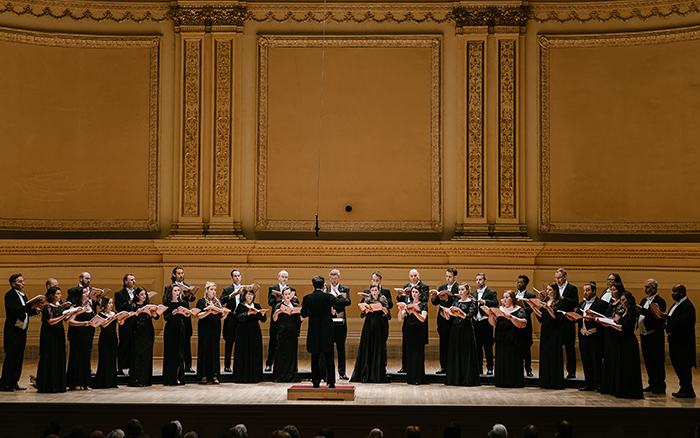
In his oratorios, whether they be sacred or secular, the Chorus always has a major role. Here, in a story from Greek mythology, they play the role of the Greek choros, supporting or admonishing the characters from a detached viewpoint. Handel exceeded his normal prowess in choral music with his daring writing here, especially in Act II’s “Jealousy! Infernal pest,” which, coming at the drama’s midpoint, delivers Hercules’ moral message and predicts its dreadful denouement.
In Act I, we are introduced to the gentler side of Dejanira and her deep love for her husband as she mourns his absence in the aria “The world, when day’s career is run.” This is not a da capo aria, but a tender, through-composed lament, toughened by grinding dissonances within the orchestral prelude and between the voice and orchestra. But already in the aria and its anguished preceding accompanied recitative, one senses the character’s passionate and potentially dangerous nature.
After Hyllus in his florid, but brief action aria “Where congealed the northern streams,” promises to search the world for his father, Handel gives us his first magnificent chorus, “O, filial piety,” approving his courage and resolve. Lang calls it, “a tremendous choral fugue framed by two homophonic sections in slow dance rhythm.”
The longed-for return of Hercules introduces us to the most important of his prisoners of war, the Oechalian princess Iole who will be the unwilling catalyst of the tragedy to follow. In her second aria, “My father,” she reveals her heavy grief over her father’s death and her dignity as a king’s daughter—the opposite of the seductive schemer of Dejanira’s obsession. This is actually a double aria, with the first section more like an accompanied recitative or arioso with the spare vocal utterances dominated by a deep, rich-toned orchestra expressing her suffering. The second section “Peaceful rest” is a lyrical lament over a softly treading accompaniment begging for rest for her father’s spirit.
In Act II, Dejanira confronts Iole with her suspicions. But here Iole throws off her victimhood and proves herself a match for Dejanira. In the racing, C-minor da capo aria “Ah! Think what ills the jealous prove,” she warns Dejanira to beware of jealousy, which only destroys peace and love. Orchestra and voice stunningly combine in this demanding showpiece to paint a portrait of the madness her adversary will soon experience.
Even more forceful is the Chorus’s “Jealousy! infernal pest,” the oratorio’s greatest chorus and one of the finest in Handel’s capacious choral repertoire. It is the linchpin of the entire work—the ultimate statement of Hercules’ central theme. Handel often remarked how important eloquent words were to the creation of his music. Working creatively with a form derived from the da capo aria, this chorus opens with a dotted-rhythm motto hurled out in unison by the orchestra; it is the rhythm of “jealousy,” and it will pervade the piece. When the chorus enters whispering that word, they shatter the E-minor tonality. The B section is in complete contrast, treating the words “trifles light as floating air” as fragile, insubstantial imitative counterpoint. No composer has created musical word-painting to exceed what Handel does here.
Another major component is the fierce marital spat that takes place between Hercules and Dejanira, demonstrating how the physically powerful hero is no match for his outraged wife. When Dejanira sarcastically accuses him of being conquered by “a captive maid,” he counters with a very macho, blustering da capo aria in C major “Alcides’ fame in latest story” (Alcides being another name for Hercules). Rather than using trumpets for this martial air, Handel substitutes the cackling voices of oboes to undermine his boasting.
Now Dejanira wields the knife with her emasculating da capo aria “Resign thy club and lion’s spoils.” Mocking violins intensify her vicious putdown of Hercules’ achievements, and the B section provides her most demeaning insult with the downward-sliding chromaticism for “Venus and her whining boy.” Hercules bluntly denies her charges and then, like every man bested by a woman’s fury, takes off to review the sacred rites at the Temple of Jupiter.
Act III, in which the terrible denouement of the story transpires, contains the oratorio’s most powerful and revolutionary music. Each act is preceded by an orchestral sinfonia, but the prophetic Largo prelude to Act III, steeped in tragic harmonies, is the finest. Played only by the strings, it is divided between slow, soft music skillfully intensified by trills and fiery, galloping rhythms marked Furioso e forte.
Hercules’ brutal death wearing Dejanira’s poisoned gift is first presented in narratives by Lichas and the Chorus, but then more vividly in Hercules’ lengthy accompanied recitative scena “O Jove! what land is this.” The Sinfonia’s fiery, racing passages are now fully developed as they describe the agonizing pains Hercules is experiencing from the garment he cannot remove as he cries out in anguish. After a wild orchestral interlude, this scena transforms into a coloratura-filled “rage aria”—a stock Baroque form designed to show off the flexibility of a deep bass voice, but here heightened to a tragic purpose. Handel continues the scene in a flexible combination of secco and accompanied recitative as Hercules begs Hyllus to carry him to a mountain-top funeral pyre where he can die and join the gods.
The ghastly news has now reached Dejanira, who had no idea that Nessus’ garment would harm her husband. Tormented by guilt for what she has done, she has a total breakdown, expressed in one of Handel’s greatest creations: a mad scene in which Dejanira believes she is being pursued by the classical Furies to punish her for her crime. Handel sets it as an extended accompanied recitative scena, ranging through ever-shifting moods and tempos. Lang: “The astounding variety of the music faithfully follows the constantly changing thoughts and feelings of Dejanira … in one of the most expressive and intimate character studies to be found in the operatic literature.”
In the classical sources for this story, Dejanira commits suicide. But the formula for Handel’s oratorios, whether sacred or secular, required a happy, uplifting ending, no matter what has come before. Handel begins this shift with Iole’s compassionate visit to Dejanira, in which she proves to be an ally rather than an enemy. Her lovely aria “My breast with tender pity swells” (many have noticed its melody slightly resembles Messiah’s “I know that my Redeemer liveth”) begins the healing process for Dejanira and her grief-stricken family.
When the priest of Jupiter decrees that Iole shall wed Hyllus as a token of peace, she gives up her resistance, and the two sing a charming love duet in a dancing three beats. In another dancing rhythm, the Chorus adds its assent with a hymn in praise of Hercules and his wondrous deeds.
—© Janet E. Bedell
Janet E. Bedell is a program annotator and feature writer who writes for Carnegie Hall, the Metropolitan Opera, Los Angeles Opera, Caramoor Festival of the Arts, and other musical organizations.





Cal Performances’ extraordinary 2025–26 season moves into the busy month of March with a schedule of offerings sure to appeal to a wide range of people and interests.
Acclaimed classical and early-music artists include the brilliant The English Concert and an impressive slate of guest vocalists under the direction of conductor Harry Bicket, performing a concert version of Handel’s 1744 vocal showcase Hercules (Mar 8, Zellerbach Hall [ZH]); the ever-adventurous JACK Quartet making its Cal Performances debut in an ambitious program of contemporary music (Mar 15, Hertz Hall [HH]); and highly anticipated chamber music concerts with violinist Théotime Langlois de Swarte and harpsichordist Justin Taylor (Mar 22, HH), and longtime friends of Cal Performances, cellist David Finckel and pianist Wu Han (Mar 29, HH).
We’ll also enjoy rousing jazz from the Julia Keefe Indigenous Big Band (Mar 6, Zellerbach Playhouse [ZP]); ace guitarist Marc Ribot performing his score to special screening of Charlie Chaplin’s silent-film masterpiece The Kid (Mar 7, ZP); a brilliant production of La Belle et la Bête from Opera Parallèle that marries Philip Glass’ remarkable score with the classic 1946 Jean Cocteau film, under the direction of Nicole Paiement and Brian Staufenbiel (Mar 13–14, ZH); the phenomenally popular Silkroad Ensemble with Rhiannon Giddens (Mar 19–20, ZH); and masters of thunderous spectacle and jaw-dropping athleticism, the astounding drummers of Drum Tao (Mar 21–22, ZH).
Before the season draws to a close in May, we’ll continue to welcome a full spectrum of talent including Cal Performances’ 2025–26 Artist in Residence Víkingur Ólafsson; legendary soprano Renée Fleming; French piano virtuoso Alexandre Kantorow in his long-awaited Bay Area recital debut; early-music superstars Jordi Savall and The Tallis Scholars; and celebrated pianist, NPR host, and California native Lara Downes with an all-star cast of collaborators that includes the great Judy Collins. And our acclaimed dance series will conclude, distinguished by genre-defining artists and major new productions like the beloved Alvin Ailey American Dance Theater in its annual Zellerbach Hall visit and The Joffrey Ballet in a bold new work set during Midsommar, the traditional Scandinavian summer solstice festival.
As you explore the calendar, I especially recommend the Illuminations “Exile & Sanctuary” events that inform the Julia Keefe, Jordi Savall, and Silkroad Ensemble/Rhiannon Giddens concerts, which focus on how issues of displacement can inform explorations of identity and community, and how artistic expression can offer safe harbor during times of unrest or upheaval.
Finally, I hope you’ll join us in late April, when we announce our thrilling 2026–27 season. One major detail has already been revealed—the Maria Manetti Shrem and Elizabeth Segerstrom California Orchestra Residency, when Cal Performances and the Philharmonic Society of Orange County will welcome the return of the world-renowned Vienna Philharmonic, conductor Yannick Nézet-Séguin, and a truly impressive list of guest artists during spring 2027. And I can promise you many more welcome and exciting surprises when full season details are announced.
The opportunity to engage with diverse artistic perspectives and share the transformative power of the live performing arts is one of life’s greatest pleasures, and I look forward to encountering these profound and entertaining experiences with you in the months ahead.

Jeremy Geffen
Executive and Artistic Director, Cal Performances