
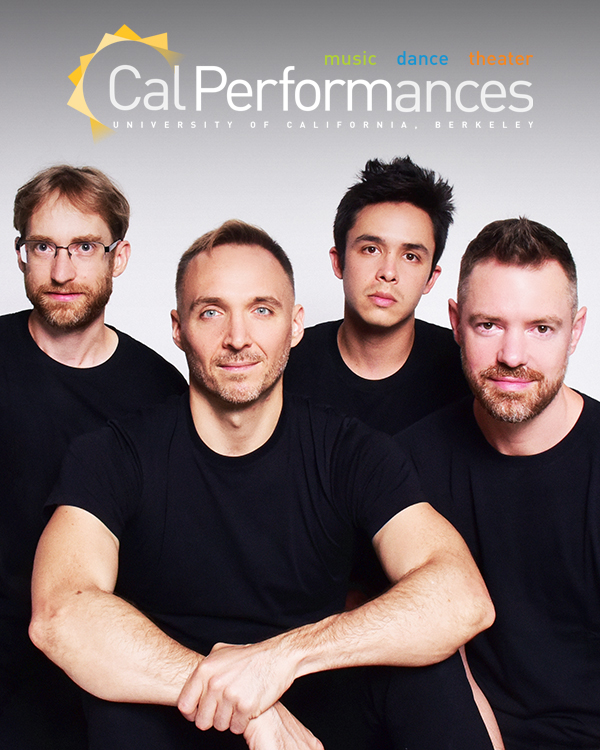
JACK Quartet
Sunday, March 15, 2026, 3pm
Hertz Hall
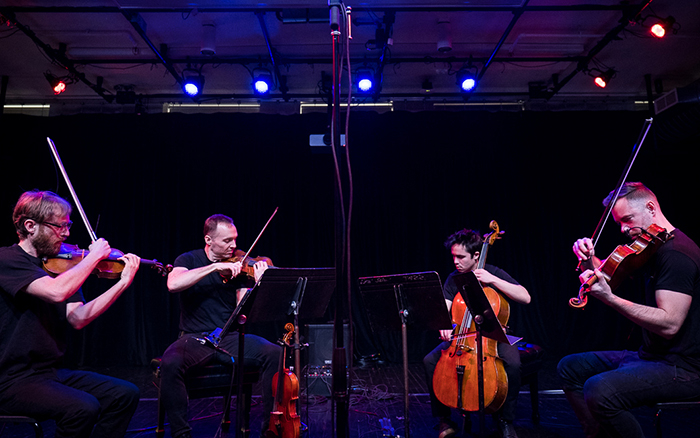
Christopher Otto and Austin Wulliman, violins
John Pickford Richards, viola
Jay Campbell, cello
This afternoon’s performance will last approximately 75 minutes and be performed without intermission.
Cal Performances is committed to fostering a welcoming, inclusive, and safe environment for all one that honors our venues as places of respite, openness, and respect. Please see the Community Agreements section on our Policies page for more information.
Austin Wulliman
The Late Edition (West Coast Premiere)
Pressed between bodies heaving to the pulse. The room inside the drum: each of us within its envelope. Sent elsewhere. Stamped to distant locales but together in this resonating box. My wrists were broken. My mind screwed on tight.
This is the first track of my recording with JACK called Escape Rites. The piece was written in a short period of time in late 2023 (edited in 2024) while on tour with the quartet. After a show in Den Bosch (Netherlands), John and I went and saw the Japanese band Goat play at another venue in the same arts center. A closely-mic’d snare drum pattern and a tightly packed room of people united by listening got me started.
—Austin Wulliman
• • •
The Chicago Tribune has praised Austin Wulliman as a “gifted, adventuresome violinist” and Peter Margasak (Best of Bandcamp) has credited him with “hardcore chops and ceaseless curiosity—[he is] the kind of musician that devours new ideas, masters new techniques, and pours himself into every endeavor with unabashed devotion.” Wulliman has gained critical and audience attention through his “wide technical range and interpretive daring” (New Music Box) as a soloist and chamber musician. A member of JACK Quartet since 2016, his second album of original music was released with JACK in 2025 to wide critical acclaim in media as diverse as The Wire, Gramophone, and WNYC Radio. Wulliman first forged his reputation in Chicago with the collective Ensemble Dal Niente, serving as the group’s program director and winning the Kranichstein Music Prize at the Darmstadt Summer Course in 2012. He was also a founding member of Spektral Quartet, which served as Ensemble in Residence at the University of Chicago from 2011–16. Consistently in search of new musical pathways through ensemble work, Wulliman has collaborated with a wide range of musical voices, from artists like Deerhoof and Julia Holter, to Miguel Zenon and Billy Childs, and Brian Ferneyhough and Kaija Saariaho. He has also been a guest artist with groups such as Eighth Blackbird, The Knights, and the Chicago Symphony Orchestra’s MusicNow Ensemble.
Keir GoGwilt
“Future Mode 1,” from Treatise on Limited Freedoms
(West Coast Premiere)
This piece comes out of a body of work called Treatise on Limited Freedoms—a set of modules and games I’m developing to encourage improvisation and composition in just intonation. “Future Mode 1” is a study on a single mode drawn from partials 8 through 14 of the natural harmonic series: a resonant series of intervals with characteristics including a lowered 7th, a raised 4th, and a lowered major 6th scale degree. This mode is explored through improvisatory-sounding melodies, stacked harmonically atop bass notes, and transposed and modulated to create subtle tonal drifts. While the tuning system used in these pieces suggests a contemporary sound, the materials that organize the composition—counterpoint, figured bass lines, stepwise voice-leading, and ornamentation—are in large part inspired by techniques from the Baroque and Renaissance periods.
This project was inspired by an invitation to write for the JACK Quartet through their Studio program. A huge thanks to Chris, Austin, John, and Jay for taking this piece on board with sincere interest and enthusiasm.
—Keir GoGwilt
• • •
Composer in residence of the JACK Quartet, violinist and composer Keir GoGwilt was born in Edinburgh and grew up in New York City. His work combines his historical and musicological research with collaborative experimentation. As a violinist, he has been described as a “formidable performer” (New York Times) with an “evocative sound” (London Jazz News) and “finger-busting virtuosity” (San Diego Union Tribune). In past seasons, GoGwilt has soloed with groups including the Sinfonieorchester Basel, Orchestra of St. Luke’s, Philharmonia Baroque Orchestra, Chinese National Symphony, Orquesta Filarmonica de Santiago, the Boston Modern Orchestra Project, and the La Jolla Symphony. A founding member of the American Modern Opera Company (AMOC), GoGwilt has composed and performed original, collaboratively devised music, dance, and theater works at 92NY, Baryshnikov Arts Center, Stanford Live, American Repertory Theater, Carolina Performing Arts, and the Ojai Music Festival.
This year, he released The Edinburgh Rollick with Ruckus Early Music, featuring Scottish fiddle music from the Niel Gow collections. Other current projects include the Zarabanda Variations: a co-authored collection of songs and dances reflecting Baroque histories and futurisms of New Spain. He is currently composing a piece for the Bergamot Quartet and harpist Jacqueline Kerrod with the support of the Barlow Endowment.
GoGwilt earned his PhD in music from UC San Diego in 2022, where he studied under Amy Cimini and Anthony Burr and was awarded the Chancellor’s Dissertation Medal for the Division of Arts & Humanities. His research on histories and philosophies of performance, pedagogy, and embodiment has been published in the Bach Journal, Current Musicology, Naxos Musicology, and the Orpheus Institute Series.
Hans Abrahamsen
String Quartet No. 4
The basic idea for my Fourth String Quartet was very clear to me: It should be quiet and soft music, or—to use a German term—“hoch im Himmel gesungen” (“High singing in heaven”).
Each of the four movements has a different scordatura/pitch. The first movement begins—like my work Schnee—sky-high, with an airy and soft melody by the first violin. The second movement is fast and joyful. It consists of two duets and a reverse style counterpoint. While the sections were progressively longer in the first movement they are getting shorter and shorter in the second. “Dark, heavy and earthy” is the third movement and its pizzicato recalls big black raindrops falling to the ground. It is the dark and grainy counterpart to the first movement, whereas the fourth movement corresponds to the second. The fourth movement was planned as a dark and heavy counterpart but it turned out to be like the “babbling” music of a child.
My Fourth String Quartet has become, in its way, a serene and cool piece. It was finished after twenty years of work; it was in 1990 that I was commissioned by Wittener Tage für Neue Musik to write the piece for Arditti Quartet.
—Hans Abrahamsen
• • •
Hans Abrahamsen’s works are created in a dialogue with what has already been composed, as existing works form the basis for new ones.
In the beginning, the composer worked within the framework of the 1970s “New Simplicity”—(in German, “Neue Einfachheit,” a stylistic tendency among some of the younger generation of German composers during the late 1970s and early 1980s)—but the “cool images of music” broke down. In the latter half of the 1970s, the composer moved into a new phase where romantically inspired German titles reflect that the music had become mood-setting. Works like Winternacht and Märchenbilder unite proportions and adherence to musical rules with a poetic expression.
Abrahamsen has a strong sensitivity to whether what he writes is reminiscent of existing music. This sensitivity and the structures became burdensome, leading to a composition pause during which he recomposed others’ music during the 1990s.
A more recent key work such as Schnee, traces backward in music history with its 10 canons, while simultaneously influencing subsequent works such as Let me tell you for soprano and orchestra. Along with the horn concerto and the orchestral work Vers le silence, the left-hand piano concerto Left forms an important trilogy. Following the Hans Christian Andersen opera The Snow Queen, Abrahamsen is working on his second opera, based on Karen Blixen’s The Dreamers.
—Thomas Michelsen
(Wise Music Classical)
Gabriella Smith
Aegolius
(World Premiere)
Aegolius refers to a genus of small owls, whose delightfully rhythmic calls Gabriella found stuck in her head after attending a festival of Steve Reich’s music in Paris. In this piece, Gabriella repeats and manipulates the owls’ calls, phasing pitch and speed over time to create a mind-bending realization of a quartet of owls. Hidden in the piece are subtle references to Haydn’s String Quartet Op. 33, No. 3, nicknamed The Bird, a fitting homage to one of the early masters of the string quartet form.”
—Gabriel Cabezas
• • •
Gabriella Smith is a composer whose work invites listeners to find joy in climate action. Her music comes from a love of play, exploring new instrumental sounds and creating musical arcs that transport audiences into sonic landscapes inspired by the natural world. An “outright sensation” (Los Angeles Times), her music “exudes inventiveness with a welcoming personality, rousing energy and torrents of joy” (New York Times).
Lost Coast, a concerto for cello and orchestra written for her longtime collaborator Gabriel Cabezas, received its world premiere in May 2023 with the Los Angeles Philharmonic conducted by Gustavo Dudamel. This work joins her organ concerto, Breathing Forests, written for James McVinnie, also premiered by the Los Angeles Philharmonic, conducted by Esa-Pekka Salonen. Other recent or current projects include a large-scale work for Kronos Quartet, commissioned in celebration of its 50th anniversary season, and an album-length work for yMusic featuring underwater field recordings. In December 2023, Smith’s work Tumblebird Contrails was performed on the Nobel Prize Concert by the Royal Stockholm Philharmonic Orchestra, conducted by Esa-Pekka Salonen.
Smith grew up in the San Francisco Bay Area playing and writing music, hiking, backpacking, and volunteering on a songbird research project.
WOLFGANG RIHM
String Quartet No. 3, Im Innersten
The temptation is strong to interpret the subtitle, Im Innersten [“at the core”], as a reference to the close of the second movement; a section suddenly appears so reminiscent of Mahler that it suggests a quotation, a nostalgic look back at a past world which, in the third movement, devolves into Wolfgang Rihm’s. In this work, Rihm’s music is again full of drama, tension, and precipitous changes of mood. The fourth movement has more touches of Mahler; his spirit is quasi-conjured up by Rihm’s use of his compositional material.
The 20th century returns, along with Rihm’s own world, in the fifth movement, with his own drama and passion. After a short intermezzo comes the sixth movement, wherein the old and new worlds alternate, until the music echoes away into nothing.
The piece is dedicated to Alfred Schlee for his 75th birthday.
—Archive Universal Edition
• • •
Wolfgang Rihm (1952–2024) was a titan of German music, widely regarded as one of the most prolific and influential composers of the post-war era. Rejecting the rigid serialism of the Darmstadt School, Rihm championed a “New Simplicity” and neo-expressionist style that reclaimed emotional directness, melody, and a deep dialogue with the Austro-German tradition.
His colossal output of over 500 works spans every major genre. Rihm achieved international fame with the orchestral piece Morphonie (1974) and the chamber opera Jakob Lenz (1977), which remains one of the most performed contemporary operas in Germany. Other major stage works include Die Hamletmaschine and Dionysos. Rihm was also a devoted educator, serving as a professor at the Hochschule für Musik Karlsruhe for nearly 40 years, where he mentored students such as Jörg Widmann and Rebecca Saunders.
Rihm’s contribuations were recognized with the Ernst von Siemens Music Prize, the Grawemeyer Award, and the Great Cross of Merit with Star. He served as the artistic director of the Lucerne Festival Academy until his death in July 2024.
About the Artists

Cal Performances’ extraordinary 2025–26 season moves into the busy month of March with a schedule of offerings sure to appeal to a wide range of people and interests.
Acclaimed classical and early-music artists include the brilliant The English Concert and an impressive slate of guest vocalists under the direction of conductor Harry Bicket, performing a concert version of Handel’s 1744 vocal showcase Hercules (Mar 8, Zellerbach Hall [ZH]); the ever-adventurous JACK Quartet making its Cal Performances debut in an ambitious program of contemporary music (Mar 15, Hertz Hall [HH]); and highly anticipated chamber music concerts with violinist Théotime Langlois de Swarte and harpsichordist Justin Taylor (Mar 22, HH), and longtime friends of Cal Performances, cellist David Finckel and pianist Wu Han (Mar 29, HH).
We’ll also enjoy rousing jazz from the Julia Keefe Indigenous Big Band (Mar 6, Zellerbach Playhouse [ZP]); ace guitarist Marc Ribot performing his score to special screening of Charlie Chaplin’s silent-film masterpiece The Kid (Mar 7, ZP); a brilliant production of La Belle et la Bête from Opera Parallèle that marries Philip Glass’ remarkable score with the classic 1946 Jean Cocteau film, under the direction of Nicole Paiement and Brian Staufenbiel (Mar 13–14, ZH); the phenomenally popular Silkroad Ensemble with Rhiannon Giddens (Mar 19–20, ZH); and masters of thunderous spectacle and jaw-dropping athleticism, the astounding drummers of Drum Tao (Mar 21–22, ZH).
Before the season draws to a close in May, we’ll continue to welcome a full spectrum of talent including Cal Performances’ 2025–26 Artist in Residence Víkingur Ólafsson; legendary soprano Renée Fleming; French piano virtuoso Alexandre Kantorow in his long-awaited Bay Area recital debut; early-music superstars Jordi Savall and The Tallis Scholars; and celebrated pianist, NPR host, and California native Lara Downes with an all-star cast of collaborators that includes the great Judy Collins. And our acclaimed dance series will conclude, distinguished by genre-defining artists and major new productions like the beloved Alvin Ailey American Dance Theater in its annual Zellerbach Hall visit and The Joffrey Ballet in a bold new work set during Midsommar, the traditional Scandinavian summer solstice festival.
As you explore the calendar, I especially recommend the Illuminations “Exile & Sanctuary” events that inform the Julia Keefe, Jordi Savall, and Silkroad Ensemble/Rhiannon Giddens concerts, which focus on how issues of displacement can inform explorations of identity and community, and how artistic expression can offer safe harbor during times of unrest or upheaval.
Finally, I hope you’ll join us in late April, when we announce our thrilling 2026–27 season. One major detail has already been revealed—the Maria Manetti Shrem and Elizabeth Segerstrom California Orchestra Residency, when Cal Performances and the Philharmonic Society of Orange County will welcome the return of the world-renowned Vienna Philharmonic, conductor Yannick Nézet-Séguin, and a truly impressive list of guest artists during spring 2027. And I can promise you many more welcome and exciting surprises when full season details are announced.
The opportunity to engage with diverse artistic perspectives and share the transformative power of the live performing arts is one of life’s greatest pleasures, and I look forward to encountering these profound and entertaining experiences with you in the months ahead.
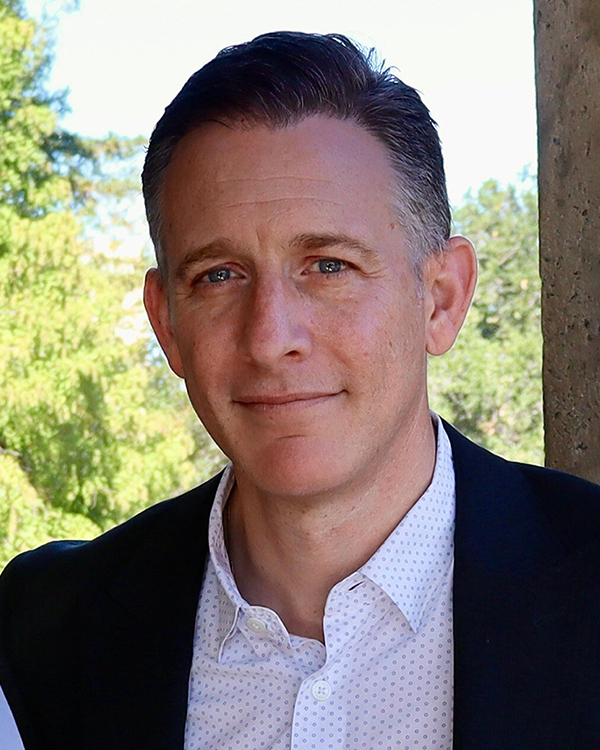
Jeremy Geffen
Executive and Artistic Director, Cal Performances