“Organic Seeds” in the Sanctuary: Silkroad’s Artistic Approach to Music
“‘Organic’ is a term completely subjective to the individual. In the context of this Sanctuary tour, it meant allowing for each unique artist to bring their idea, their musical ‘seed,’ and share it in a way that felt authentic to them.”
By Angelina Josephine Rosete, Cal Performances’ Engagement Writer
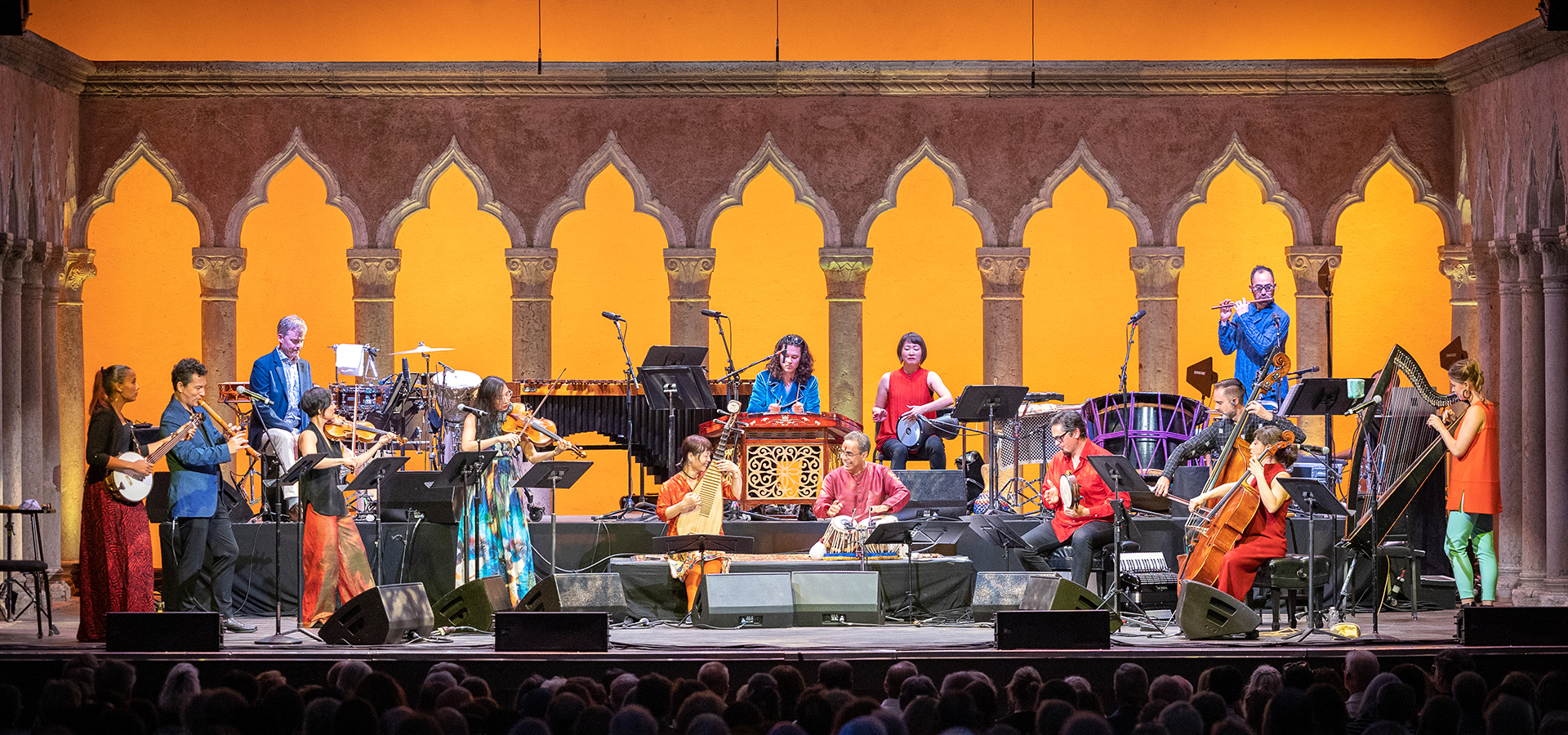
Of all ensembles that perform music across cultural boundaries, Silkroad Ensemble emerges as a living testament to what music can fully be, transcending audience expectations with their signature organicism and collaborative ethos. Founded 25 years ago under the vision of Yo-Yo Ma, the Silkroad Ensemble has long operated on the guiding principle that music is a living conversation that grows richer with each voice that is invited in. This season, that conversation has taken on a new urgency. As part of Cal Performances’ Illuminations: “Exile and Sanctuary” programming, Silkroad arrives with artistic director Rhiannon Giddens at Zellerbach Hall on March 19–20 with Sanctuary: The Power of Resonance and Ritual, a program that begs the question: what does it mean for music to be a home?
In an interview with Maeve Gilchrist, Silkroad’s Scottish-Irish harpist, we explore the ensemble’s approach to music that unfolds organically, and how the conversations that happen in music create a sanctuary for both artist and spectator alike.
Edinburgh-born and currently based in Kingston, New York, Gilchrist has been credited as an innovator on the Celtic (lever) harp, taking the instrument to new levels of visibility and performance. A member of the Grammy-winning Arooj Aftab Vulture Prince Ensemble and the Grammy-winning Silkroad Ensemble, she has performed and recorded alongside Yo-Yo Ma, esperanza spalding, and Ambrose Akinmusire, among others. She is ultimately an artist deeply fluent in the art of cross-cultural musical dialogue, and an ideal guide into the world Silkroad is building with Sanctuary.
The seeds from which we grow our roots build the foundation for future processes, especially in creative fields where we draw on tradition to forge new innovations. Gilchrist grew up in a household where every social gathering was an occasion for songs and storytelling. Music was never a fully individual pursuit. She shares, “Now, as a professional musician, I reflect on the joy of my musical baptism on a regular basis. It gives me perspective, reminds me of the importance of inclusion and passing on what was shared so generously with me.” That spirit of transmission, of music as something that is received and in turn offered forward, runs through everything Silkroad does.
At the heart of the program is an intentional shift in how the ensemble works. Rather than using commissioned scores, artistic director Rhiannon Giddens pushed for the group to learn primarily by ear, promoting in turn collective arranging and improvisation. The result, Gilchrist shares, is something that feels genuinely alive. “‘Organic’ is a term completely subjective to the individual,” she explains. “In the context of this Sanctuary tour, it meant allowing for each unique artist to bring their idea, their musical ‘seed,’ and share it in a way that felt authentic to them.” Each musician draws from their own cultural tradition and personal story—ranging from Sicilian tarantella to Moroccan Gnawa, Indian classical music to American old-time—planting these seeds into a shared ensemble soil, then tending them together.
To build this entire program by ear, with no sheet music and relying on collective instinct of a highly collaborative nature, is no easy feat. It requires, as Gilchrist puts it, “time and patience and a generosity of spirit.” But the payoff is a sense of communal ownership that she believes audiences will be able to feel. “I think the mindfulness that was present in the rehearsal process translates to a feeling of ownership within the ensemble. A feeling that in each piece of music there is a real part of each of us.” Of all the different cultural conversations occurring through this musical process, Maeve calls their collectivity “a family.”
Perhaps that is what makes Sanctuary so timely. “Music transports us to a place where we can have important emotional, contemplative, and connective experiences in ways that might not otherwise be possible,” Gilchrist reflects. “Helping create pathways to those heart spaces, where healing and change is possible, is essential now more than ever.” For Gilchrist, the heart of Silkroad lies in the process, in the moments of unexpected connection. “It’s the only organization I’ve ever been associated with that is focused on those moments. That’s a beautiful thing.”
To watch the Silkroad Ensemble perform this special program is to partake in a communal concert experience that emphasizes collaboration and improvisation to create music that heals. Through bearing witness to the conversations happening in this performance, the audience is invited into the sanctuary created in the dialogue between artists, instruments, and music. The seeds have been planted, and on March 19 and 20, Zellerbach Hall becomes the garden.