
Explaining the “New Music” Genre with Jeremy Geffen
“Finding new sonic possibilities”
Video editing by El Zager, Cal Performances’ Social Media, Digital Content and Engagement Specialist
So, what is “New Music” anyway? Is it really all that new? What does it sound like? And what comes next?!
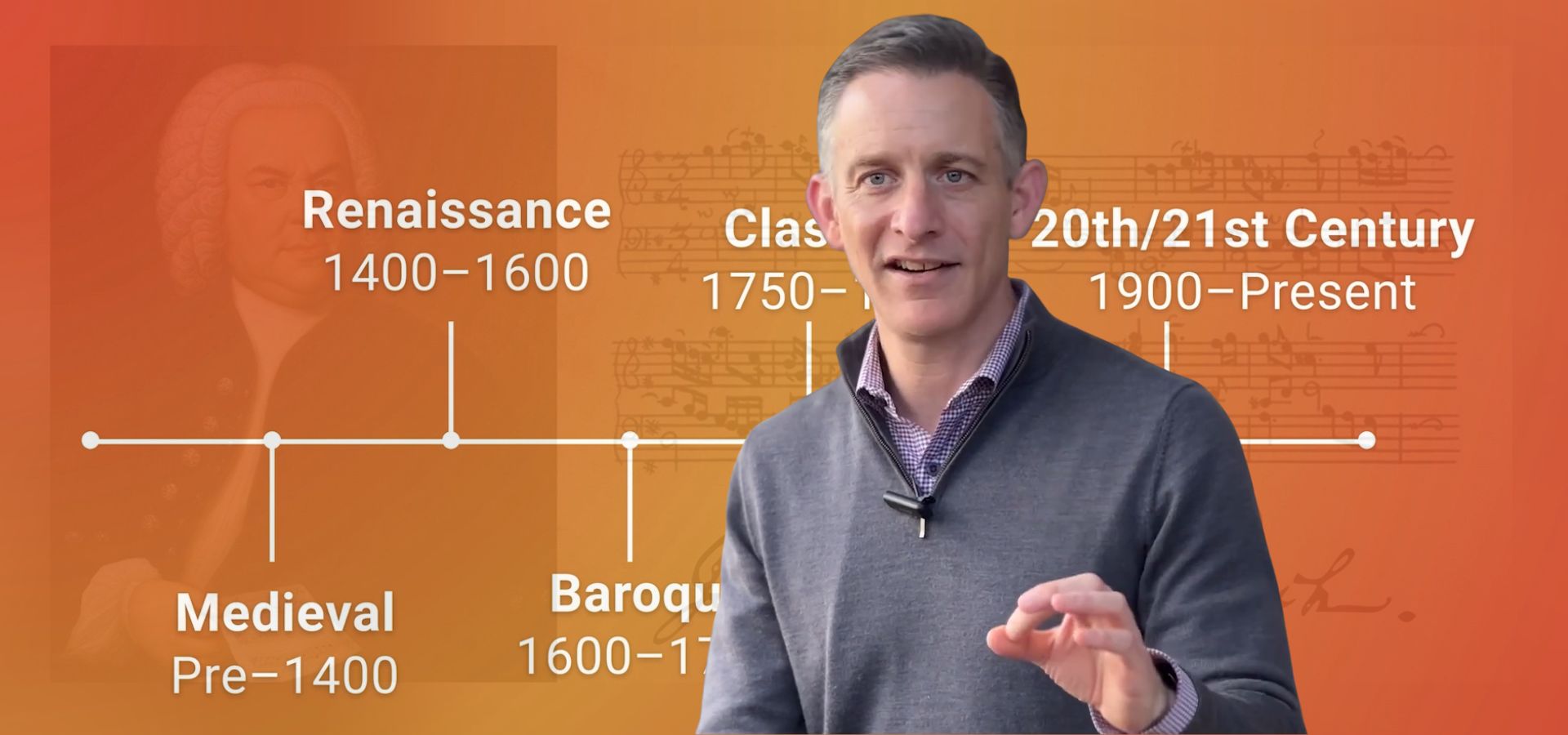
While genre tags are generally intended to help listeners create a clearer picture of the music they’re about to experience, genres that are tied to time periods— especially time periods that include this very moment!—can feel much harder to grasp. In this five-minute video, Jeremy Geffen, Cal Performances’ Executive and Artistic Director, helps to demystify the New Music genre, and shares what makes it so exciting to explore!
To see what New Music performances are coming up at Cal Performances during the 2025–26 season, see our genre calendar page here.
Transcript
Jeremy Geffen:
Hi, I’m Jeremy Geffen. I’m the Executive and Artistic Director for Cal Performances, and I’m here to talk about new music.
What do we mean by “New Music”?
New music is perhaps the most artificial term that we use today because essentially it just means music of our time, and that can mean any number of stylistic options. To me, when I see the term new music, I think, okay, this is music that’s probably composed within the last 10 years. But I think… there are many pieces that musicians may consider having already entered the repertoire or the cannon that our audiences still consider new. So, a piece like Terry Riley’s In C, which is from, I think it’s from the ’60s, ’64, ’68… Pivotal piece. We wouldn’t have works like Steve Reich’s Music for 18 Musicians, a lot of Philip Glass, without it. I think people still think of that as new. The ’60s were 60 years ago.
What is one example of a movement within the genre?
The Polish composer, Witold Lutoslawski, interestingly, he has something in common with John Cage. In much of Cage’s music, there is the element of chance. He was very inspired by the I Ching. So he actually, he wants to create random moments within pieces… so the piece will never be performed the same way twice. There’s a movement that Lutoslawski really champions, which is called aleatory. And aleatoric music provides much more of a scaffolding. So there’s actually, there’s harmony, there is melody, but there are also these moments where the performers, often entire sections of violins, are given patterns of notes which they can repeat at their own speed, at their own will. And it creates the impression of these clouds of sounds, which I find incredibly alluring because they’re presented in combination with “traditional styles of composition.”
What is one event at Cal Performances this season that provides and eclectic sampling of New Music works?
We have the JACK Quartet, who are a young American quartet. All new music is fair game to them. They are including works composed by some of the members of the group. There’s a piece by Gabriella Smith, who is a Berkeley native and one of the most in-demand composers of our time. There’s a piece by the wonderful Danish composer, Hans Abrahamsen, whose work we don’t hear enough because he hasn’t written all that much, especially that has crossed the Atlantic. And then the proto-modernist Helmut Lachenmann, who—that’s hardcore new music. [Editor’s note: Lachenmann piece has been substituted on current program since filming.] So, all within one concert, you’re getting this incredible amount of stylistic variety.
How do you see modern composers and performers evolving the genre?
Composers are writing in manners that will often advance the technique for the instruments for which they’re writing. So, they can find new sonic possibilities that haven’t yet been fully explored or haven’t been incorporated into formal pieces of music. There is such an incredible variety of sonic experience that can be found under the umbrella term “New Music.”
If you don’t have these moments where you’re trying to advance the technical aspects of an instrument, you don’t get works like the opening bassoon solo of Stravinsky’s Rite of Spring. It was meant to be so difficult that it would sound like there was strain for the performer in it. The performer would crack. And now what’s happened is that it’s been around for well over 100 years, that was from 1913, and technique has adapted. And now every bassoonist can play that opening passage of The Rite of Spring without cracking, turn it into something beautiful.
It’s just wonderful to hear what people are coming up with. Because, similarly to Early Music thinking, “Well, this is what we’ve been hearing for the last 20 years. The next logical outgrowth from this is what I’m going to do now.” I think composers are thinking about what they’re going to write that is authentic to them, where they’re going to put their best foot forward, where they’re creating something that is meaningful to them. And you can absolutely hear it when a composer has found that voice, because those pieces are the most convincing.