

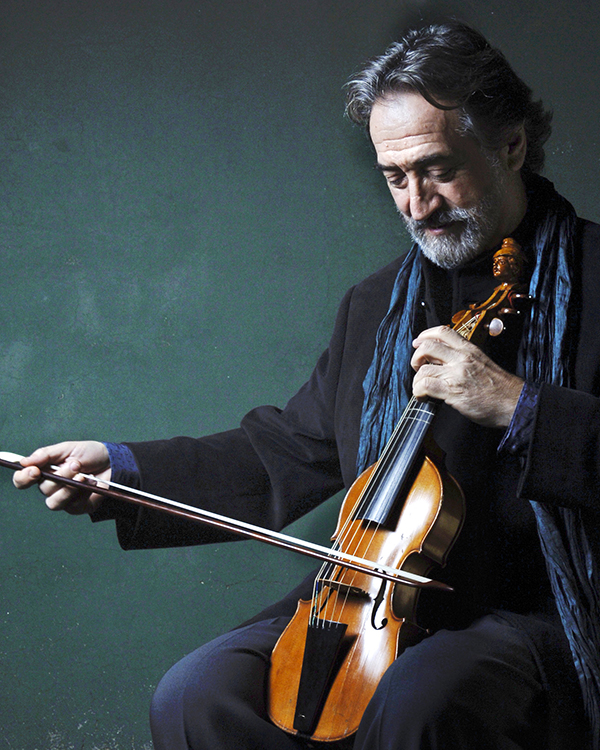
JORDI SAVALL
Jordi Savall is one of the most versatile musical personalities of his generation. For more than 50 years, he has rescued musical gems from the obscurity of neglect and oblivion and given them back for all to enjoy. A tireless researcher into early music, he interprets and performs the repertory both as a gambist and a conductor. His activities as a concert performer, teacher, researcher, and creator of new musical and cultural projects have made him a leading figure in the reappraisal of historical music. Together with Montserrat Figueras, he founded the ensembles Hespèrion XXI (1974), La Capella Reial de Catalunya (1987) and Le Concert des Nations (1989), with whom he explores and creates a world of emotion and beauty shared with millions of early-music enthusiasts around the world. Then, in 2017, he founded the Jove Capella de Catalunya, and in 2020, La Capella Nacional de Catalunya, with the aim of creating a new generation of international singers for La Capella Reial de Catalunya and making both historical and contemporary music accessible to all audiences. In 2018, he created Orpheus 21, an ensemble made up of professional musicians, migrants, and refugees from the Mediterranean region. Five years later, in 2023, Savall founded Les Musiciennes du Concert des Nations, an all-female orchestra specializing in Baroque repertoire, inspired by the women’s orchestras of the 18th century, particularly in Italy.
With his key participation in Alain Corneau’s film Tous les Matins du Monde (winner of the César Cinema Prize for the Best Soundtrack), his intense concert activity (about 140 concerts each year), his record releases (six recordings per year), and the creation in 1998, together with Montserrat Figueras, of his own record label, Alia Vox, Savall has shown that early music need not be elitist, but rather that it appeals to an increasingly wide and diverse audience of all age groups.
Savall has recorded and released more than 230 discs covering the Medieval, Renaissance, Baroque, and Classical music repertories, with a special focus on the Hispanic and Mediterranean musical heritage, receiving awards and distinctions including the Midem Classical Award, the International Classical Music Award and the Grammy Award. His concert programs have made music an instrument of mediation to achieve understanding and peace between different and sometimes warring peoples and cultures. Accordingly, guest artists appearing with his ensembles include Arab, Israeli, Turkish, Greek, Armenian, Afghan, and Mexican and other North American musicians. In 2008, Savall was appointed European Union Ambassador for intercultural dialogue and, together with Montserrat Figueras, was named an “Artist for Peace” under the UNESCO Good Will Ambassadors program.
Between 2020 and 2021, to mark Ludwig van Beethoven’s 250th anniversary, he conducted the composer’s complete symphonies with Le Concert des Nations and recorded them on two CDs entitled Beethoven Révolution. The impact they have had worldwide has been defined as “a miracle” (Fanfare) and volume II has been distinguished with the Schallplattenkritik Prize for the Best Orchestral Recording.
Savall’s prolific musical career has brought him the highest national and international distinctions, including honorary doctorates from the universities of Evora (Portugal), Barcelona (Catalonia), Louvain (Belgium) and Basel (Switzerland); the order of Chevalier de la Légion d’Honneur (France); the Praetorius Music Prize awarded by the Ministry of Culture and Science of Lower Saxony; the Gold Medal of the Generalitat of Catalonia; the Helena Vaz da Silva Award ;and the prestigious Léonie Sonning Prize, which is considered the Nobel Prize of the music world. This year, Savall has been elected an Honorary Member by the Royal Philharmonic Society, the Royal Swedish Academy of Music, and la Accademia Nazionale di Santa Cecilia.
Since its formation in 1998, Alia Vox has become established as one of the foremost labels specializing in high-quality early music. It is the exclusive producer of new recordings by Jordi Savall and his groups.
Ancient music’s most important value stems from its ability as a universal artistic language to transmit feelings, emotions, and ancestral ideas that even today can enthrall the contemporary listener. With a repertoire that encompasses the period between the 10th and 18th centuries, Hespèrion XXI searches continuously for new points of union between the East and West, with a clear desire for integration and for the recovery of international musical heritage, especially that of the Mediterranean basin and with links to the New World.
In 1974 Jordi Savall and Montserrat Figueras, together with Lorenzo Alpert and Hopkinson Smith, founded the ancient music ensemble Hespèrion XX in Basel as a way of recovering and disseminating the rich and fascinating musical repertoire prior to the 19th century based on historical criteria and the use of original instruments. The name “Hespèrion” means “an inhabitant of Hesperia,” which in ancient Greek referred to the two most westerly peninsulas in Europe: the Iberian and the Italian. It was also the name given to the planet Venus as it appeared in the west. At the turn of the 21st century, Hespèrion XX became known as Hespèrion XXI.
Today Hespèrion XXI is central to the understanding of the music of the period between the Middle Ages and the Baroque. The musicians’ labors to recover works, scores, instruments, and unpublished documents have a double and incalculable value. On one hand, their rigorous research provides new information and understanding about the historical knowledge of the period; on the other hand, their exquisite performances enable people to freely enjoy the aesthetic and spiritual delicacy of the works of this period.
Right from the beginning, Hespèrion XXI set out on a clearly innovative and artistic course that would lead to the establishment of a school in the field of ancient music because they conceived, and continue to conceive, of ancient music as an experimental musical tool and with it they seek the maximum beauty and expressiveness in their performances. All musicians in the field of ancient music must have a commitment to the original spirit of each work and learn to connect with it by studying the composer, the instruments of the period, the work itself, and the circumstances surrounding it. But as craftsmen in the art of music, they are also obliged to make decisions about the piece being played: musicians’ capacity to connect the past with the present and to connect culture with its dissemination depend on their skill, creativity, and capacity to transmit emotions.
Hespèrion XXI’s repertoire includes the music of the Sephardic Jews, Castilian romances, and pieces from the Spanish Golden Age. Some of the ensemble’s most celebrated concert programs are Les Cantigues de Santa Maria d’Alfons X El Savi, La Diàspora Sefardí; the music of Jerusalem, Istanbul, and Armenia; and the Folías Criollas. Thanks to the outstanding work of numerous musicians and collaborators who have worked with the ensemble over the years, Hespèrion XXI still plays a key role in the recovery and reappraisal of an important musical heritage that continues to have great resonance throughout the world. The group has published more than 60 CDs and performs concerts for the whole world, appearing regularly at the great international festivals of ancient music.
Following the model of the famous Medieval “royal chapels” for which the great masterpieces of both religious and secular music were composed on the Iberian Peninsula, in 1987 Montserrat Figueras and Jordi Savall founded La Capella Reial de Catalunya, one of the first vocal groups devoted to the performance of Golden Age music on historical principles and consisting exclusively of Hispanic and Latin voices. In 1990, the ensemble received the regular patronage of the Generalitat of Catalonia.
The newly formed ensemble specialized in the recovery and performance on historical principles of the polyphonic and vocal music of Spain and Europe from the Middle Ages and Golden Age up to the 19th century. La Capella Reial de Catalunya shares with Hespèrion XXI the same artistic outlook and goals, rooted in respect for the profoundly spiritual and artistic dimension of each work it performs, combining quality and authenticity regarding the style of the period with a careful attention to the declamation and expressive projection of the poetic text.
The ensemble’s extensive repertory ranges from the Medieval music of the various cultures of the Mediterranean to the great masters of the Renaissance and the Baroque. Some of its most celebrated concert programs are the Missa de Batalla by Joan Cererols, Vespro della Beata Vergine by Claudio Monteverdi, the Cantigas of Alfonso X (the Wise), El Llibre Vermell of Montserrat, Sephardic songs, the music of The Elche Mystery Play, the ballads from Miguel de Cervantes’ Don Quijote, the Cancioneros del Siglo de Oro (the Songbooks of the Golden Age), and Mozart’s Requiem. Recently, the group has also performed and recorded Johann Sebastian Bach’s St. Mark Passion and Christmas Oratorio, Handel’s Messiah, Vivaldi’s oratorio Juditha Triumphans, and Joseph Haydn’s The Creation, which has won wide international acclaim.
The group has distinguished itself in various Baroque and Classical opera repertories, as well as in contemporary works by Arvo Pärt. The Capella Reial de Catalunya can be heard on Jacques Rivette’s soundtrack for Jeanne la pucelle (1993), a film based on the life of Joan of Arc.
In 1992, La Capella Reial de Catalunya made its opera debut accompanying all the performances of Le Concert des Nations. The group has received various awards and distinctions in recognition of its more than 40 CDs, notably the Midem Classical Award and the Grammy Award. Under the direction of Jordi Savall, La Capella Reial de Catalunya pursues an intense program of concerts and recordings all over the world, and since the ensemble’s creation, it has regularly performed at the major international early-music festivals.