

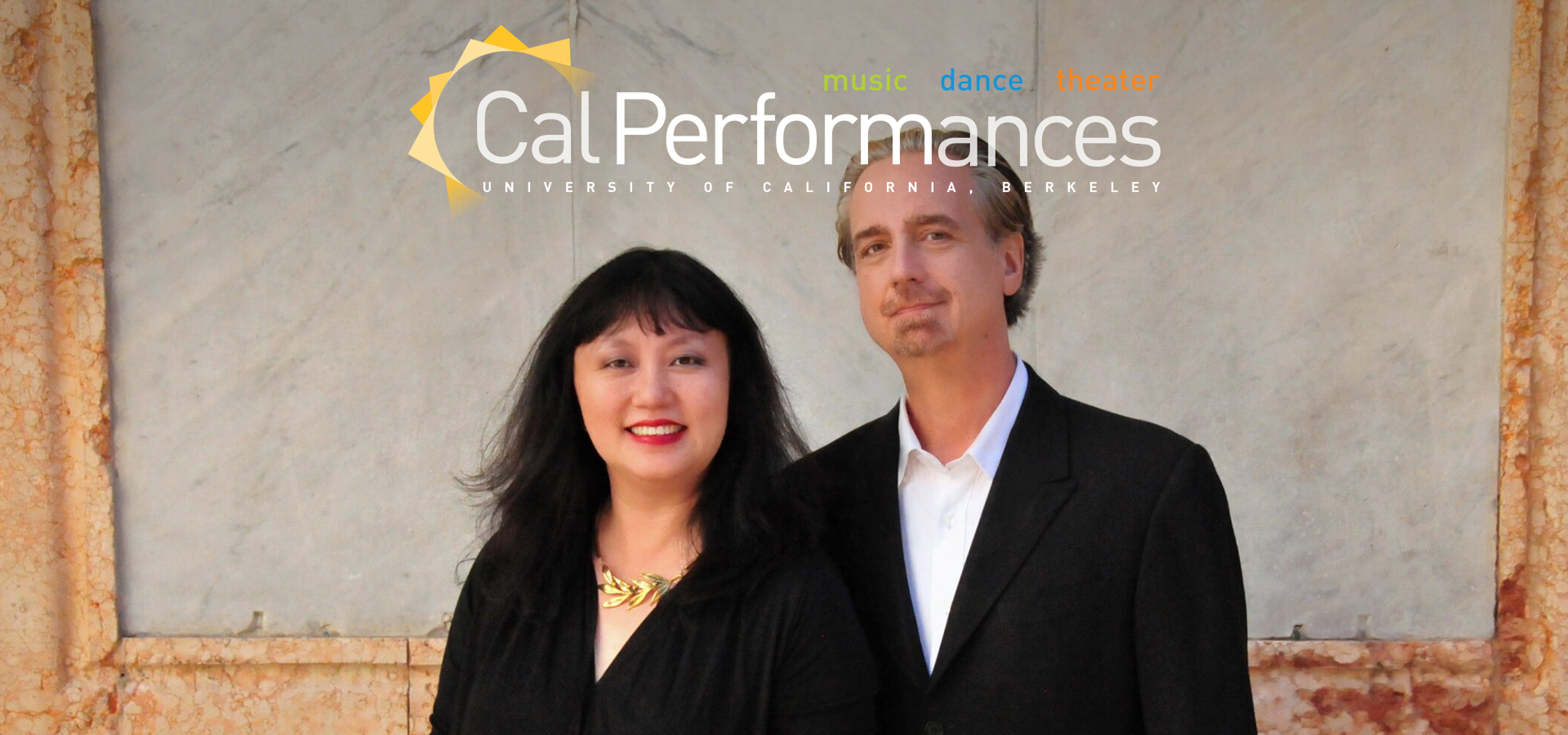
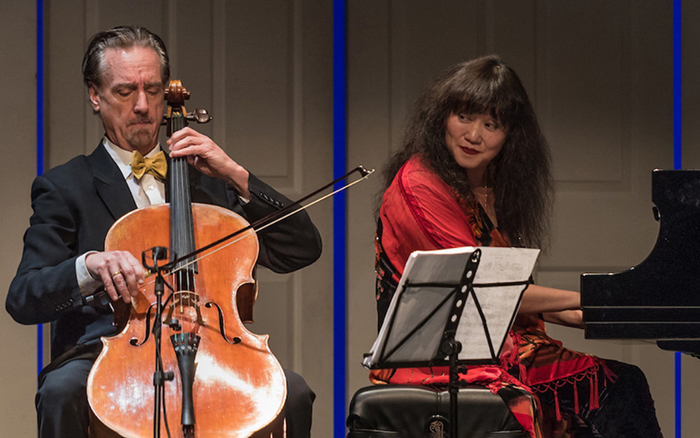
David Finckel, cello
Wu Han, piano
Sunday, March 29, 2026, 3pm
Hertz Hall
David Finckel and Wu Han appear by arrangement with David Rowe Artists. www.davidroweartists.com
Public Relations and Press Representative: Milina Barry PR, www.milinabarrypr.com
David Finckel and Wu Han recordings are available exclusively through ArtistLed. www.artistled.com
Artist website: www.davidfinckelandwuhan.com
Wu Han performs on the Steinway Piano.
This performance is made possible in part by Michael A. Harrison and Susan Graham Harrison.
Cal Performances is committed to fostering a welcoming, inclusive, and safe environment for all one that honors our venues as places of respite, openness, and respect. Please see the Community Agreements section on our Policies page for more information.
Johann Sebastian Bach
Adagio from the Toccata in C major for Organ, BWV 564, for Cello and Piano
This magisterial movement sits at the heart of Bach’s trio of movements and is set in the relative key of A minor. It has been transcribed for various solo instruments and keyboard; the version performed today was created by the eminent Russian pianist and composer Alexander Siloti.
—David Finckel
Sonata No. 1 in G major for Viola da Gamba and Harpsichord, BWV 1027
On two occasions in 1723, the rich musical life of Leipzig got magnificently richer. On May 22, the famous musician Johann Sebastian Bach arrived to assume the post of Cantor and Music Director at St. Thomas’ Church, one of the city’s musical epicenters. Bach, now 36 years old, had achieved enough celebrity throughout Germany for his elite musical skill, that not only his appointment, but his family’s very arrival in Leipzig was reported in newspapers as far away as Hamburg, 180 miles away: “He himself arrived with his family on two carriages at 2 o’clock and moved into the newly renovated apartment in the St. Thomas School.”
The other great development to occur that year was the partnership between Gottfried Zimmermann’s coffeehouse, Leipzig’s most prominent such establishment, and the Collegium Musicum. The Collegium was a performing collective of singers and instrumentalists (largely comprising students) founded in 1701 by Georg Philipp Telemann, and had since then played a vital role in Leipzig’s musical culture. Zimmermann’s coffeehouse included a concert hall that could accommodate large ensembles, and audiences of 150 (the neighborhood Starbucks it most certainly was not). A series of weekly concerts—always free of charge—sprung from this partnership and would eventually fall under Bach’s supervision when he became the Collegium’s Music Director in 1729.
Though overseeing this series undoubtedly added a substantial commitment to Bach’s already demanding church duties, he nevertheless thrived in his dual position as Cantor at St. Thomas’ and concert presenter at Zimmerman’s coffeehouse. In fact, in addition to offering works by Handel, Locatelli, Scarlatti, and others, Bach moreover took advantage of the Collegium series as an opportunity to compose a good deal of non-liturgical music himself: primarily instrumental music, as well as a number of cantatas known as “moral cantatas,” lighthearted musical dramas dealing with themes of moral virtue (including the famous “Coffee Cantata,” which passes tongue-in-cheek judgment on the vice of caffeine addiction).
The instrumental works Bach produced for this series include numerous important works, among them this first of three Sonatas for Viola da Gamba, BWV 1027–1029. Bach’s Collegium works for Zimmermann’s coffeehouse also include the six Sonatas for Violin and Keyboard Obbligato, BWV 1014–1019; the Violin Concerto in A minor, BWV 1065; and the famous Double Concerto in D minor, BWV 1043.
The Sonata in G major for Viola da Gamba and Harpsichord also exists as a Trio Sonata for Two Flutes and Basso Continuo, BWV 1039, which is almost certainly the earlier version (probably from Bach’s days as Kapellmeister at Cöthen). By the late 1730s (around the time of Bach’s arrangement for viola da gamba of his trio sonata), the viola da gamba had already begun to fall out of favor as a solo instrument. Marin Marais, the instrument’s greatest virtuoso, had died in 1728. Bach remained a champion of the instrument, however, as evidenced by his use of it in numerous concertos, cantatas, and the St. John and St. Matthew Passions, in addition to these sonatas. They remain today as standard repertoire for both the viola and cello; the latter’s more burnished tone, compared to the delicacy of the gamba, demands a heightened sensitivity of the player to the nuances of Bach’s writing. The early Bach biographer Philipp Spitta—who ranked this work among the three gamba sonatas “the loveliest, the purest idyll conceivable”—also noted that the viola da gamba “afforded a great variety in the production of tone, but its fundamental character was tender and expressive rather than full and vigorous. Thus, Bach could rearrange a trio originally written for two flutes and bass, for viol da gamba, with harpsichord obbligato, without destroying its dominant character.”
The sonata does indeed demonstrate trio sonata-style writing. Instead of a sparse basso continuo accompaniment to the through-composed gamba part, Bach provides a complete keyboard accompaniment, which moves in melodic and contrapuntal dialogue with the soloist. In the opening movement, a dignified yet dance-like Adagio, the keyboard and gamba bear equal melodic responsibility, often following each other in canon. The movement’s latter half features an intricately involved dialogue between the two, colored gracefully in turn by florid countermelodies and ornamental trills.
The work follows the four-movement structure of the Italian sonata da chiesa (church sonata) from the late 17th and early 18th centuries. Following a slow introduction, Bach launches into the fugal Allegro ma non tanto, whose rollicking, perfectly shaped subject inches its way upwards before quickly laughing its way back down to its starting point. The third movement is a languishing Andante in the relative minor, which the finale answers with another jovial fugue.
In the great wealth of solo and chamber instrumental works throughout Bach’s oeuvre, the Sonatas for Viola da Gamba are among those gems that have, though certainly not ignored, somewhat taken a back seat to the cello suites, the sonatas and partitas for violin, Die Kunst der Fuge, and other such works. Even 200 years ago, Johann Nikolaus Forkel, Bach’s first biographer, only quaintly made note of “Several Sonatas for Harpsichord and Violin, Harpsichord and Flute, Harpsichord, and Viol da Gamba. They are admirably written and most of them are pleasant to listen to even today.” These sonatas are far from second-tier pieces, however, and demonstrate Bach’s genius in the mature years of his career as fully as any other works.
—Patrick Castillo
Ludwig van Beethoven
Sonata No. 3 in A major for Cello and Piano, Op. 69
One of the greatest works in the cello literature, Beethoven composed the Sonata in A Major in the midst of one of his most phenomenally prolific periods, which also birthed the Fifth and Sixth Symphonies, the Fourth Piano Concerto, the Choral Fantasy, and the Opus 70 Piano Trios. The new prominence of the cello, the sweeping use of the instrument’s range, and the long, singing lines in the sonata all herald the full flowering of the cello’s role in Beethoven’s compositions. The earliest sketches of the work appeared in 1807 amongst those for the Fifth Symphony; Beethoven completed the sonata in Vienna in the spring of 1808 at the age of 38.
Beethoven dedicated the sonata to Baron Ignaz von Gleichenstein, an amateur cellist and one of Beethoven’s closest friends and advisers between 1807 and 1810. Gleichenstein helped to organize a consortium of sponsors who offered Beethoven a guaranteed annual stipend to remain in Vienna. It is thought that the dedication of the sonata was a gesture of thanks to Gleichenstein. After the agreement was signed, Beethoven asked Gleichenstein to help him find a wife.
A year after the work was completed, Beethoven complained that the sonata “had not yet been well performed in public.” The first record of a performance is from 1812 when the sonata was played by Beethoven’s pupil Carl Czerny and Joseph Linke, the cellist who would later give the first performance of the Opus 102 sonatas. Linke was the cellist of the Razumovsky Quartet, which premiered many of Beethoven’s quartets.
After presenting the first movement’s noble theme alone, the cello rests on a low note while the piano continues to a cadenza. The music is then repeated with the roles reversed, the cello playing an ascending cadenza marked dolce. The mood is rudely broken by a ferocious version of the theme in minor that quickly dissipates to allow for the entrance of the second subject, a beautiful combination of a rising scale (cello) against a falling arpeggio (piano). The cello and piano continue trading motifs, each repeating what the other has just played. A heroic closing theme is the culmination of the section and a brief; contemplative recollection of the opening motif leads to the repeat of the exposition.
The development explores even more incredible worlds, turning through mysterious, rhapsodic, stormy soaring, and mystical sound worlds before reaching the recapitulation, where the cello plays the theme in its original form against triplet decorations in the piano. The coda is thoughtful, and an extended chromatic buildup leads to a heroic statement of the theme. After some dreamy, languishing music almost dies away, Beethoven finishes this great movement with a surprise forte.
The scherzo movement is the only appearance of a scherzo (meaning “joke”) in all five cello sonatas. The music begins on the upbeat, and the 3-1 rhythm never ceases, even in the happier trio section. Although there are many clever exchanges, the incessant, manic energy leaves the distinct impression that this scherzo is no joke.
A short Adagio cantabile, a beautiful song for both instruments, relieves the nervousness of the scherzo. A moment of hesitation leads to the quiet, almost surreptitious appearance of the final Allegro vivace. The theme, though happy like its predecessors in the earlier sonatas, is more lyrical and has greater emotional depth. It introduces a movement in which the composer employs virtuosity not as an end, but as a means of creating internal excitement. The second subject presents a difference of opinion between cello and piano, the cello singing a short phrase, the piano responding with percussive eighth notes. The development section is mostly wild, with flying scales and pounding octaves. Approaching the recapitulation, Beethoven employs the basic materials of the movement: the rhythmic eighth-note accompaniment is combined with chromaticism, grasping for the main theme. The coda is full of thoughtfulness and pathos. There is a sense of reflection amidst excitement, of Beethoven yearning to be understood, yet with satisfaction denied. After a series of repeatedly unsuccessful attempts to reach the home key, A major is finally attained, as the eighth-note melody accelerates to frenzied sixteenth notes. The ending is triumphant, as Beethoven hammers his point home, the cello repeating the first bar of the theme over and over again with the piano pounding out the eighth-note accompaniment (“I will not give up!”).
—David Finckel
Claude Debussy
“Clair de lune” from the Suite bergamasque, L. 75
Debussy’s Au clair de la lune (“In the light of the moon”) is also one of the composer’s favorite works, and its iconic harmonies and melody have become almost synonymous with the subject. It is originally for solo piano, appearing as the third movement of the composer’s Suite bergamasque of 1890.
—David Finckel
Maurice Ravel
Pièce en forme de Habanera (arr. for cello and piano)
Maurice Ravel’s Vocalise-Étude “en forme de habanera” is one of his most-often heard miniatures, due to its hypnotic rhythm, exotic flavor, and stunning melodic material. Originally composed for voice without words (“vocalise”) it is now frequently transcribed for a variety of instruments. The Habanera is a slow dance that originated in Cuba, its name stemming from one of the earliest spellings of Havana (“Habana”).
—David Finckel
Benjamin Britten
Cello Sonata in C, Op. 65
Benjamin Britten’s Cello Sonata in C is the first of five products—each of them bona fide masterpieces—of a rich artistic relationship with the Russian cellist Mstislav Rostropovich, whom the composer first met in 1960. In September of that year, Britten was invited to attend the premiere, being given in London, of the First Cello Concerto of Shostakovich, another of the myriad composers for whom Rostropovich has served as muse. Rostropovich by that time was already a great admirer of Britten’s music; the admiration would quickly be reciprocated. The cellist once surmised in an interview: “He wrote the Cello Sonata, then the Cello Symphony, followed by three Unaccompanied Cello Sonatas. I take that as a personal compliment. If I had played the Cello Sonata poorly, would Britten have written his Symphony for me?”
Britten agreed to Rostropovich’s request for a new sonata, which he completed in January of the following year and sent to Rostropovich. The two agree to meet for the sonata’s first rehearsal on the cellist’s next trip to London two months later. By Rostropovich’s account, both musicians were so nervous that they began the session with “four or five very large whiskies.” With Britten at the piano, the work received its premiere at the Aldeburgh Festival on July 7, 1961; the evening’s program also included the Debussy and Schubert Sonatas, as well as the Schumann Cello Concerto, conducted by Britten.
While lending testament to a wondrous musical partnership, the Cello Sonata in C carries a greater significance as well, given the political context of the 1960s. The alienation between Western and Eastern Europe was strong at the time of Rostropovich’s introduction to Britten, the composer of the War Requiem and an outspoken pacifist. Such a sympathetic, not to mention high-profile, Anglo-Soviet collaboration was not to go unnoticed. During a visit to the Soviet Union in 1963, Britten offered the following in an interview with Pravda:
I must own that until my arrival in the USSR, I was assailed with doubts whether the Soviet audiences would understand and accept our musical art, which had been developing along different national lines than the Russian. I am happy at having had my doubts dispelled at the very first concert. The Soviet public proved not only unusually musical—that I knew all along—but showed an enviable breadth of artistic perception. It is a wonderful public.
This interview appeared internationally and, in its transcendence of political circumstance (Britten also noted, “I disbelieve profoundly in power and violence”), can only have benefited relations between the two nations.
The opening movement, aptly subtitled “Dialogo,” shows off Britten’s impeccable compositional technique. The entire movement is a meditation on the wide expressive potential of whole steps and half steps. In the conversational introduction, the piano’s fragmentary scale figures underscore sighing stepwise gestures in the cello, which Britten directs to be played lusingando (“coaxingly”). The animated first theme emerges, extending the subdued whole step and half step figures into a turbulent ride. Following a boisterous transitional passage in which triplets are bowed across the second string (fingered) and first (open)—still a succession of major and minor seconds—a lyrical second theme appears. The ascending whole steps in the cello are interrupted by a striking slide up a minor seventh (or, more fittingly, an inverted whole step), which Rostropovich so described to his student, and the cellist on this program, David Finckel: “It should be as if the devil comes along and grabs your cello from you” (at which point Rostropovich himself, in the devil’s absence, pulled the instrument upward from behind his student’s chair to produce the required abruptness of the melodic leap).
The second movement offers further evidence of Britten’s complete technique as a composer: though not a cellist himself, he spins a cello part ingeniously suited to the instrument. Furthermore, the Scherzo-Pizzicato—so designated because the entire movement is played with plucked rather than bowed strings—demonstrates the most virtuosic use of this technique in the entire cello literature. Pizzicati are played by both the right and left hand, often in rapid alternation; full chords are strummed across all four strings; and in addition to conventional pizzicato technique, Britten also calls for the cellist to hammer notes out directly on the fingerboard. These liberties speak not only to the composer’s ability, but also to his deep trust in the instrumental wizardry of his sonata’s dedicatee.
The Elegia sets a mournful melody in the cello against morose, atmospheric chords in the piano. The accompaniment simultaneously drives the music’s harmonic motion and establishes the movement’s plaintive character. Perhaps recalling the first movement, major and minor seconds predominate throughout, and continue when the piano’s low chords yield to sparse high notes. Harsh triple- and quadruple-stops herald an impassioned variation of the opening melody, an anguished cry in the upper register of the cello.
An energetic Marcia follows, evoking the sounds of a full marching band. The cello opens with a low, trombone-like quintuplet figure, answered rhythmically by drums and flutes. Over the course of the movement, the marching band seems to pass before the listener’s eyes and ears, eventually dying away in the cello’s high harmonics. The menacing tone of Britten’s march also calls to mind, whether consciously or not, the more sardonic works of Shostakovich.
In the Moto Perpetuo, Britten fashions a vigorous finale, full of short-tempered mood swings and fierce syncopations. A constant eighth- and sixteenth-note rhythm provides the rhythmic engine throughout the entire movement. The music is written in triple meter, though the listener would be challenged to clap out a waltz. This rhythmic ambiguity sits alongside Britten’s ironic designation of the entire work as a “Sonata in C” (all white keys after all, right?), given its tonal ambiguity throughout. The cello part is directed to be played saltando (jumping), a technique in which the bow is thrown against the cello and made to ricochet off the strings. Midway through the movement, Britten transforms the central saltando figure into a singing, dolce melody: a short-lived respite before a tremendous unison passage between the cello and piano hurl forward into the work’s forceful close.
—Patrick Castillo
About the Artists

Cal Performances’ extraordinary 2025–26 season moves into the busy month of March with a schedule of offerings sure to appeal to a wide range of people and interests.
Acclaimed classical and early-music artists include the brilliant The English Concert and an impressive slate of guest vocalists under the direction of conductor Harry Bicket, performing a concert version of Handel’s 1744 vocal showcase Hercules (Mar 8, Zellerbach Hall [ZH]); the ever-adventurous JACK Quartet making its Cal Performances debut in an ambitious program of contemporary music (Mar 15, Hertz Hall [HH]); and highly anticipated chamber music concerts with violinist Théotime Langlois de Swarte and harpsichordist Justin Taylor (Mar 22, HH), and longtime friends of Cal Performances, cellist David Finckel and pianist Wu Han (Mar 29, HH).
We’ll also enjoy rousing jazz from the Julia Keefe Indigenous Big Band (Mar 6, Zellerbach Playhouse [ZP]); ace guitarist Marc Ribot performing his score to special screening of Charlie Chaplin’s silent-film masterpiece The Kid (Mar 7, ZP); a brilliant production of La Belle et la Bête from Opera Parallèle that marries Philip Glass’ remarkable score with the classic 1946 Jean Cocteau film, under the direction of Nicole Paiement and Brian Staufenbiel (Mar 13–14, ZH); the phenomenally popular Silkroad Ensemble with Rhiannon Giddens (Mar 19–20, ZH); and masters of thunderous spectacle and jaw-dropping athleticism, the astounding drummers of Drum Tao (Mar 21–22, ZH).
Before the season draws to a close in May, we’ll continue to welcome a full spectrum of talent including Cal Performances’ 2025–26 Artist in Residence Víkingur Ólafsson; legendary soprano Renée Fleming; French piano virtuoso Alexandre Kantorow in his long-awaited Bay Area recital debut; early-music superstars Jordi Savall and The Tallis Scholars; and celebrated pianist, NPR host, and California native Lara Downes with an all-star cast of collaborators that includes the great Judy Collins. And our acclaimed dance series will conclude, distinguished by genre-defining artists and major new productions like the beloved Alvin Ailey American Dance Theater in its annual Zellerbach Hall visit and The Joffrey Ballet in a bold new work set during Midsommar, the traditional Scandinavian summer solstice festival.
As you explore the calendar, I especially recommend the Illuminations “Exile & Sanctuary” events that inform the Julia Keefe, Jordi Savall, and Silkroad Ensemble/Rhiannon Giddens concerts, which focus on how issues of displacement can inform explorations of identity and community, and how artistic expression can offer safe harbor during times of unrest or upheaval.
Finally, I hope you’ll join us in late April, when we announce our thrilling 2026–27 season. One major detail has already been revealed—the Maria Manetti Shrem and Elizabeth Segerstrom California Orchestra Residency, when Cal Performances and the Philharmonic Society of Orange County will welcome the return of the world-renowned Vienna Philharmonic, conductor Yannick Nézet-Séguin, and a truly impressive list of guest artists during spring 2027. And I can promise you many more welcome and exciting surprises when full season details are announced.
The opportunity to engage with diverse artistic perspectives and share the transformative power of the live performing arts is one of life’s greatest pleasures, and I look forward to encountering these profound and entertaining experiences with you in the months ahead.
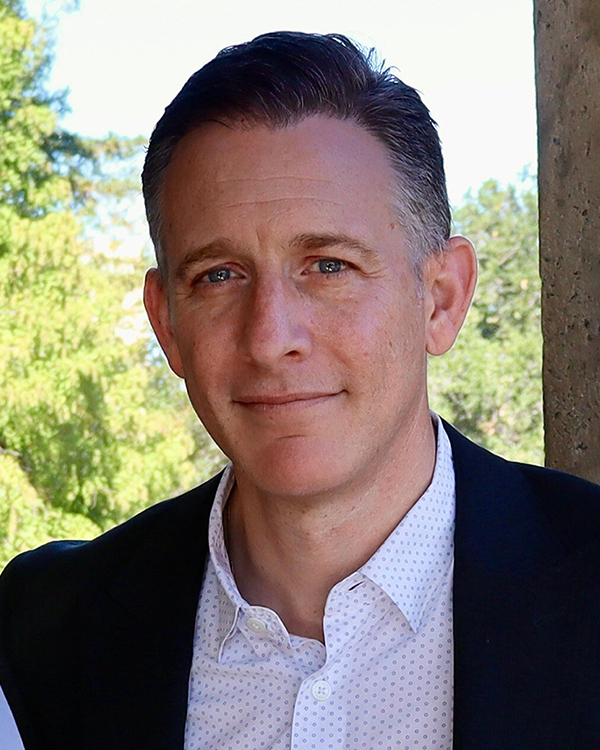
Jeremy Geffen
Executive and Artistic Director, Cal Performances