

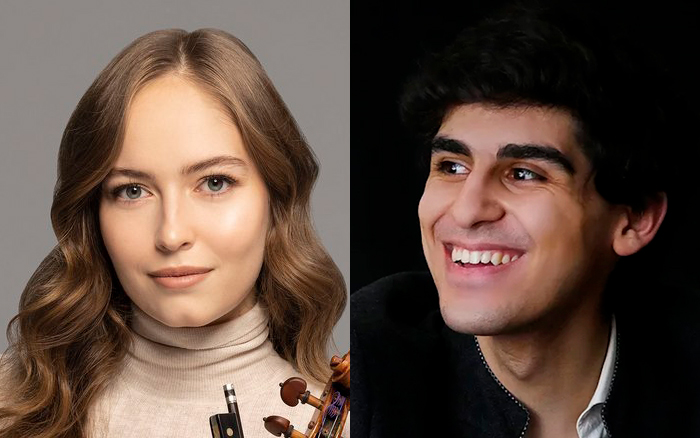
Geneva Lewis, violin
Evren Ozel, piano
Sunday, March 1, 2026, 3pm
Hertz Hall
Cal Performances is committed to fostering a welcoming, inclusive, and safe environment for all one that honors our venues as places of respite, openness, and respect. Please see the Community Agreements section on our Policies page for more information.
Johann Sebastian Bach
Violin Sonata in E major, BWV 1016
J. S. Bach’s legendary fame as a performer has rested on his prowess at keyboard instruments and especially the organ. Less known is his competency, if not virtuosity, as a violinist and violist. Both his grandfather and father had been celebrated violinists, and Bach from early childhood took lessons from his father. When, as a young man, he became a musician at the court of Weimar, he was appointed concertmaster of the orchestra as well as chief organist in the chapel.
Thus, when he moved from Weimar to become kapellmeister at the court of Cöthen in 1717, Bach brought a thorough understanding of string instruments to his new post. And this served him well, for there was little need for his renowned organ playing at this Calvinist court. The organ in the Cöthen chapel had fallen into decrepitude since the Reformed Church severely restricted the use of music during services. However, religious austerity did not affect musical life in the court itself, and Prince Leopold maintained an orchestra of the highest quality. Therefore, the composer turned his attention to creating secular instrumental music. We can thank Cöthen’s Calvinism for such masterpieces as the Brandenburg Concertos, the Well-Tempered Clavier, the cello suites, and the extraordinary sonatas and partitas for unaccompanied violin.
To this list must be added the six impressive sonatas for piano and clavier, from which Geneva Lewis and Evren Ozel have chosen one of the richest and most inventive to open this program. Though these sonatas were probably composed at Cöthen between 1720 and 1723, there is evidence that they were also performed later at Bach’s Collegium Musicum chamber programs in Leipzig.
As is the case with its five siblings, the Violin Sonata in E major is a work in which violin and piano are equal partners, both sharing roles as melodic leader as well as accompanist. The result is a texture like that of the three-instrument trio sonata (two solo instruments plus bass continuo) so popular during this period, with the pianist’s right hand often becoming a second soloist dovetailing with the violin while the left hand provides the harmonic bass line and is an active participant in the counterpoint of the fast movements as well.
The four movements follow the sonata da chiesa pattern of slow/fast/slow/fast. The two slow movements contain some of the loveliest music Bach ever wrote while the two fast movements are vivacious fugues demonstrating his contrapuntal genius. The Adagio first movement breaks away from the trio-sonata texture with the violin as the soloist singing a beautifully ornamented legato aria while the piano plays the accompaniment featuring a gentle rocking motive. The Allegro second movement moves us to the trio-sonata texture with the piano right hand introducing a merry, hyperactive fugue subject in partnership with the violin.
Moving to C-sharp minor, the third movement is a chaconne or passacaglia, with a repeating bass pattern in the left hand whose subtle adjustments allow the music to modulate. In the two upper solo parts, the violin and the piano right hand share solo and accompaniment roles with the violin introducing a wide-ranging aria while the piano counters it with a syncopated repeated-note pattern. Both of these elements are then traded back and forth between the two soloists.
The final Allegro outdoes the second movement in rhythmic vivacity and contrapuntal excitement. Here, the whirlwind fugue subject opens with a hiccup that misses the downbeat. In a middle section, Bach adds more rhythmic conflict by introducing triplet figures against the original hiccupping duple pattern of the subject. This is an ebullient fugue that is as captivating (if also difficult!) for the players as it is for the listeners.
Robert Schumann
Violin Sonata in A minor, WoO 27
From 1852 on, Robert Schumann’s brave fight against his mental demons slowed his formerly prodigious creative output. Bouts of tinnitus tormented his hearing, along with dizziness and fierce headaches. However, there was one final surge of composing late in 1853 that was stimulated by his friendship with the superb young violinist Joseph Joachim and then amplified by the arrival of the 20-year-old Johannes Brahms—recommended to the Schumanns by Joachim—at his doorstep that September.
Joachim inspired a violin concerto and a set of violin sonatas, including an unusual joint production of a sonata named the F–A–E Sonata to celebrate Joachim’s return to the Schumann home in October. “F–A–E” was Joachim’s personal theme, embodied in those three notes and in his motto “Frei, aber einsam” (“Free, but lonely”) expressing his unhappiness with his bachelor status. Schumann concocted this scheme of a four-movement work for violin and piano, with another young musical friend, Albert Dietrich, composing the first movement; Brahms the Scherzo; and Schumann the slow Intermezzo and fast Finale.
However, Schumann was not content to stop with this hybrid work and decided to transform it into his Violin Sonata No. 3 in A minor by replacing Dietrich’s first movement with his own and likewise Brahms’ Scherzo. It was to be his final major work before his attempted suicide early in 1854. But it was probably never played in Schumann’s lifetime and not published until 1956, the 100th anniversary of his death.
Marked “Ziemlich langsam” (“rather slow”), the impassioned first movement opens with the rich sound of chords establishing the key of A minor played by both instruments, the violin in double stops. Immediately, the pianist is the driving force countering the rather reticent violin with forceful chords adorned with virtuosic flourishes and an important motive of quick, detached three-note patterns. However, the violin is soon animated by the piano and introduces a lovely, flowing second theme. Rather than clearly marking out the sonata sections, this music is more a free rhapsody in which development and recapitulation are mingled together.
The second movement, marked “Lebhaft” (“lively”), replaces Brahms’ scherzo in the F–A–E Sonata. Though it’s already in three beats, the piano doubles the effect with triplet rhythms, giving the music an uneasy, slightly seasick feeling and intriguing rhythmic conflicts with the violin. It contains several more lyrical episodes between the returns of the main scherzo theme.
In F major, the Intermezzo is one of Schumann’s original movements from the F–A–E Sonata and contains Joachim’s musical motto using those three pitches. The violin introduces this motto in its smoothly flowing theme, underpinned by the piano’s rocking arpeggios that give this music an intriguing three against two rhythmic feeling.
The sonata closes with the Finale Schumann originally used in the F–A–E. And from the piano’s first three vigorous chords, this movement is saturated with the F–A–E motive, whose rhythm and angularity will identify it even when the original pitches are no longer there. Virtuosity reigns as the two instruments compete with each other in force and dexterity. Fortunately, Schumann also leavens the drama with more lyrical reveries and ultimately moves this stentorian minor-mode music to the joyful brightness of A major.
Arnold Schoenberg
Phantasy, Op. 47
Written in March 1949 as he approached his 75th birthday, the Phantasy was the last instrumental work Arnold Schoenberg composed. For most of the previous decade, he had been in frail health and in 1946 suffered an almost fatal heart attack. Restricted to periods when he was physically stronger, his compositions were less frequent, but when they came, they were worth waiting for. Such a work was the Phantasy, written for his friend the American violinist Adolf Koldofsky, which distilled his twelve-tone harmonic system to produce its loveliest and most delicate effects. That September, Koldovsky premiered it at a concert sponsored by the International Society for Contemporary Music commemorating Schoenberg’s 75th birthday.
Special attention needs to be paid to this work’s title. Schoenberg did not call it a “sonata for violin and piano”; instead, he emphasizes the violin’s status as the principal soloist in this work and the melodic leader, with the piano in the subsidiary role of filling out the tone-row’s activity. In fact, he created the violin part first, then wrote the piano part a week later. And though this one-movement piece has aspects suggesting a sonata form, even returning to the opening music at the end, he chose to call it a freer fantasy. That corresponds well with its mercurial style, which moves rapidly through different tempos, meters, and moods. Schoenberg marks those mood changes with precise expressive markings such as “Grave”/“Furioso”/“Grazioso”/“Scherzando.”
Many analysts have commented that this brief piece subdivides into four distinct sections. The first, marked “grave,” is the most dramatic as it establishes the theme, which incorporates the tone row. The violin leads off with powerful leaps and plunges covering its full range. Schoenberg scholar Dika Newlin describes it as “one of Schoenberg’s most fiery and youthful thematic conceptions.” Throughout, the composer makes imaginative use of extended playing techniques that produce a rainbow of colors.
Serving as a slow movement, the first episode, beginning “cantabile,” moves to a dancelike triple meter, and is generally more flowing and lyrical. A more forceful transition leads to the third section, marked “scherzando”: spikier, playful music that adopts the style of a scherzo and trio via a bouncing 6/8 meter. Abruptly, the music then reprises a variant of the opening “grave” section, with its angular leaps, followed by a virtuoso coda filled with shivering tremolandos.
Franz Schubert
Fantasy for Violin and Piano in C major,
D. 934
Throughout his career, Franz Schubert was fascinated by the fantasia genre: an unfettered style that gave free rein to his imagination without constraining it within rigid formal boundaries. The fantasia is a type of composition that, although carefully planned, attempts to recreate the spirit of an improvised piece and also to capture the virtuoso brilliance of execution such a piece would emphasize. Traditional formal schemes are relatively unimportant; the composer is encouraged instead to use his own fancy to link together a free flow of musical ideas.
Such freedom produced several of Schubert’s greatest piano works, notably his great Wanderer Fantasy of 1822 and the Fantasy in F minor for Piano Four-Hands of 1828. Shortly before the F-minor Fantasy, it also inspired a work of stunning virtuosity for violin and piano, the Fantasy in C major, D. 934 written in December 1827. This work was created specifically to show off the talents of two members of Schubert’s musical circle, the pianist Karl Maria von Bocklet and 21-year-old Bohemian violinist Josef Slavik, at one of the composer’s legendary Schubertiad evenings. The Fantasy’s first performance took place in Vienna on January 20, 1828, and, sadly, it was not a success even among Schubert’s devoted coterie. Thus, it was not published until decades after Schubert’s death.
Though it is technically in one interconnected movement, the Fantasy actually breaks down into four contrasting movement-like sections. At its center is an extended theme and variations based on one of Schubert’s songs, “Sei mir gegrüsst” (“I Greet You”). It opens with a prelude-like section in C major marked “Andante molto.” Over a dramatic piano tremolo, the violin sings a soulful melody that soars ever higher. It is wonderful example of Schubertian song, including the shadows of minor mode that is one of his trademarks.
The tempo increases in the Allegretto second movement and the key shifts to A minor and major for the second section: a blithe dance in Hungarian folk style introduced by the two instruments in close canon. Virtuosity comes to the fore in this exuberant dance, as both instruments urge each other on through thickets of intricate fast figurations.
The music slides into the distant key of A-flat major for the heart of the work, the Andantino theme and variations based on “Sei mir gegrüsst.” The piano is the leader in presenting this warmly expressive theme. Four variations follow, with each of their sections also repeated. The first three are highly ornamental in style, pushing both instrumentalists to their limits in terms of fleetness and accuracy of execution. The loveliest variation is the rhapsodic last one, rising upward on a series of trills. But before it has progressed very far, it is interrupted by the return of the work’s opening section, with its piano tremolo and soulful violin theme. Rising higher and higher, the violin then flows into the Fantasy’s final section.
In a fast “Allegro vivace” tempo and the home key of C major, the piano introduces a bold, thickly chorded melody with a firm foursquare shape that suggests Schubert’s idol Beethoven. But before long there is yet another interruption. Remembering he hasn’t finished his theme and variations section, Schubert suddenly wrenches the tonality back to A-flat major and tenderly reprises its core melody. But a virtuoso piece needs a virtuoso finish, and so the music soon returns to C major and a breakneck “Presto” tempo for a blaze of two-fisted double octaves for the pianist and crunchy multiple stops for the violinist.
—Janet E. Bedell © 2026
Janet E. Bedell is a program annotator and feature writer who writes for Carnegie Hall, the Metropolitan Opera, Los Angeles Opera, Caramoor Festival of the Arts, and other musical organizations.
About the Artists

Cal Performances’ extraordinary 2025–26 season moves into the busy month of March with a schedule of offerings sure to appeal to a wide range of people and interests.
Acclaimed classical and early-music artists include the brilliant The English Concert and an impressive slate of guest vocalists under the direction of conductor Harry Bicket, performing a concert version of Handel’s 1744 vocal showcase Hercules (Mar 8, Zellerbach Hall [ZH]); the ever-adventurous JACK Quartet making its Cal Performances debut in an ambitious program of contemporary music (Mar 15, Hertz Hall [HH]); and highly anticipated chamber music concerts with violinist Théotime Langlois de Swarte and harpsichordist Justin Taylor (Mar 22, HH), and longtime friends of Cal Performances, cellist David Finckel and pianist Wu Han (Mar 29, HH).
We’ll also enjoy rousing jazz from the Julia Keefe Indigenous Big Band (Mar 6, Zellerbach Playhouse [ZP]); ace guitarist Marc Ribot performing his score to special screening of Charlie Chaplin’s silent-film masterpiece The Kid (Mar 7, ZP); a brilliant production of La Belle et la Bête from Opera Parallèle that marries Philip Glass’ remarkable score with the classic 1946 Jean Cocteau film, under the direction of Nicole Paiement and Brian Staufenbiel (Mar 13–14, ZH); the phenomenally popular Silkroad Ensemble with Rhiannon Giddens (Mar 19–20, ZH); and masters of thunderous spectacle and jaw-dropping athleticism, the astounding drummers of Drum Tao (Mar 21–22, ZH).
Before the season draws to a close in May, we’ll continue to welcome a full spectrum of talent including Cal Performances’ 2025–26 Artist in Residence Víkingur Ólafsson; legendary soprano Renée Fleming; French piano virtuoso Alexandre Kantorow in his long-awaited Bay Area recital debut; early-music superstars Jordi Savall and The Tallis Scholars; and celebrated pianist, NPR host, and California native Lara Downes with an all-star cast of collaborators that includes the great Judy Collins. And our acclaimed dance series will conclude, distinguished by genre-defining artists and major new productions like the beloved Alvin Ailey American Dance Theater in its annual Zellerbach Hall visit and The Joffrey Ballet in a bold new work set during Midsommar, the traditional Scandinavian summer solstice festival.
As you explore the calendar, I especially recommend the Illuminations “Exile & Sanctuary” events that inform the Julia Keefe, Jordi Savall, and Silkroad Ensemble/Rhiannon Giddens concerts, which focus on how issues of displacement can inform explorations of identity and community, and how artistic expression can offer safe harbor during times of unrest or upheaval.
Finally, I hope you’ll join us in late April, when we announce our thrilling 2026–27 season. One major detail has already been revealed—the Maria Manetti Shrem and Elizabeth Segerstrom California Orchestra Residency, when Cal Performances and the Philharmonic Society of Orange County will welcome the return of the world-renowned Vienna Philharmonic, conductor Yannick Nézet-Séguin, and a truly impressive list of guest artists during spring 2027. And I can promise you many more welcome and exciting surprises when full season details are announced.
The opportunity to engage with diverse artistic perspectives and share the transformative power of the live performing arts is one of life’s greatest pleasures, and I look forward to encountering these profound and entertaining experiences with you in the months ahead.
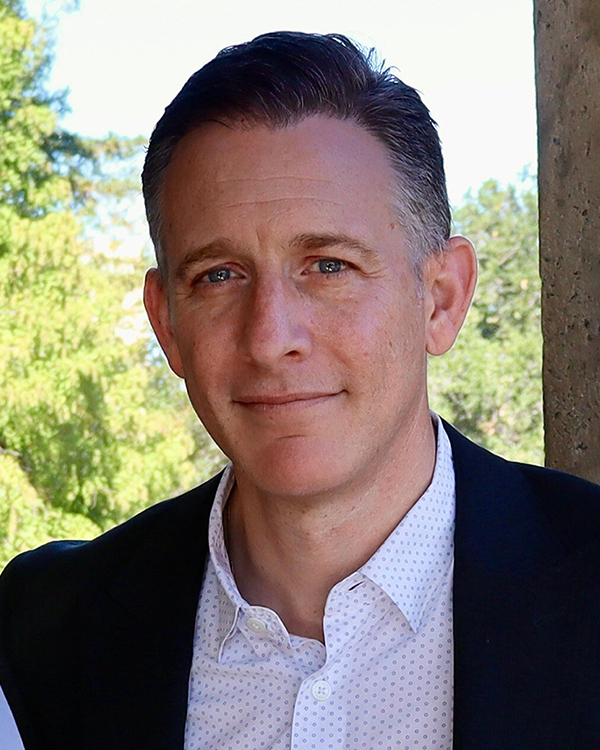
Jeremy Geffen
Executive and Artistic Director, Cal Performances