A Vast Theatrical Reckoning: William Kentridge’s The Head & the Load
By Thomas May, Cal Performances-commissioned writer, critic, educator, and translator
Before The Head & the Load filled a stage too wide to take in from a single seat, it began with a sentence in a letter.
William Kentridge first encountered the document as a university student in South Africa, while studying politics and colonial history: a protest written by John Chilembwe, an African Baptist minister in Nyasaland, now Malawi, against the recruitment of Africans into service during the First World War. The minister’s argument was as bitter as it was exacting. In peacetime, he wrote, everything belonged to Europeans. But in war, as Kentridge recalls the minister writing, Africans were suddenly invited “to shed our blood in equality.”
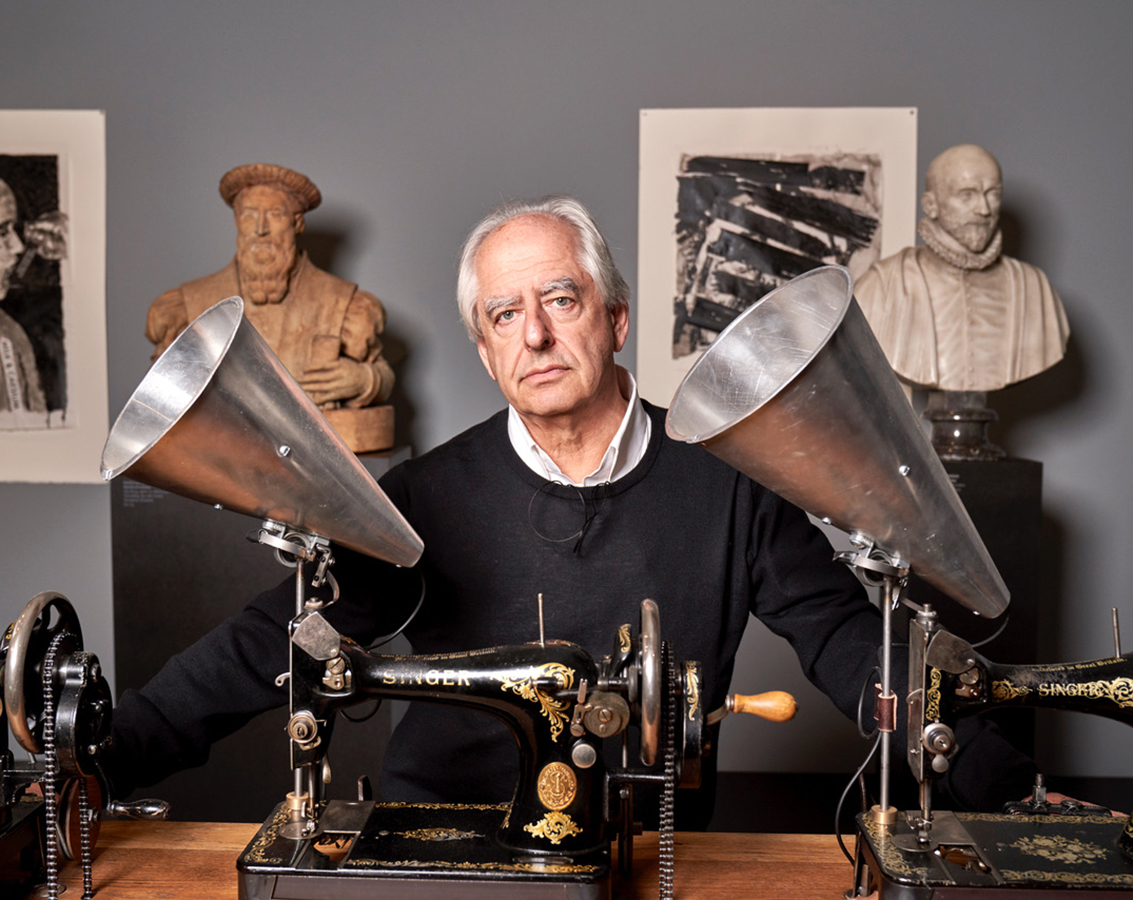
William Kentridge. Photo by Norbert Miguletz.
The sentence stayed with Kentridge for some 40 years, resurfacing when he was invited to create a work as part of 14-18 NOW: WW1 Centenary Commissions, a major UK arts and culture program that ran from 2014 to 2018. The Head & the Load received its world premiere at London’s Tate Gallery in 2018 and its North American premiere later the same year at New York’s Park Avenue Armory. It was the Armory’s drill-hall character, Kentridge recalls, that suggested a military subject, and he wanted that subject to remain connected to South Africa or Southern Africa. So it was that the long-carried fragment from Chilembwe’s letter became the seed of this vast theatrical reckoning with the role of Africa and Africans in the First World War—and with the lives, labor, choices, and contradictions that the historical record has too often left at the margins.
Following its 2018 premiere in the Tate Modern’s cavernous Turbine Hall and the North American premiere later that year at the Armory, The Head & the Load comes this fall to Cal Performances for its West Coast premiere, presented at the newly remodeled Henry J. Kaiser Center for the Arts in Oakland (November 12–15). At Cal Performances, the production also serves as the centerpiece of the 2026–27 Illuminations theme, “Innocence & Experience,” and launches a new five-year initiative that will see a multidisciplinary Kentridge work during each of the next five seasons. The initiative deepens a relationship with an artist who has already become a recurring campus presence dating back to 2015 (Ubu and the Truth Commission with Handspring Puppet Company) and, more recently, Sibyl (2023); various other appearances as UC Berkeley’s 2022–23 Artist in Residence, organized and produced by Cal Performances; and the Cal Performances co-commission The Great Yes, The Great No (2025).
Kentridge, whose practice moves among drawing, film, sculpture, performance, theater, opera, and collaborative stage-making, has built a body of work in which images, objects, music, text, and theatrical action continually feed each other. Although the programs included in future Cal Performances seasons have yet to be announced, the initiative invites audiences into a longer encounter with an artist whose recent stage works begin, as Kentridge puts it, from “things that we are forgetting and things we never knew.”
For Jeremy Geffen, Cal Performances’ executive and artistic director, the point of the five-year commitment is not to turn Kentridge’s work into a fixed cycle, but to give audiences something more sustained than an occasional encounter. The Kentridge productions Geffen has seen, he says, have been “among the most powerful experiences” he has had in a theater: “enormous, multidisciplinary works” that are “not easily classifiable as theater, dance, music, visual art.” He does not think of the five-year initiative as a cycle so much as “an exploration”—an opportunity to understand “what lies at the core of Kentridge’s creativity” and how the artist binds eclectic materials into cohesion.
The Burden of a European War
The title comes from a Ghanaian proverb: “The head and the load are the troubles of the neck.” In Kentridge’s hands, the phrase becomes more than an image of physical strain. It links thought to weight, memory to labor, and historical knowledge to the bodies asked to carry it.
The scale of the subject is immense: more than two million Africans labored, fought, and died during the First World War. Yet their presence was often barely recorded. For South African choreographer Gregory Maqoma, part of the creative team, the burden of war includes not only “the carrying of machinery, supplies, and empire itself,” but also “the carrying of wounded bodies, broken spirits, and lives forever altered by conflict.”
Other African proverbs enter the libretto as well: “‘My witness is in Europe,’ says the liar”; “One should not be too hopeful of a ship sailing from Europe”; “The pool ahead is not to be trusted”; “God’s opinion is unknown.” For Kentridge, such sayings open “riddles without a definitive answer.” They do not explain events from above. They turn and tilt them, offering another angle of approach.
Proverbs also run through Kentridge’s wider practice. The name of the Johannesburg arts incubator he co-founded with Bronwyn Lace in 2016, The Centre for the Less Good Idea, comes from a Tswana proverb: “If the good doctor can’t cure you, find the less good doctor.” The name points to a working method that values detours, accidents, and secondary ideas rather than the quickest route to an apparent solution.
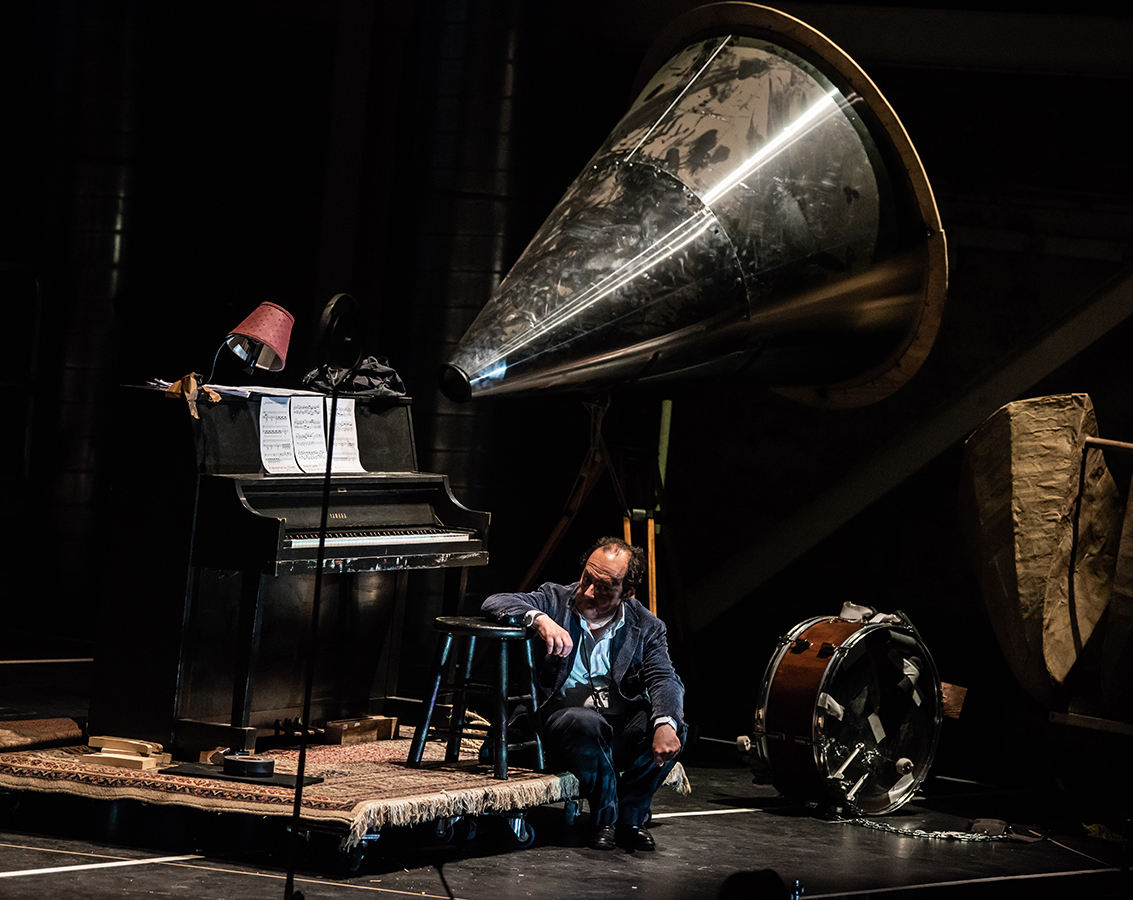
William Kentridge’s THE HEAD & THE LOAD. Pictured: Vincenzo Pasquariello. Photos by Stella Olivier.
The same resistance to simplistic resolution shapes The Head & the Load. The Nyasaland minister’s argument—why should Africans die for a European war?—sits beside another historical position. Some Africans, especially in Senegal, demanded the right to fight, to see themselves as Frenchmen and to make the same sacrifice as other French citizens. They offered, in Kentridge’s recollection of the phrase, “a harvest of devotion.” For him, the paradox of some refusing the war while others claimed the right to take part became one of the engines of the piece.
The Head & the Load recognizes erasure, but it does not simplify the lives of the erased. It asks what it meant to be summoned by an empire that had denied one’s equality; what it meant to refuse; what it meant to demand inclusion; and what it means now to recover traces of those choices from a record designed to leave them at the margins.
Not a Lecture but a Collage
During the making of The Head & the Load, Kentridge recalls, there was a debate about whether to insert a lecture into the middle of the performance to explain the historical background. He had prepared one. The team ultimately rejected it. A lecture would have avoided the real artistic challenge: whether a performance could give audiences information and meaning without stopping to explain itself. In other words, could the work itself become, as Kentridge puts it, “the history lesson”?
That decision shaped the form of The Head & the Load, which remains discontinuous. Processions give way to shadows, songs, projected drawings, proverbs, chants, European modernist quotations, African languages, and Dadaist eruptions of sound and nonsense. Collage, for Kentridge, is not a decorative layer pasted over a historical subject but a way of thinking historically, assembling frag¬ments, weighing them differently, allowing contradiction to remain visible. The work’s broken form reflects how history itself is apprehended—never discovered whole, but constructed from traces, omissions, accidents, and competing claims.
The First World War also brings Dada into the work’s bloodstream. Dada emerged from the war as a revolt against the European rationality that had helped produce mechanized slaughter. If “good Cartesian European logic” had led to such disaster, Kentridge suggests, then perhaps another logic—illogic, broken logic, bad logic—was needed.
In The Head & the Load, that breakdown of language also points to colonial incomprehension. From the Berlin Conference onward, European powers were not interested in hearing African voices. Orders were issued, borders declared, authority established. Facts, as Kentridge puts it, were “simply imposed.” Language ceased to be a bridge. It became another instrument of power.
The work’s libretto mirrors that collapse. The production’s own description calls it a collage of texts and phrases “cut-up, interleaved, and expanded,” drawing on sources as varied as Frantz Fanon, Tristan Tzara, Wilfred Owen, Kurt Schwitters’ Ursonate, military-drill handbooks, Sol Plaatje’s Setswana proverbs, and Aimé Césaire.
“Theater, music, and procession,” Kentridge says, “can activate an archive which can otherwise be very, very dead.” A static photograph may be informative, but performance can search for “the life inside” it. Drawing, music, film, and stage action can bring an audience closer to the archive, not by pretending to fill every gap, but by restoring emotional force to images that might otherwise be met, as Kentridge puts it, “in a very jaded way.”
When Africa Talks Back
For Thuthuka Sibisi, musical director and co-composer of The Head & the Load, and Philip Miller, credited with composition, music concept, and orchestration, the historical question became a musical one. What might the First World War have sounded like to African soldiers and carriers whose experiences were not recorded? Miller found few sound recordings, musical scores, or transcriptions in the archives.
What he did find were clues: written accounts, photographs, documents, and lists of “gifts” sent by the English Committee for the Welfare of Africans to African battalions—gramophone records, accordions, harmonicas, and banjos—so that soldiers and carriers might “entertain themselves” during breaks from marching and carrying munitions.
The language of benevolence sits uneasily beside the violence of the situation. These were men drawn into imperial war, offered musical instruments in the intervals between carrying its machinery. Those archival clues led Sibisi to ask what songs “of war, love and longing” African men might have made “in the trenches on the Western Front or in the camps of East Africa.” The archive cannot fully answer. It was this silence, Miller says, that gave him and Sibisi the freedom to imagine “a sonic world that was multi-layered,” speaking both to colonial musical tropes and to the diverse African musical traditions and languages of the regions from which the soldiers came.
“Right from the very beginning,” Miller says, “I wanted to bring a strong emotional and dramatic layer to evoke the many conflicting feelings around this complex and untold history.” Music, for him, could fill “a space of emptiness,” breaking a silence where history had been hidden, overlooked, or deliberately suppressed.
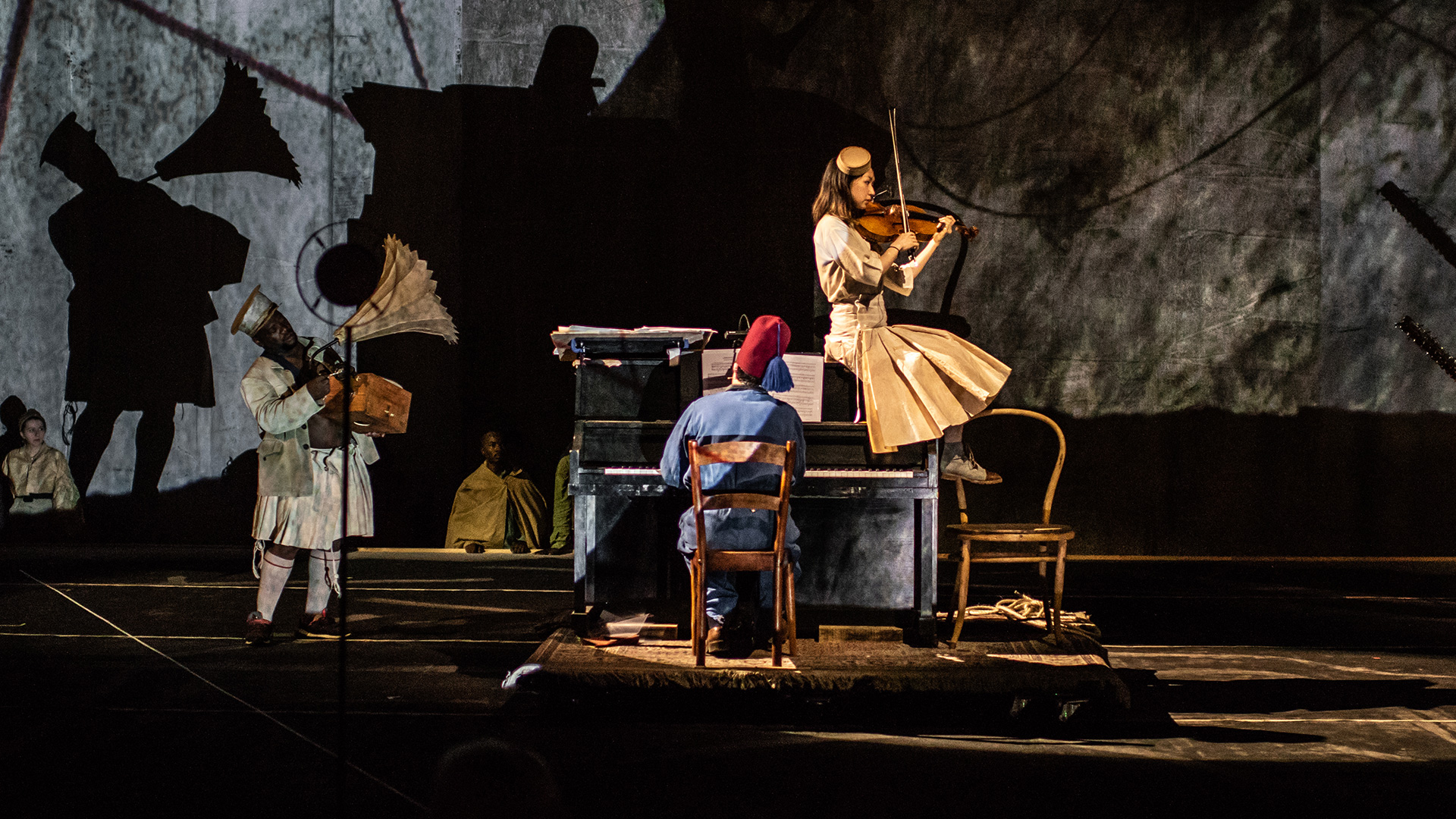
William Kentridge’s THE HEAD & THE LOAD. Pictured: (from left to right): Nhlanhla Mahlangu, Mhlaba Buthelezi, Vincenzo Pasquariello, and Mario Gotoh. Photo by Stella Olivier.
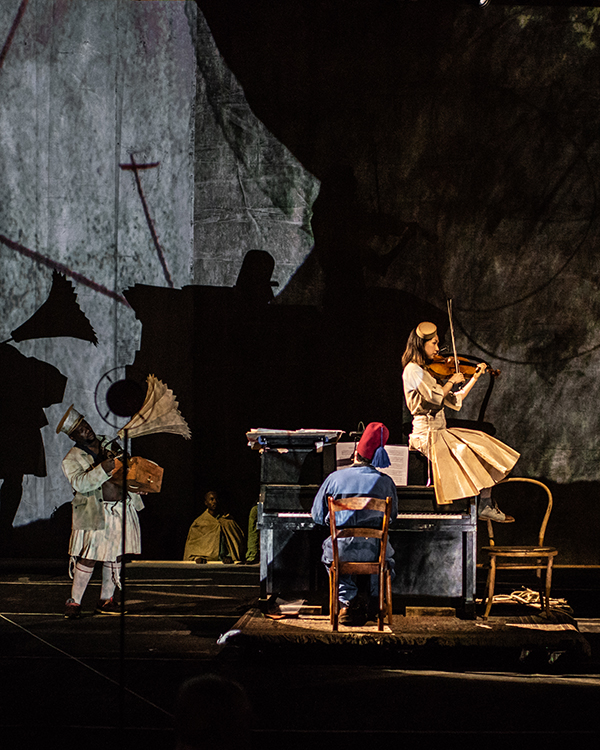
William Kentridge’s THE HEAD & THE LOAD. Pictured: (from left to right): Nhlanhla Mahlangu, Mhlaba Buthelezi, Vincenzo Pasquariello, and Mario Gotoh. Photo by Stella Olivier.
Miller did not imagine the score as mere accompaniment. He wanted it to push back against the familiar Western European soundtrack of war songs, military bands, and modernist repertoire. The voices of the singers break what he calls the “muteness” of African soldiers and porters: “These are the voices of Africa, calling out to Europe. Re-telling this history anew.” They are also, he says, voices of “lamentation” for disregarded and unknown deaths.
For Miller, that answering back is also a matter of dramaturgy. He describes archival texts becoming “lyrics” absorbed into the libretto; the songs, he says, acted as interpolations that helped shape the work during rehearsals and workshops. Written music was then developed and expanded by singers and musicians while the work’s visual world was also taking shape, allowing sound, image, and movement to “dialogue with each other,” sometimes “in opposition” and sometimes “in sympathy.” In Miller’s account, music does not simply support the drama; it helps make it.
Sibisi approaches the same silence from another angle. He speaks of scouring archives for clues that might “sound the friction” between the global South and its northern counterpart. He asks whether Swahili phrase books and dictionaries published for colonial commanders might have sounded as absurd to a Kenyan soldier as Kurt Schwitters’ nonsense poetry. Sibisi describes a collage that moves from a Schoenberg cabaret song, intercut with percussive slaps on hymnbook covers, to a Viennese waltz by Fritz Kreisler. Amid that tension, he says, Africa “talks back to Europe through rhythmic war songs and chants.”
Kentridge, quick to credit the “great musicality and intelligence” of Miller and Sibisi, describes his own role as someone involved in assessing, judging, and provoking musical ideas as the sound world took shape. The process began early. In the first workshop, he recalls, the team asked whether the bow tapping against the side of a double bass might become a machine gun, or whether bugle calls might be played not by brass instruments but by a violin.
The aim was not simple imitation. It was defamiliarization: familiar sounds made strange, and strange sounds charged by their context. The process also drew on music from the First World War era—Kentridge mentions Erik Satie—alongside new pieces by South African composers and traditional songs or hymns from Africa around the period of the war.
A Living Organism
Sibisi describes the score emerging from the rehearsal room, not arriving fully formed. He and Miller had worked with Kentridge before on Triumphs and Laments, the large-scale processional project along the Tiber River in Rome whose structure helped seed The Head & the Load. In the rehearsal room, Sibisi says, no single idea remained important until meaning attached itself to it. A dancer’s gesture might drive the core of a musical phrase. A costume might become play material for choreography, which in turn might open space for a particular musical color or texture.
Geffen sees that collaborative dimension as part of Kentridge’s larger stage practice. Kentridge provides the overall shape, but the works gather contributions from many disciplines and many hands. In The Head & the Load, that range is visible not only in music and choreography, but also in the production’s design, with Catherine Meyburgh’s projections and video work, Greta Goiris’ costumes, Sabine Theunissen’s sets, and Urs Schönebaum’s lighting design helping to define the work’s theatrical architecture.
Sibisi describes his own role in almost custodial terms: The Head & the Load, he says, feels like “a living organism” requiring “care, attention and feeding.” One of his most important responsibilities has become that of a caretaker.
Movement as Archive
If music gives the work one way of answering the archive, choreography gives it another. Gregory Maqoma, the South African choreographer who designed the movement for The Head & the Load, understood the body itself as a historical medium. “For me, movement became an archive,” he says. “Long before many Africans had the opportunity to write their histories, the body carried memory.” Maqoma understands that memory is not abstract. Growing up in South Africa, he says, history “lived in people’s bodies, in the way they walked, worked, mourned, and celebrated.” In The Head & the Load, he did not want simply to illustrate history through choreography. He wanted audiences to feel its weight physically.
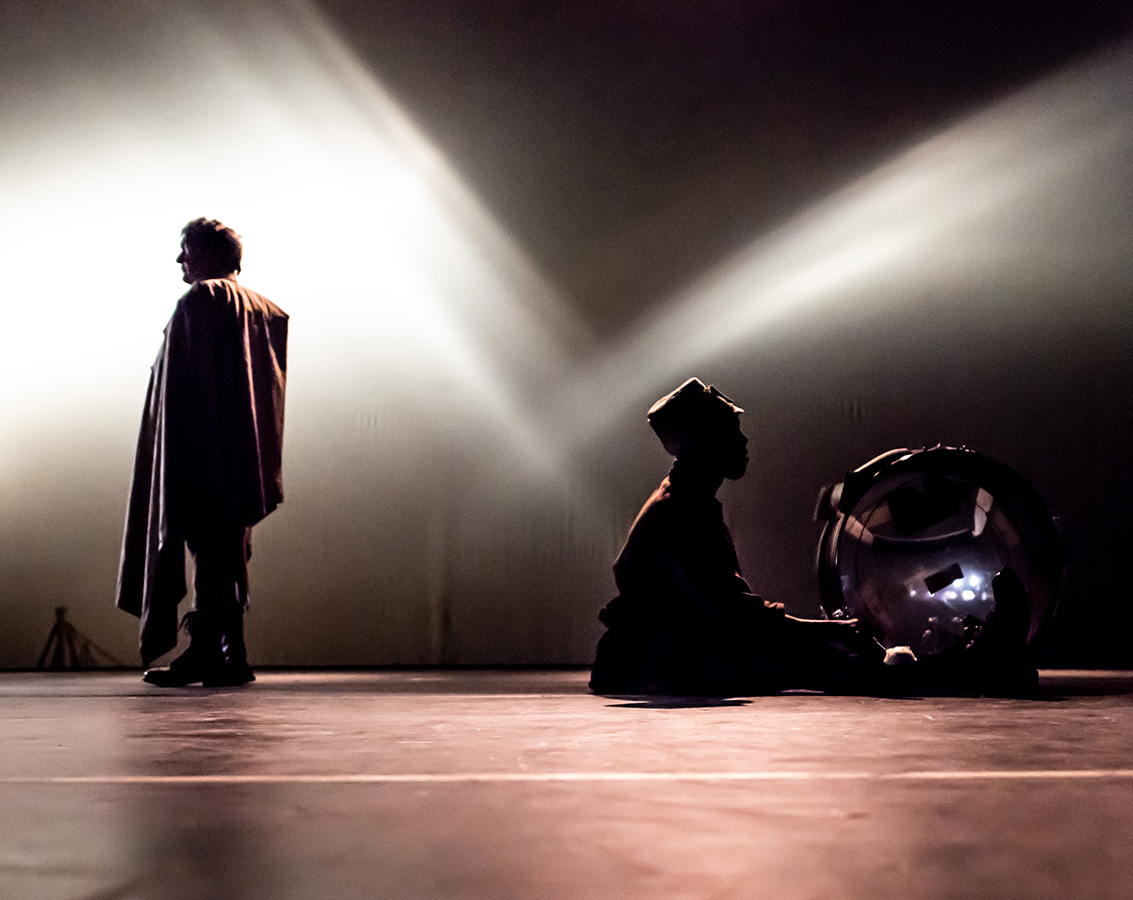
William Kentridge’s THE HEAD & THE LOAD. Pictured: (from left to right): Luc de Wit and Gregory Maqoma. Photo by Stella Olivier.
The proverb at the work’s center became one of his entry points. Burden, according to Maqoma, changes the body. It alters posture, breath, rhythm, and the relationship to space. A load carried long enough becomes part of identity. The performers in The Head & the Load do not merely represent African porters and carriers; they embody carrying as labor, trauma, endurance, and care.
One image remains especially important to Maqoma: the figure he calls the “Wounded Man,” carried across the stage by another performer and “constantly kept awake by his carrier.” For Maqoma, “this image embodies the entire work.” The image, he suggests, reveals what statistics cannot: “what it means for one human being to carry another through unimaginable circumstances.”
Maqoma says choreography need not provide answers. Sometimes, he notes, its responsibility is “to ask questions that words cannot.” What he chose to leave unresolved—“perhaps the most important thing”—was justice. “There is no neat ending to this story. The consequences of colonialism, exploitation, and erasure are still with us. The work refuses to close those wounds because they remain open.” Maqoma wants audiences to leave carrying “a discomfort, a question, a responsibility.” Theater should not always send audiences home satisfied; sometimes, he says, it should send them home “awake—even more important, disturbed!”
A Stage Too Wide to Master
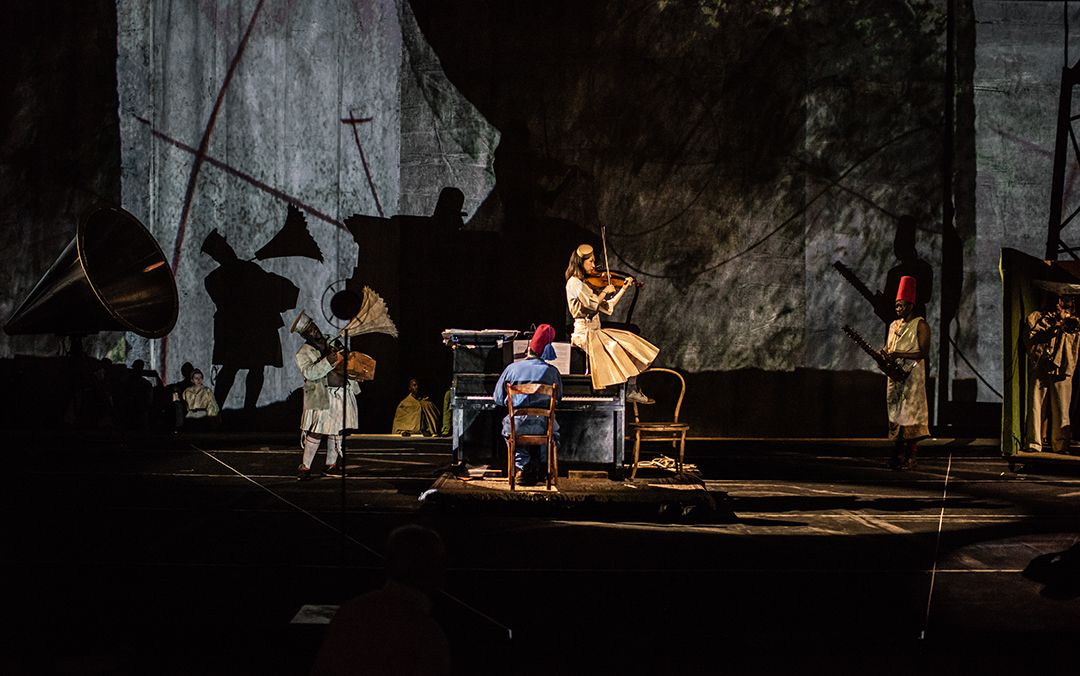
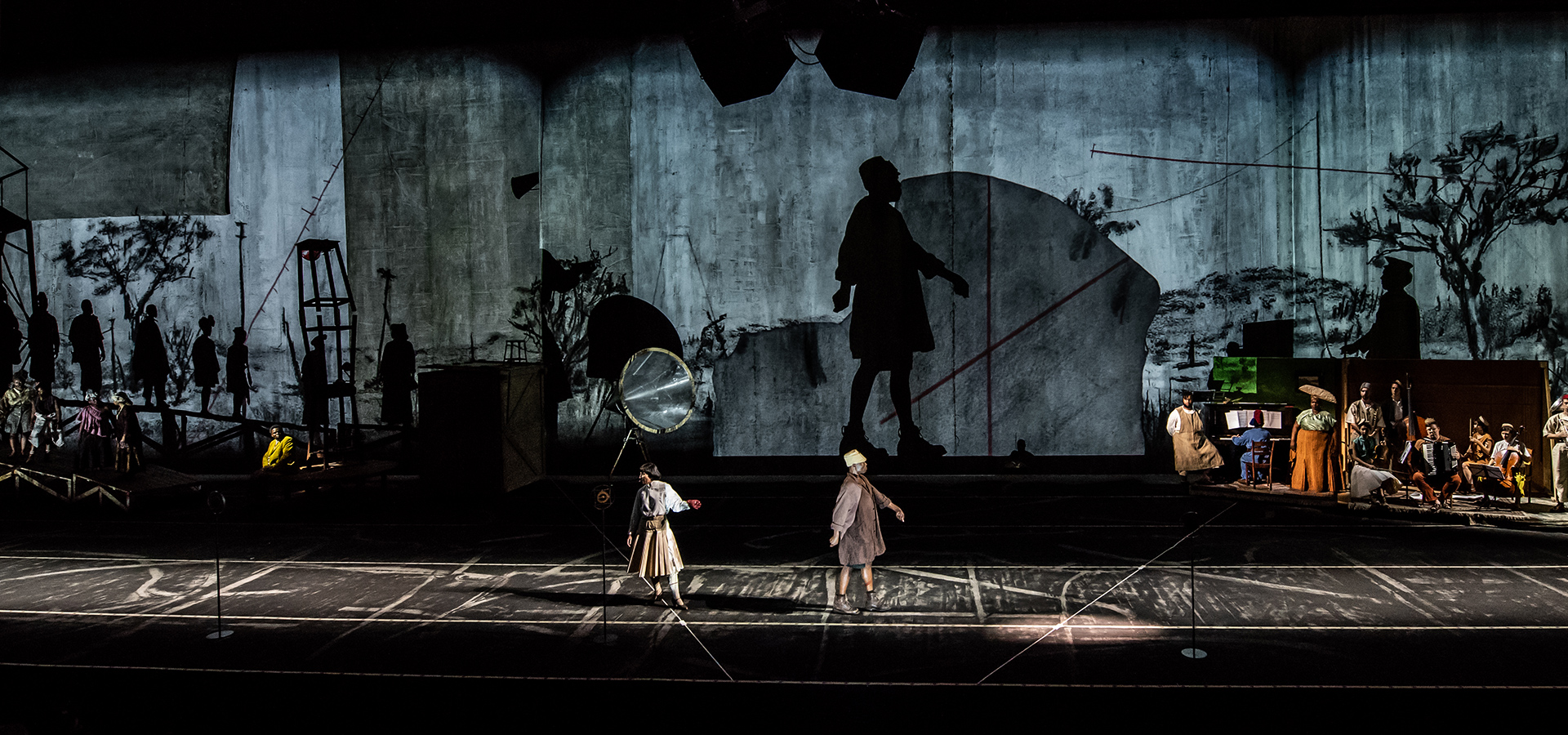
The Head & the Load was conceived for an unusually long stage. At New York’s Park Avenue Armory, Kentridge recalls, the stage used was about 60 meters. The team had recently worked on Triumphs and Laments along a 500-meter stretch of the Tiber River; by comparison, 60 meters felt almost like a miniature. At first, they imagined the whole piece as a procession. But even the slowest procession would take only a few minutes to cross the space, so procession became one component among many.
Still, the long stage remained “almost the starting point of the whole production.” For Kentridge, that length means that no one can take in the entire work from a single seat: “no two people see exactly the same show.” Someone seated near the officers “cutting up the continent of Africa,” he notes, will be at a distance from the soldiers waiting to be called into action. Yet Kentridge also stresses that the staging was designed so that wherever one sits, something is happening directly ahead or at an angle. The audience is not looking at a conventional proscenium, but across what he calls “a very wide expanse,” where distant actions gradually make their way toward the viewer. The audience encounters the work in pieces, never from a single commanding view.
Even the musicians inhabit that mobile world. Kentridge describes the production’s two bands or orchestras as housed in containers and platforms on wheels, which can be moved into position and opened “like a kind of music box.” The image is almost playful, but it also captures the production’s larger logic. Music is not hidden offstage; it becomes part of the production’s visible machinery.
The musicians’ mobility is one part of a larger spatial demand. Zellerbach Hall’s proscenium opening is 63 feet wide; for The Head & the Load, Cal Performances is building a performance stage inside the Kaiser Center arena that will be 180 feet wide and 32 feet deep. That nearly threefold difference in width helps explain why the work could not simply be moved into a conventional proscenium theater. The venue does more than accommodate The Head & the Load; it preserves the audience’s partial view of the work—the sense of not seeing everything, not knowing everything, not being able to assemble the past into one complete picture.
For Geffen, who saw The Head & the Load at the Park Avenue Armory, the work was overwhelming in the best sense: beautiful, energizing, thought-provoking, and impressive in nearly every meaning of that word. But his broader interest in Kentridge has less to do with spectacle alone than with the artist’s ability to make audiences think through image, sound, movement, and historical fragments.
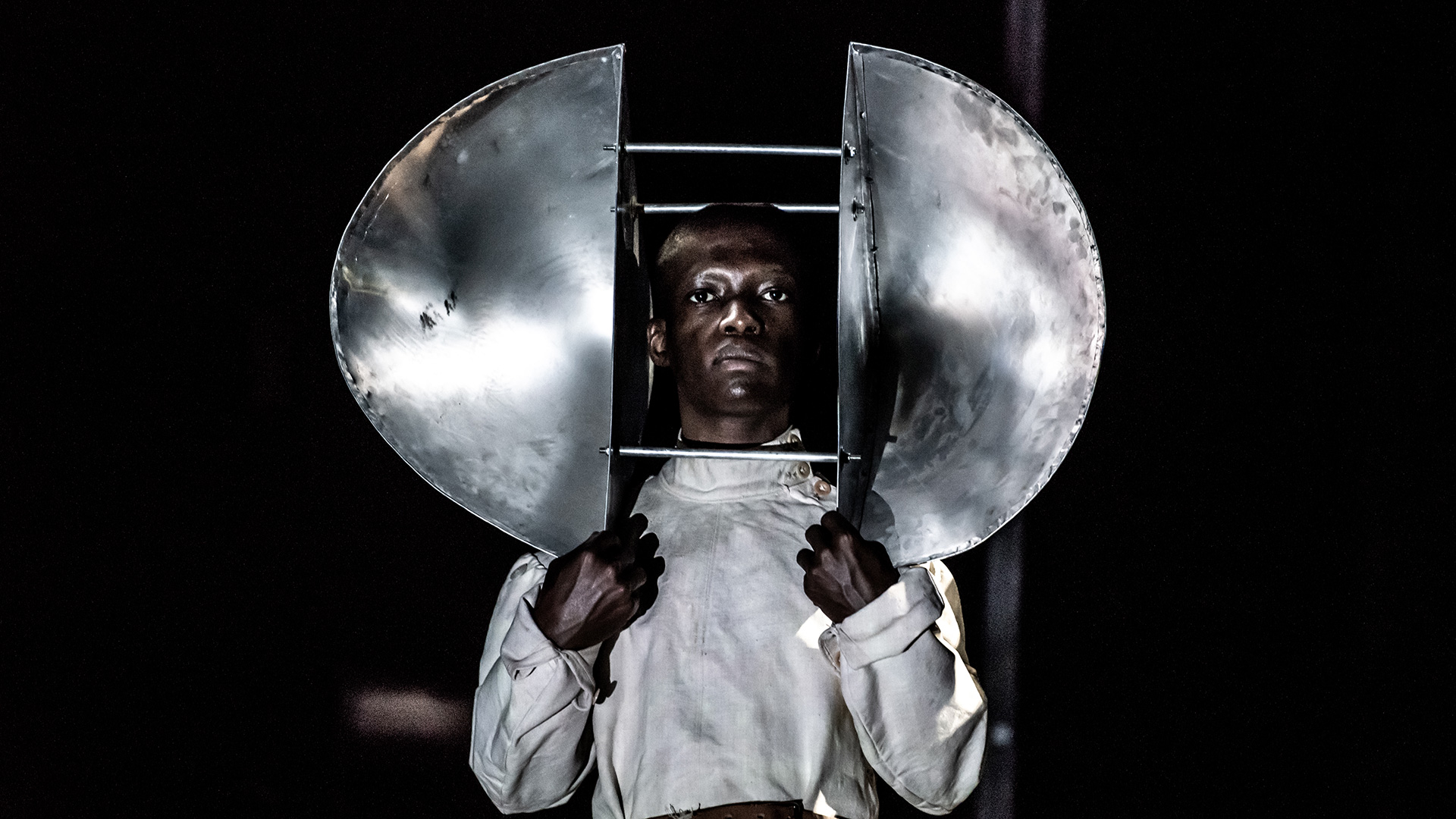
William Kentridge’s THE HEAD & THE LOAD. Pictured: Sipho Seroto. Photo by Stella Olivier.
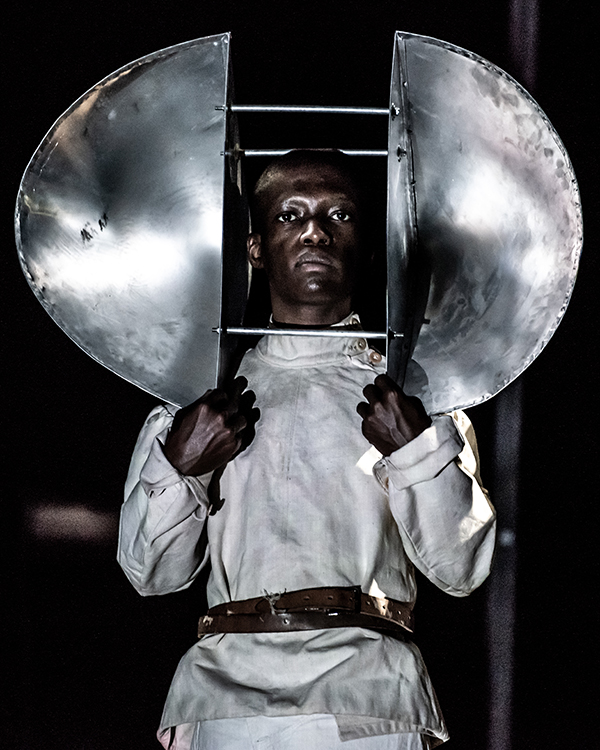
William Kentridge’s THE HEAD & THE LOAD. Pictured: Sipho Seroto. Photo by Stella Olivier.
A Five-Year Conversation
Cal Performances’ five-year Kentridge initiative grows out of this kind of cumulative encounter. Some artists intersect with a presenter once. Others return often enough that audiences develop a deeper sense of their language over time. Geffen compares the value of such repeated encounters to Cal Performances’ long relationships with artists and ensembles such as Jordi Savall, Mark Morris, the Alvin Ailey American Dance Theater, and the Takács Quartet. The point is not simply frequency. It is cumulative understanding. Each encounter changes the next.
Kentridge’s recent stage works reward that kind of repeated encounter. Sibyl, The Great Yes, The Great No, and The Head & the Load differ sharply in subject and form; not all are anchored in a specific historical period in the same way. But together they address issues Kentridge keeps circling: what is remembered and what is forgotten—which he calls “productive amnesia”—the absurdities of reason, and how historical fragments can be assembled onstage without pretending to become a finished, authoritative story.
Kentridge says these historically grounded works often start not from knowledge but from “a frustration at my own ignorance”—even the shame of realizing how little he knows about histories he assumed he understood. Each project becomes a discovery for him and for his team. The projects, he says, are not a matter of arriving with knowledge to hand down as a history lesson. They invite audiences instead to join “a series of riddles we didn’t even know about,” a “strange exploration” without a definitive conclusion.
The urgency of The Head & the Load extends well beyond the historical period it addresses. It is not only about a neglected chapter of the First World War. It is about the mechanisms by which histories become inaudible, invisible, or archived into lifelessness. It asks what bodies remember when documents fail, what music can imagine when recordings do not exist, and what theater can do with fragments that refuse to become whole.
Near the end of his response from Johannesburg, Kentridge described an ongoing preoccupation: “picking up a trace of an event and following that trace through to find a heart, a still-beating heart.” That is what The Head & the Load—a vast theatrical reckoning, indeed—attempts. It takes traces—a sentence from a letter, a proverb, a photograph, a list of instruments, a colonial phrase book, a porter’s burden—and follows them until they begin to beat again onstage.