
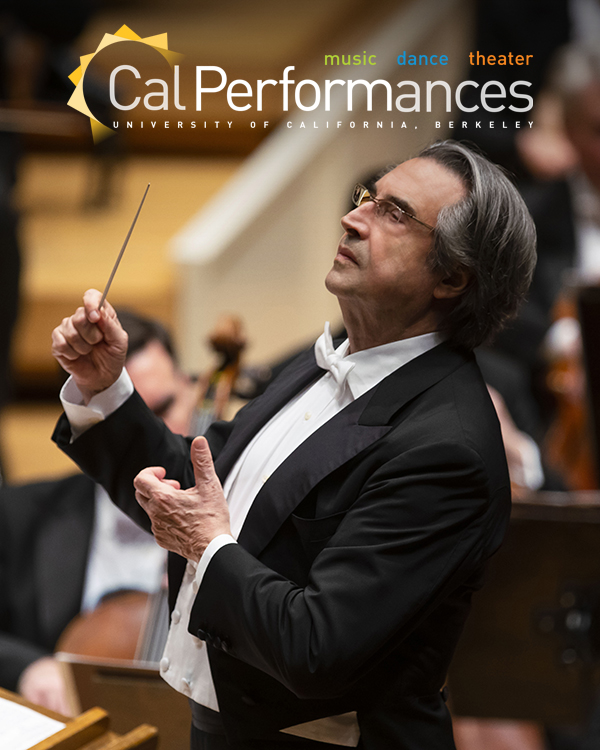
MARIA MANETTI SHREM GREAT ARTIST PERFORMANCE
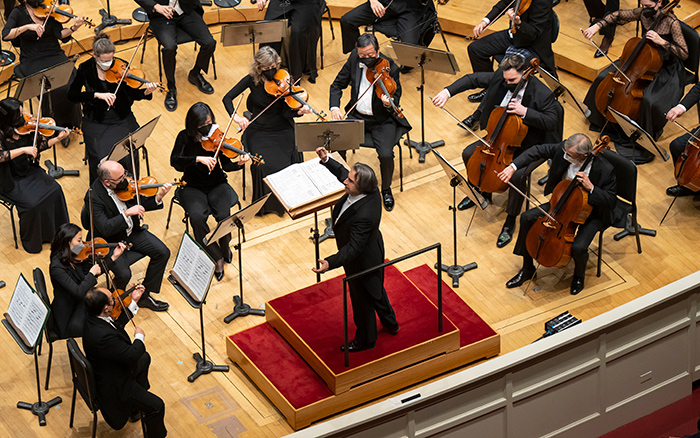
Chicago Symphony Orchestra
Riccardo Muti, conductor
Saturday, January 17, 2026, 8pm
Zellerbach Hall
This performance by the Chicago Symphony Orchestra is a Maria Manetti Shrem Great Artist Performance.
Leadership support for this performance is provided by Jerome and Thao Dodson and by The Dr. M. Lee Pearce Foundation, Inc.
Major support for this performance is provided by Diana Cohen & Bill Falik and Greg Lutz.
The Chicago Symphony Orchestra’s US tour is generously sponsored by Zell Family Foundation.
Cal Performances is committed to fostering a welcoming, inclusive, and safe environment for all one that honors our venues as places of respite, openness, and respect. Please see the Community Agreements section on our Policies page for more information.
JOHANNES BRAHMS
Symphony No. 4 in E Minor, Op. 98
Brahms’ Fourth Symphony is his final statement in a form he had completely mastered, although for a very long time he was paralyzed by the nine examples by Beethoven. It’s difficult to imagine what Beethoven or Brahms might have done next, since their last symphonies seem to sum up all either knew of orchestral writing. The difference is that Beethoven’s choral symphony opened up a vast new world for the rest of the 19th century to explore, while Brahms reached something of a dead end. But what a glorious ending it is. Brahms was never one to forge new paths—like Bach and Handel, he added little to the historical development of music—and yet he always seemed to prove that there was more to be said in the language at hand.
Brahms’ Fourth Symphony begins almost in mid-thought, with urgent, sighing violins coming out of nowhere; it often disorients first-time listeners. (Brahms meant it to: he originally wrote two preparatory bars of wind chords and later crossed them out, letting the theme catch us by surprise.) The violins skip across the scale by thirds—falling thirds and their mirror image, rising sixths—a shorthand way of telling us that the interval of a third pervades the harmonic language of the entire symphony. (It also determines key relationships: the third movement, for example, is in C major, a third below the symphony’s E minor key.)
Brahms has a wonderful time playing with the conventions of sonata form in the first movement. He seems to make the classical repeat of the exposition, but, only eight measures in, alters one chord and immediately plunges into the new harmonic fields of the development section. Listen for the great point of recognition—at ppp, the quietest moment in the symphony—with which Brahms marks the recapitulation. For 12 measures, the music falters like an awkward conversation, the winds suggesting the first theme, the violins not seeming to understand. Suddenly they catch on and, picking up the theme where the winds left off, sweep into a full recapitulation capped by a powerful coda.
In the Andante moderato, Brahms takes the little horn call of the first measure and tosses it throughout the orchestra, subtly altering its color, rhythm, and character as he proceeds. A forceful fanfare in the winds introduces a juicy new cello theme. (It turns out to be nothing more than the fanfare played slowly.) Near the end, shadows cross the music. The horns boldly play their theme again, but the accompaniment suggests that darkness has descended for good.
The lightning flash of the Allegro giocoso proves otherwise. This is music of enormous energy, lightened by an unabashed comic streak—unexpected from Brahms, normally the most sober of composers. Here he indulges in the repeated tinklings of the triangle, and he later boasted that “three kettledrums, triangle, and piccolo will, of course, make something of a show.” Midway through, when the first theme’s thundering left foot is answered by the puny voice of the high winds, the effect is as funny as anything in Haydn.
Throughout his life, Brahms collected old scores and manuscripts to study their pages to see what history might teach him. More than once, he spoke of wanting to write a set of variations on a theme he remembered from a cantata by Bach. But no one before Brahms had seriously thought of writing a strict passacaglia—a continuous set of variations over a repeated bass line—to wrap up a symphony.
The finale to Brahms’ Fourth Symphony isn’t a musty, academic exercise, but a brilliant summation of all Brahms knew about symphonic writing set over 32 repetitions of the same eight notes. Trombones make their entrance in the symphony to announce the theme, loosely borrowed from Bach’s Cantata No. 150, Nach dir, Herr, verlanget mich (I Long for You, O Lord) [the cantata is no longer thought to be by Bach]. To bring the ancient passacaglia form into the 19th century, Brahms superimposes over his variations the general outline of sonata form, with an unmistakable moment of recapitulation midway through.
A look at the finale in its entirety reveals the sturdy four-movement structure of the classical symphony: Brahms begins with eight bold and forceful variations, followed by four slow variations of yearning and quiet eloquence, an increasingly hectic dancelike sequence, and an urgent and dramatic final group that provides a triumphant conclusion.
One can follow Brahms’ eight-note theme from the shining summit of the flute line, where it first appears over rich trombone harmonies, to the depths of the double bass, where it descends as early as the fourth variation, supporting a luscious new violin melody. Even in the twelfth variation, where the theme steps aside so the focus is on the poignant, solemn song of the flute, the spirit of those eight notes is still with us. And as Arnold Schoenberg loved to point out, the skeleton of the main theme from the first movement also appears in the penultimate variation, like the ghostly statue in Mozart’s Don Giovanni. The finale is as magnificent and as satisfying as any movement in symphonic music; it’s easy to assume that, having written this, Brahms had nothing left to say. We’ll never know whether that was so, or if, in the end, he simply ran out of time.
IGOR STRAVINSKY
Divertimento, Suite from The Fairy’s Kiss
Igor Stravinsky had known and loved Tchaikovsky’s music from childhood—certainly ever since he was taken to The Sleeping Beauty for the first time at the age of seven or eight. Some 30 years later, acting on a suggestion from Diaghilev, Stravinsky even orchestrated two passages from The Sleeping Beauty that Tchaikovsky had cut before the first performance. Stravinsky’s next work, the opera Mavra, was dedicated to “the memory of Tchaikovsky, Glinka, and Pushkin,” and prompted by Diaghilev’s Sleeping Beauty revival. And so, in 1928, when Stravinsky was asked to compose a ballet inspired by Tchaikovsky’s music for Ida Rubinstein’s new company, Stravinsky jumped at the challenge. The ballet was to be produced in November 1928, on the thirty-fifth anniversary of Tchaikovsky’s death.
For his subject, Stravinsky turned to Hans Christian Andersen, whose powerful and fantastic tales had been part of Stravinsky’s childhood, along with Tchaikovsky’s music. He picked Andersen’s “The Ice Maiden,” apparently finding in Tchaikovsky’s creative life (branded by the Muse’s kiss) a parallel with the tale of a boy who is doomed by the kiss of the Ice Maiden. The ballet was described as an allegory.
Having already breathed new life into music by Pergolesi in Pulcinella, here Stravinsky decided to use music by Tchaikovsky, limiting himself only to works not written for orchestra. But where Pulcinella fashioned something purely Stravinskian out of old music he held in no particular regard, The Fairy’s Kiss is a loving homage to his favorite Russian composer. Later, Stravinsky claimed he could no longer remember “which music is Tchaikovsky’s and which mine,” but at various times he identified (not always accurately) a number of Tchaikovsky’s songs and piano pieces that he had borrowed. (Lawrence Morton eventually narrowed the debt list to some 14 works.)
Stravinsky set to work with untiring enthusiasm. He rented a room in a mason’s cottage where he could work undisturbed. The music was barely completed in time for the premiere, which the composer conducted, on November 27, 1928; Stravinsky wasn’t
entirely pleased with Bronislava Nijinska’s choreography (the public evidently shared his view), but he had been too busy finishing the music to check out the dancing.
The music is prime Stravinsky, largely based on lesser Tchaikovsky. Only two Tchaikovsky works are used complete; the rest are excerpts. Most are taken from little-known songs and piano miniatures. Stravinsky’s handling of borrowed material runs the gamut: he merely assigns instruments to the notes of Tchaikovsky’s popular humoresque for piano, but much of the original music is so totally transformed that it’s easy to understand Stravinsky’s not remembering which music was whose.
As early as 1931, Stravinsky approved playing excerpts from the 45-minute ballet score as a concert-hall suite. In 1945, he finally settled on his own suite, which he called the Divertimento, cutting out nearly half of the music but including substantial chunks from the first three of the ballet’s four scenes.
In 1962, Stravinsky returned to Russia after nearly 50 years. The Stravinskys, along with Robert Craft, arrived in Moscow on September 21. On October 4, they flew to Leningrad, where Stravinsky was met by Vladimir Rimsky-Korsakov (the youngest son of the composer), who was then living in the apartment where Stravinsky had written The Firebird more than half a century before. On October 8, Stravinsky conducted a concert of his own music. Before the performance, Stravinsky addressed the crowd, saying that he had attended his first concert in this hall: “Sixty-nine years ago, I sat with my mother in that corner,” he said, pointing, “at a concert conducted by Nápravník to mourn the death of Tchaikovsky.” He then conducted music from The Fairy’s Kiss.
MAURICE RAVEL
Boléro
One of the most famous pieces ever written, Boléro began as an experiment in orchestration, dynamics, and pacing. Ravel was quick to tire of his exercise—he once said that, although people thought it his only masterpiece, “Alas, it contains no music.” But he didn’t object to being famous. Late in 1927, Ravel accepted a commission from Ida Rubinstein and her ballet company to orchestrate six piano pieces from Albéniz’s Ibéria as a sequel to his brilliant scoring of Mussorgsky’s Pictures from an Exhibition. But when Ravel returned from his whirlwind concert tour of America and encountered problems with the exclusive rights to Ibéria, he dropped the project and instead chanced upon a tune with “a certain insistent quality” that became Boléro. “I’m going to try and repeat it a number of times without any development, gradually increasing the orchestra as best I can,” he remarked at the time, and that’s precisely what he did.
Boléro was an immediate success as a ballet, but its real hey-day started after Rubinstein’s exclusive rights ran out, and the first concert performances began. Ravel was embarrassed by its popularity:
I am particularly anxious that there should be no misunderstanding as to my Boléro. It is an experiment in a very special and limited direction, and it should not be suspected of aiming at achieving anything different from, or anything more than, it actually does achieve. Before the first performance, I issued a warning to the effect that what I had written was a piece lasting 17 minutes and consisting wholly of orchestral texture without music—of one long, very gradual crescendo. There are no contrasts, and there is practically no invention except in the plan and the manner of the execution.
One can imagine Ravel’s dismay when he realized that this was the music that would carry his name around the world. But, while Boléro is by no means his most accomplished or sophisticated work, it is, like every single piece in the Ravel canon, impeccably detailed and polished music. (In 40 years, Ravel only wrote about 60 works, nearly all of which belong in the standard repertoire—an almost unparalleled achievement.) The first tune, stated by the flute, is as familiar as any melody in music, yet how many of us could accurately sing it from memory, precisely following its unpredictable, sinuous curves and recalling the ever-fresh sequence of long and short notes. Certainly the second tune, a free and supple melody introduced by the high bassoon, has an elusive, almost improvisatory quality.
Ravel proceeds with his exercise, stating the first tune twice, then the second one twice, and so on back and forth, each time adding new instruments not just to effect a gradual crescendo, but to create an astonishing range of orchestral colors. Just before the end, Ravel’s patience suddenly wears out, and he makes a sudden swerve from a steady diet of C major into E major, upsetting the entire structure and toppling his cards with the sweep of a hand.
—Phillip Huscher
Phillip Huscher is the program annotator for the Chicago Symphony Orchestra.
About the Artists


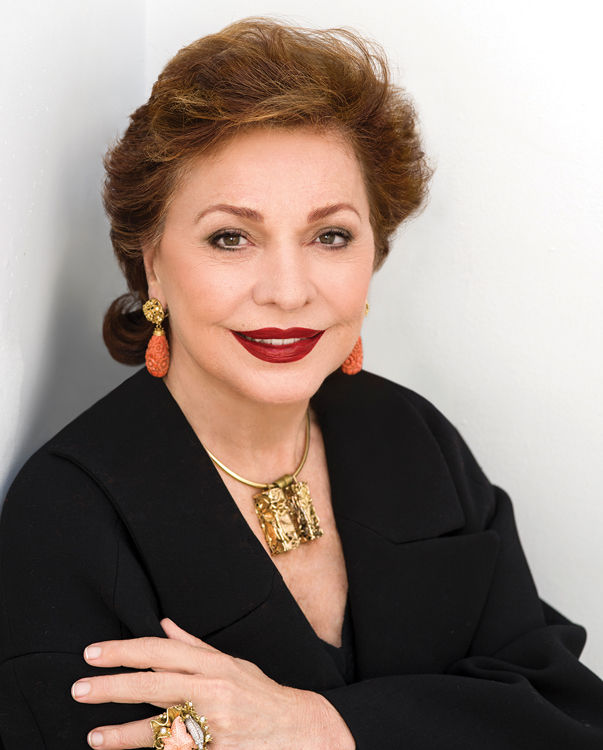 Born in Florence, Italy, Maria Manetti Shrem relocated to San Francisco, California, in 1972, where she played a pivotal role in the internationalization of iconic fashion brands such as Gucci and Fendi.
Together with her husband, Jan Shrem, Maria has supported over 60 charitable programs across the US, Italy, France, Mexico, Africa, and the UK, contributing to more than 45 foundations. Their philanthropy spans education, music, art, and medicine, creating meaningful social impact worldwide.
In the US, the Manetti Shrems have supported institutions such as the Metropolitan Opera in New York City, UC Davis, the San Francisco Opera, Festival Napa Valley, UC Berkeley–Cal Performances, KQED, Francisco Park, the San Francisco Symphony, SF Film, SF MoMA, ArtSmart, KDFC, and hospitals like UCSF and Sutter Health–CPMC.
In Europe, Maria has been a principal benefactor for organizations including the King’s Foundation, the Royal Drawing School, Palazzo Strozzi Foundation, Teatro del Maggio Musicale Fiorentino, Friends of the Louvre, Friends of Versailles, the Venetian Heritage, the Italian National Trust, Museo 900, and the Andrea Bocelli Foundation, with which she helped construct four new schools, including one at the Meyer Children’s Hospital.
Additionally, the Manetti Shrems are founders and lifetime members of the Cabo Jewish Center. Maria also funded a scholarship in Africa through the Global Sojourns Giving Circle, empowering the next generation of women leaders.
Maria and Jan co-founded the Jan Shrem and Maria Manetti Shrem Museum of Art at UC Davis, which opened in 2016, fulfilling a 60-year legacy in the arts. The museum’s collection features celebrated California artists such as Wayne Thiebaud, William T. Wiley, Robert Arneson, Roy De Forest, and Manuel Neri. Its architectural design has been recognized by ARTnews as “One of the World’s 25 Best Museum Buildings of the Past 100 Years.”
Maria has been honored as a cultural ambassador and philanthropist. In 2019, Italian President Sergio Mattarella awarded her the Grand Officer of the Order of the Star of Italy. In 2022, the Mayor of Florence presented her with the Keys of the City for her exemplary patronage, following in the spirit of the Medici legacy. The City and County of San Francisco also declared June 22 as “Manetti Shrem Day for Philanthropy.”
Maria’s accolades include the inaugural Angels of the Arts Award from Festival Napa Valley, The Spirit of the Opera Award from San Francisco Opera, and the lighting of San Francisco City Hall in the Italian flag colors during “Maria—50 Years in America,” a celebration of her legacy. She also received the 2023 UC Davis Medal, the highest honor from the University of California system, in recognition of her extraordinary contributions to the arts. In 2024, UC Berkeley recognized Maria and Jan as “Builders of Berkeley.”
In Spring 2024, Maria made history by endowing the College of Letters and Science at UC Davis with its largest gift ever, establishing eight endowments to protect the arts and humanities in perpetuity. Her visionary donation integrates arts, humanities, science, and technology, creating a Renaissance Zeitgeist through the establishment of a dedicated Art District, inaugurated in January 2025. In recognition of her global philanthropy, Maria received the 2024 Premio StellaRe from Fondazione Sandretto Re Rebaudengo in Torino, Italy. She was honored with the 2025 Ellis Island Medal. SF Opera Guild celebrated her as person of the year 2025 with An Evening on the Stage.
Maria Manetti Shrem continues to lead with vision and generosity, shaping cultural landscape and enriching lives across the globe.
Our programming this month begins on a truly auspicious note as we welcome the return of revered maestro Riccardo Muti and his legendary Chicago Symphony Orchestra for a program of orchestral gems by Brahms, Ravel, and Stravinsky (Jan 17, Zellerbach Hall [ZH]; a Maria Manetti Shrem Great Artist Performance). Muti stepped down as the esteemed ensemble’s music director in 2023 to assume the role of Music Director Emeritus for Life, but his close rapport with this group of remarkable musicians continues to enchant.
In other classical music presentations this month, we’ll enjoy the Cal Performances debut of American mezzo-soprano Samantha Hankey as she and pianist Myra Huang offer an inviting program that combines Robert Schumann’s much-loved song cycle Dichterliebe with cabaret songs, lieder, and popular favorites (Jan 18, Hertz Hall [HH]). And one week later, on January 25 (HH), we’ll see the beloved Takács Quartet in its first of two programs this season, this one featuring the brilliant Jamaican American violist Jordan Bak (another Cal Performances debut) in a rare performance of Mozart’s revelatory viola quintets in C major (K. 515) and G minor (K. 516).
In dance, the sensational Mark Morris Dance Group returns for its annual visit to campus, this time with the West Coast premiere of Morris’ brilliant new MOON, a multimedia feast danced before a backdrop featuring video, animation, and photographs of our constant celestial companion (Jan 23–25, ZH). And to close out January, we are thrilled to present the marquee Broadway star, opera diva, and acclaimed television actor Kelli O’Hara (Jan 31, ZH), singing favorite show tunes and classics from the Great American Songbook (our third Cal Performances debut this month).
In the coming months, our season will continue with a wide range of talent including vocalists Renée Fleming and Joyce DiDonato; the virtuoso JACK Quartet; early-music superstars The English Concert, Jordi Savall, and The Tallis Scholars; jazz greats Cécile McLorin Salvant and Somi; and appearances by Silkroad Ensemble with Rhiannon Giddens.
And our acclaimed dance series continues, distinguished by genre-defining artists and major new productions including the Martha Graham Dance Company celebrating its centennial; The Joffrey Ballet in a bold new work set during Midsommar, the traditional Scandinavian summer solstice festival; the long-awaited Cal Performances debut of A.I.M by Kyle Abraham; and, of course, a return April engagement with the Alvin Ailey American Dance Theater.
As you explore the calendar, I recommend you pay particular attention to our Illuminations theme of “Exile & Sanctuary,” focusing this season on how issues of displacement can inform bold new explorations of identity and community; and how artistic expression can offer safe harbor during times of unrest or upheaval.
The opportunity to engage with diverse artistic perspectives and share the transformative power of the live performing arts is one of life’s greatest pleasures, and I look forward to encountering these profound and entertaining experiences with you in the months ahead.
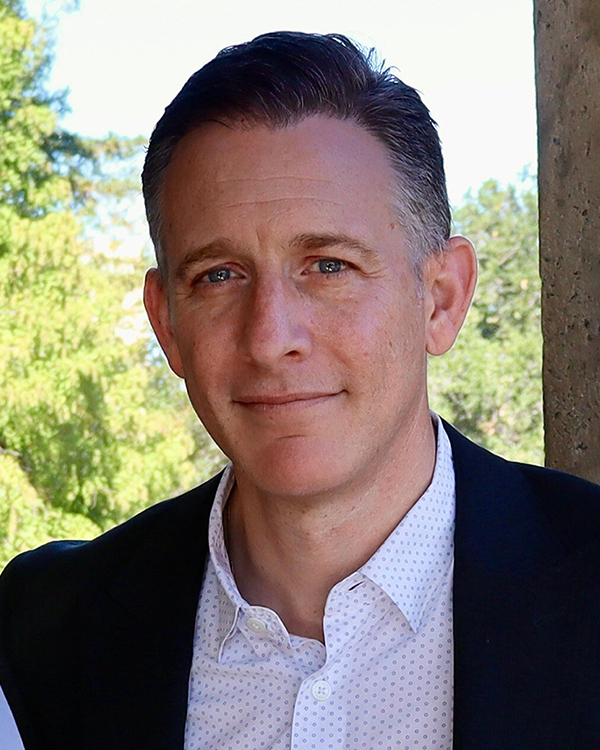
Jeremy Geffen
Executive and Artistic Director, Cal Performances