
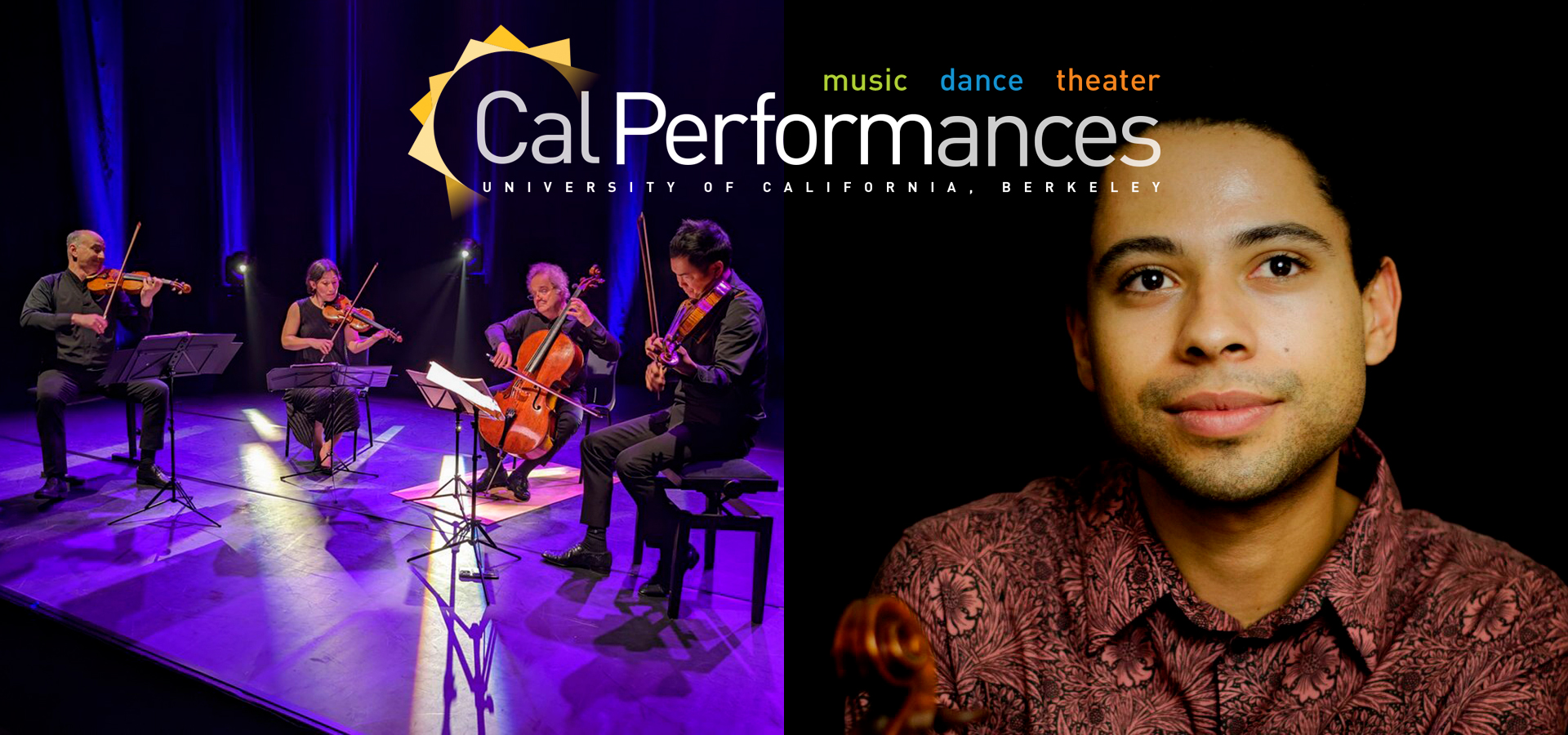
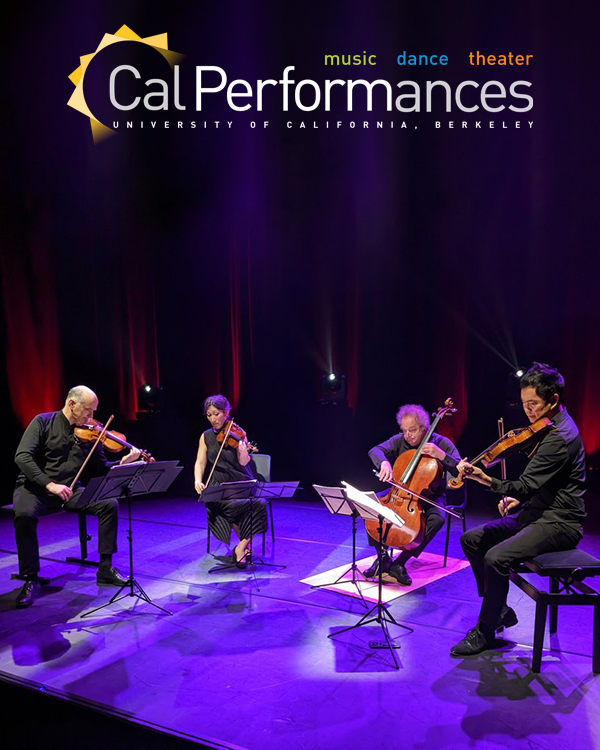
Takács Quartet with Jordan Bak, viola
Sunday, January 25, 2026, 3pm
Hertz Hall
The Takács Quartet appears by arrangement with Seldy Cramer Artists, and records for Hyperion and Decca/London Records.
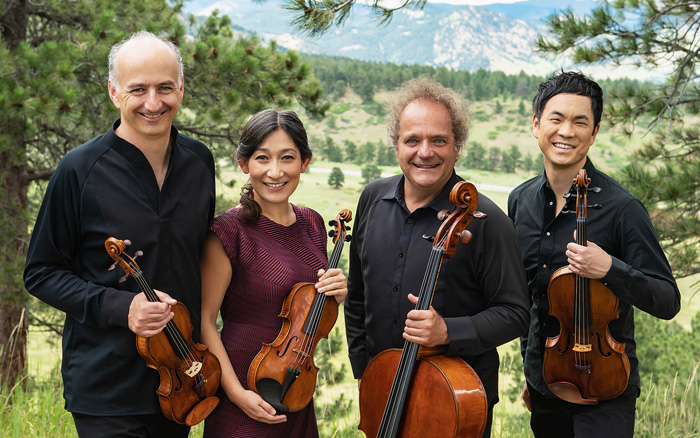
The Takács Quartet is Quartet-in-Residence at the University of Colorado in Boulder; the members are Associate Artists at Wigmore Hall, London. www.takacsquartet.com
Jordan Bak is represented by Arts Management Group, Inc.
Leadership support for this performance is provided by Nadine Tang.
Additional support is provided by the E. Nakamichi Foundation.
Cal Performances is committed to fostering a welcoming, inclusive, and safe environment for all one that honors our venues as places of respite, openness, and respect. Please see the Community Agreements section on our Policies page for more information.
Franz Schubert
Quartettsatz, D. 703
If Mozart’s death at age 35 was a terrible loss for music, the close of Franz Schubert’s life at 31 may have been a still greater tragedy. At least Mozart had been able to work in the full maturity of his powers for a decade and a half, leaving behind a rich, artistically complete legacy. At his premature demise, Schubert was surging ahead, constantly experimenting with the technical and emotional content of his music, reshaping the Classical tradition into a powerfully individualistic expression that fused it with the new Romanticism. Where his music would have gone if he had lived longer is one of music’s most tantalizing “what-ifs.”
In listening to the Allegro assai movement known as the Quartettsatz—the first movement of a projected string quartet in C minor—we feel this frustration especially intensely. Even the similar situation of the Schubert’s Unfinished Symphony is less disturbing because that work’s two completed movements seem to form a harmonious whole. But the Quartettsatz ushers us into an extraordinary new world —musically advanced and psychologically tormented—where neither Schubert nor any of his predecessors had ventured. Enthralled, we enter only to find the road stops after less than 10 minutes. Schubert scholar Brian Newbould calls it “the first work in which Schubert reached full maturity as an instrumental composer.”
Death did not rob us of the rest of this quartet, just as it didn’t end the Unfinished: the composer still had almost eight years more to live when he wrote this movement in December 1820. At age 23, he was experiencing a turbulent period of artistic growth. So strong did his creative flame burn that he often left off one work to begin another. Frequently, he returned to complete the first work, but in this case, for reasons we’ll never know, he did not. However, he did compose 40 measures of a second movement, described by Alfred Einstein as “an indescribably rich and tragic Andante.”
When he was in the mood, Schubert could be the most lovable and gemütlich of composers. But he also had a dark, demonic side, and that is what animates the Quartettsatz. Its opening is startling. Out of silence emerges an eerie, barely audible tremolo figure in the first violin, which quickly crescendos to a savage fortissimo as, one by one, the other instruments join in. Chromatically twisting, this deeply disturbing idea bedevils the entire movement. Less than a minute later, the key of C minor shifts to the unexpected key of A-flat major, and the first violin launches a yearning second theme—pure Schubertian melody at its most touching. But the buzzing tremolo soon routs it. Eventually, another lyrical melody in G major emerges in the first violin; chromatically twisting like the tremolo figure but very soft and ethereal (especially in its high-register repeat), it is one of Schubert’s most haunting inspirations. After repeating this exposition section, the composer then merges development and recapitulation into one seamless whole. At the end, he reprises the buzzing C-minor crescendo that opened the work, then cuts it off with three savage chords.
Wolfgang Amadeus Mozart
Viola Quintet in C major, K. 515
Viola Quintet in G minor, K. 516
Like Haydn and Beethoven, Mozart was a master of that quintessential chamber ensemble the string quartet, as his six superb “Haydn” quartets show. But it was in the more unusual string quintet ensemble of two violins, two violas, and cello that he created what many consider to be his greatest chamber works. He wrote six in all, of which four—including the two we will hear this afternoon—rank among his most outstanding masterpieces.
There were many reasons why Mozart may have been attracted to this larger ensemble. Though as a youth he had been a talented violinist, by adulthood he preferred to play the viola, where he could luxuriate in the warm center of his harmonies. He seems to have loved this instrument’s dusky, complex sound, for he featured it as soloist along with a violin in his wonderful Sinfonia Concertante, K. 364. And in his orchestral and chamber writing, he generally lavished much attention on his interior parts, which included the viola. The five voices of a quintet gave him a richer sound as well as many more instrumental combinations to exploit.
In 1773, Michael Haydn—younger brother of the great Joseph—wrote three quintets using two violas. These were clearly Mozart’s initial inspiration because in that same year, at age 17, he created his First String Quintet, K. 174 in the informal divertimento style.
By the time Mozart returned to the string quintet genre in the spring of 1787, he was at the height of his powers and now saw the string quintet as an expansion of the string quartet—able to carry the profound expressive and formal ideas associated with the quartet medium. Within six weeks, he composed a pair of mighty yet contrasting quintets: one in C major (K. 515) and another in G minor (K. 516). They bear an uncanny relationship to the two equally mighty symphonies he wrote in the same brief time period about a year later: his Symphony No. 40 in G minor and Symphony No. 41 in C major, Jupiter, using the same combination of keys. The Quintet in C major is the longest of all Mozart’s chamber works for strings.
In keeping with this breadth of expression, the first movement is a sonata form of unusually generous proportions that looks ahead to the practices of Beethoven. As we find so often in Beethoven’s works, the principal theme is more of a spare, yet pregnant motive than the kind of full-blown singing melody we would expect from Mozart. Over pulsing inner parts, the cello creeps upward over two octaves outlining the notes of the C-major triad, to which the first violin gives a pleading response. This bare-bones idea will prove to be ideal material for development and harmonic exploration. Indeed, the exploration begins almost immediately: after a sudden pause, the upward creep resumes but now in the key of C minor and with the roles of the cello and violin reversed. Mozart spends an exceptional amount of time with his principal theme before moving on to two more: an understated swirling idea led by first violin and, more significantly, a rocking closing theme elaborated in wonderful counterpoint between all five instruments.
The development section—built around the creeping first theme and the rocking closing theme—is one of Mozart’s richest in terms of harmonic interest and craftsmanship. And, as is often the case with this composer, the development process doesn’t stop there, but continues throughout the recapitulation and even into a marvelous coda based on the rocking theme.
The second movement is a wonderfully strange and enigmatic minuet, very distant from its strongly rhythmic court-dance origins. By beginning his phrases on the upbeat, Mozart even obscures the familiar 3/4 beat, and the irregular phrase lengths thwart rhythmic clarity still more. In this dance, the middle or trio section—far longer in proportion to the minuet than was customary is the most important element. Mozart shades his melodies and harmonies here with dramatic chromaticism, most notably in an arresting motive that rocks upward and downward by plaintive half steps.
During 1787, Mozart’s creativity was also focused on opera, producing his monumental tragi-comedy Don Giovanni. Thus, it is not surprising that in the sublime Andante third movement we hear the instruments treated like singers of what sounds like an impassioned love duet between a soprano first violin and a tenor first viola. Here the serenely beautiful opening melody of the two violins is interrupted by pleading phrases from the first viola—colored by sighing appoggiatura dissonances—that imitate operatic recitative. Gradually this solidifies into a duet between first violin and first viola in which both adopt those yearning appoggiaturas. The other three instruments provide subtle, sympathetic support. Near the end, the two instruments’ rapture climaxes in an ecstatically soaring phrase initiated by the viola.
The quintet closes with a spacious, eventful finale in sonata rondo form, in which a blithely innocent refrain theme becomes the basis for extensive developments. Mozart uses all the members of his enlarged ensemble to create superb counterpoint throughout.
Viola Quintet in G Minor, K. 516
The beginning of 1787 was one of the most difficult periods in Mozart’s life. His search to find a wealthy noble sponsor had not succeeded, and his challenging music had made him less popular with the Viennese public, thus receiving fewer performances. His financial difficulties forced him to move to a smaller and less expensive apartment outside the center of Vienna. On top of this, his father, Leo, against whom he’d often rebelled but still deeply loved, was seriously ill and in fact died just after Mozart finished the Quintet in G minor. That the usually ebullient composer was now sunk in depression and grief is attested to by his choice of the key, one always associated in his mind with oppression and tragedy. In his masterful recent biography of Mozart, Jan Swafford comments that this quintet is “in some ways the most tragic piece Mozart ever wrote.” It is also generally ranked as one of his greatest creations in any genre.
In Swafford’s description, the first movement “begins with simmering anxiety in the top three voices, no [cello] bass line as a foundation in the low register, and uneasily shifting harmonies. The opening theme will persist throughout the movement like an obsession.” Usually, Mozart would modulate to the major for his second theme, but here he stays firmly in G minor for a first-violin theme that leaps yearningly upward, but cannot reach its goal. Using both subjects, the development section is rather brief because development will continue throughout the recapitulation section. A closing coda “presents the leading themes jammed together like a surge of pain and its atmosphere” (Swafford).
Still in G minor, the second movement is a minuet no one could dance to. One can hardly discern the ¾ beat, and Mozart keeps adding violent chords on the third beat that sound like a cry of protest. Finally moving to. G major, the Trio section is more lyrical but hardly consoling. Filled with chromatic shifts, it still sounds melancholy and dragging.
In E-flat major, the Adagio ma non troppo slow movement, despite its major key is music of grief. Expressing choked emotions, all the instruments are muted throughout this beautiful, introspective movement. The melodic line is broken off by little sighing motives, such as we heard in the first movement. A second theme of long descending scales in the first violin is intensified by an agitated accompaniment.
Haydn often wrote slow introductions to his finales, but Mozart rarely did. However, here he clings to the G-minor mood with another Adagio, even slower than that of the third movement. Nevertheless, Mozart typically reverted to his bright, optimistic nature, and after another few minutes of mourning, he finally embraces G major with a bright-spirited rondo in dancing 6/8 meter and an Allegro tempo that points hopefully to the future.
—Janet E. Bedell © 2026
Janet E. Bedell is a program annotator and feature writer who writes for Carnegie Hall, the Metropolitan Opera, Los Angeles Opera, Caramoor Festival of the Arts, and other musical organizations.
About the Artists


The Takács Quartet recently announced the impending retirement of cellist András Fejér, the last remaining member of the original Takács Quartet (founded in 1975). Fejér will step down at the end of the 2025–26 season, after a remarkable 51-year tenure. The ensemble’s newest member, cellist Mihai Marica, will join the Takács as of September 1, 2026.
The quartet’s two performances at Cal Performances this season (January 25 and February 22) mark Fejér’s final Berkeley appearances as a member of the ensemble.
Cal Performances salutes András Fejér on the accomplishments of his long and remarkable career. We join his many Bay Area friends and admirers in congratulating him on the occasion of his retirement, and extend all good wishes as he turns the page and begins this new chapter.
Our programming this month begins on a truly auspicious note as we welcome the return of revered maestro Riccardo Muti and his legendary Chicago Symphony Orchestra for a program of orchestral gems by Brahms, Ravel, and Stravinsky (Jan 17, Zellerbach Hall [ZH]; a Maria Manetti Shrem Great Artist Performance). Muti stepped down as the esteemed ensemble’s music director in 2023 to assume the role of Music Director Emeritus for Life, but his close rapport with this group of remarkable musicians continues to enchant.
In other classical music presentations this month, we’ll enjoy the Cal Performances debut of American mezzo-soprano Samantha Hankey as she and pianist Myra Huang offer an inviting program that combines Robert Schumann’s much-loved song cycle Dichterliebe with cabaret songs, lieder, and popular favorites (Jan 18, Hertz Hall [HH]). And one week later, on January 25 (HH), we’ll see the beloved Takács Quartet in its first of two programs this season, this one featuring the brilliant Jamaican American violist Jordan Bak (another Cal Performances debut) in a rare performance of Mozart’s revelatory viola quintets in C major (K. 515) and G minor (K. 516).
In dance, the sensational Mark Morris Dance Group returns for its annual visit to campus, this time with the West Coast premiere of Morris’ brilliant new MOON, a multimedia feast danced before a backdrop featuring video, animation, and photographs of our constant celestial companion (Jan 23–25, ZH). And to close out January, we are thrilled to present the marquee Broadway star, opera diva, and acclaimed television actor Kelli O’Hara (Jan 31, ZH), singing favorite show tunes and classics from the Great American Songbook (our third Cal Performances debut this month).
In the coming months, our season will continue with a wide range of talent including vocalists Renée Fleming and Joyce DiDonato; the virtuoso JACK Quartet; early-music superstars The English Concert, Jordi Savall, and The Tallis Scholars; jazz greats Cécile McLorin Salvant and Somi; and appearances by Silkroad Ensemble with Rhiannon Giddens.
And our acclaimed dance series continues, distinguished by genre-defining artists and major new productions including the Martha Graham Dance Company celebrating its centennial; The Joffrey Ballet in a bold new work set during Midsommar, the traditional Scandinavian summer solstice festival; the long-awaited Cal Performances debut of A.I.M by Kyle Abraham; and, of course, a return April engagement with the Alvin Ailey American Dance Theater.
As you explore the calendar, I recommend you pay particular attention to our Illuminations theme of “Exile & Sanctuary,” focusing this season on how issues of displacement can inform bold new explorations of identity and community; and how artistic expression can offer safe harbor during times of unrest or upheaval.
The opportunity to engage with diverse artistic perspectives and share the transformative power of the live performing arts is one of life’s greatest pleasures, and I look forward to encountering these profound and entertaining experiences with you in the months ahead.

Jeremy Geffen
Executive and Artistic Director, Cal Performances