

Carols of Birds, Bells, and Peace from Ukraine:
A Holiday Celebration
Saturday, December 13, 2025, 2pm
Zellerbach Hall
Ensemble Cherubim Chamber Chorus
Marika Kuzma, director
with
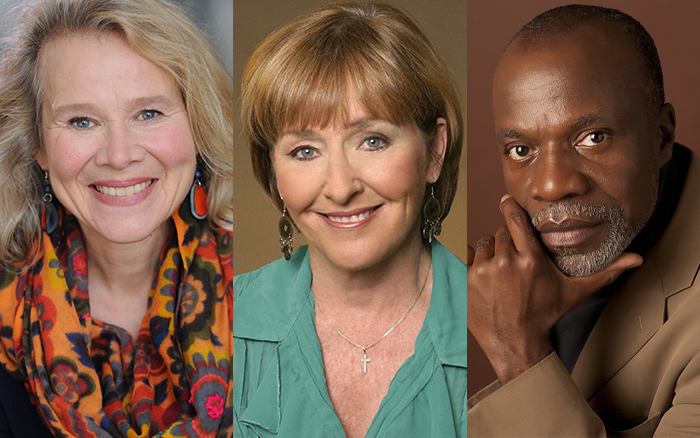
Frederica von Stade, mezzo-soprano
L. Peter Callender, narrator
Piedmont East Bay Children’s Choir
Eric Tuan, director
Karen Bentley Pollick, Patrick Russell, and Cookie Segelstein
Cal Performances is committed to fostering a welcoming, inclusive, and safe environment for all one that honors our venues as places of respite, openness, and respect. Please see the Community Agreements section on our Policies page for more information.
About the Performance
CAROLS OF BIRDS, BELLS,
AND PEACE FROM UKRAINE
New joy has come, the pride of the heavens.
A bright star above a manger has illumined the whole world.
—from the traditional
Ukrainian carol “Nova radist stala”
It is an honor and a joy to present this unique concert today with so many voices, so many artists joining in celebration. There is much to celebrate.
Ukraine has thousands of winter carols. Thousands. Our program shares (a mere) 25 of them, spanning traditional miniatures to more extended choral fantasies. Some of them have never been heard on the West Coast. One of them, our concert finale, has never been performed outside of Ukraine. Perhaps only one of these carols is familiar to American ears, the ubiquitous “Carol of the Bells” that we hear every year in concerts and on the air waves. Yet even this carol is seldom recognized as being Ukrainian, and its original lyrics are rarely known. It is even more beguiling in its original meaning!
Let the introduction begin—our introduction to an ancient culture that is nevertheless new to American audiences. Which songs to keep and which to leave out? Particularly at this time of prolonged war in Ukraine, I feel responsible to give ample voice to this country and its glorious, multi-ethnic culture. Our concert cannot represent all of Ukraine’s many regions or music styles, but it can offer a sample. These program notes cannot cover all the background information on this concert’s pieces and composers, but they offer some explanation as to the rituals and history that surround the music and spoken words you will be hearing this afternoon.
Rituals and Themes
Ukraine’s rituals and vast body of music for the holidays are unique. In Ukraine, carols are sung continuously between Christmas Eve, called Sviatyi vechir (Holy Night), and a holiday called Shchedryi vechir (Generous Eve), a holiday of both generosity and gratitude, traits Ukrainians see as inextricably intertwined. Singing carols is integral to all holiday gatherings. In the mountains of Ukraine, carolers even believe that spring will not come unless they sing for every person in every home of their village.
There are two basic genres of Ukrainian carols, reflecting these two holidays. In general carols that refer to the Christian Nativity Story are called koliadky, while those associated with New Year’s or Shchedryi vechir are shchedrivky. Similarly, our concert is divided into two halves: the first more sacred and the second more secular.
The first half of our concert presents a series of koliadky that express wonder at miracles. The opening piece is the oldest documented song from Ukraine: a pre-Christian koliadka of creation. It is followed by a series of Christmas carols about the wonder of Christ’s birth. Next come pieces devoted to the Prechysta Diva (Immaculate Virgin, or Blessed Virgin Mary): from an ancient chant to a recently composed ode. Ukrainians feel a profound closeness to Mary, a relationship perhaps deepened by their ancient, pre-Christian worship of the feminine divine. Overall, koliadky express the awe Ukrainians feel at the Star in the East and the Nativity Story. In their folk imagination, magical bells rang and flowers blossomed at the birth of Jesus. Also, many of the pieces you will hear in the concert’s first half—the excerpt from Bortniansky’s Choral Concerto No. 6 as well as several carols—describe how the celestial and the terrestrial realms came together as one continuum at Christ’s birth, including the descent of angels from heaven to earth to sing with shepherds in chorus.
The second half of our concert features a series of shchedrivky: carols for the New Year and Shchedryi vechir. Many of these carols feature birds in their lyrics: cuckoos, swallows, falcons. Why birds? In earlier centuries, Ukrainians celebrated New Year’s at the start of spring, a time of winged returns. In Ukraine and in its carols, birds are often symbols of good luck, prosperity, and fertility. The famous “Shchedryk” that most Americans know in its English version as “Carol of the Bells” is one such shchedrivka. A lastivka (swallow)—the harbinger of spring—flies into a farmer’s yard to insistently remind him of all that he has. The carol is about the bounty of nature and gratitude. In Alzhnyev’s shchedrivka, a falcon—a symbol of virility—lands on a windowsill to wake a household of brothers. The name of the leading brother, Vasyl, is related to New Year’s Day in Ukraine: also called the Feast Day of St. Basil (Vasyl). In folk tradition, Ukrainians believe that if a young man is the first to arrive with caroling at a home on New Year’s Day and a meets a young woman, marriage and good fortune are sure to follow.
Interspersed in the second half of our concert are traditional holiday greetings, called vinshuvannia. Caroling in Ukraine begins or ends with greetings of blessing. Quasi-improvised, these greetings are typically delivered at a quick pace in rhyming couplets. Sometimes they are polite and grandiloquent, sometimes irreverent and comic. Poetry recitation and storytelling, as in the pieces by Skovoroda, Ukrainka, and Lepky, are also part of Ukraine’s holiday lore.
Because Ukraine embraces various ethnicities, religions, and languages, our concert includes songs in Yiddish and Crimean Tatar as well as Ukrainian. Many poetic themes and melodic motives resonate across ethnic lines. Within the set of three lullabies in our concert’s first half, Avram Goldfaden’s, about a prosperous future, is regarded as a metaphor for the exile of Jewish people and their promised redemption. Fr. Bohdan Hanushevsky’s lullaby about Mary’s wish to protect Jesus from Herod as they flee to Egypt relates to the plight of Hanushevsky’s refugee congregation, sheltering in a displaced person’s camp at the end of World War II. All three lullabies in the set (as well as the Crimean song “Pendzhereden khar geliyur” and lullaby “Oy khodyt son” in the second half of our concert) express a universal longing for peace, union with those we love, and a safe place to dream.
The Nature of the Music
Virtually all pieces in this concert are performed a cappella. (Within Jewish and Tatar culture, singing is typically accompanied by instruments, hence the violin obligato provided for their songs). Most of the pieces are quite short—one of the carols clocks at just 45 seconds—and we group them into continous sets of three or four.
The brevity and modesty of scoring of Ukrainian carols comes not from a lack of creativity or skill among its composers but from ecclesiastical and political circumstances. Ukrainian composers have met each constraint with determination and ingenuity. Sacred music for the Orthodox and Eastern Rite Catholic Church are a cappella by definition: instruments are not allowed in worship services. Thus, Dmytro Bortniansky treats his chorus symphonically, changing vocal textures with almost every measure to create brilliant contrasts of sound.
The colonization of Ukraine during the Russian empire limited composers economically: wealth (and access to orchestras) was concentrated in St. Petersburg and Moscow. Further, the Russian tsars suppressed the Ukrainian language: an edict in the 1870s prohibited the publication of any and all Ukrainian words, even within songs. Thus, at the turn of the 20th century, composers like Koshetz, Leontovych, and Stetesenko wrote short, masterful pieces for a cappella chorus that could easily be copied by hand, taught by rote, and taken on concert tours.
After the fall of the Russian Empire, the Bolshevyk leadership and eventual Soviet regime lifted the official ban on the Ukrainian language but continued cultural oppression in other ways. Carols were banned as expressions of religion. Composers were assassinated (Leontovych), displaced (Yanytsevych), ostracized (Koshetz), their manuscripts burned wholesale (Barvinsky), and their music generally kept in the shadows as unworthy of international promotion. The history of Ukrainian choral music is indeed full of tragic stories. Yet the brutality of the Russian tsars and Soviet leaders toward Ukraine’s composers bespeaks just how powerful these carols were in galvanizing Ukrainians as a nation and reviving their spirits.
After the fall of the Soviet Union in 1991, Ukrainian composers have been able to write, publish, and publicize choral music freely—pieces of any length and scoring. Yet they continue to write and treasure miniatures for a cappella chorus. The tradition continues, and their inventiveness with carol arrangements is often stunning.
Composers and Poets
Given an appropriate place of honor in this concert, Kyrylo Stetsenko (1882–1922) was the first composer to recognize that Ukrainian carols were worthy of sharing not just in village homes but also in formal concert halls and elevated choir lofts. He arranged at least 50 if not 100 village carols, and together with his colleague Alexander Koshetz, organized the first Christmas concerts in Kyiv in the 1910s. One of those concerts in 1916 presented the premiere of Mykola Leontovych’s ear-catching “Shchedryk.”
In 1919–21, “Shchedryk” and various other Ukrainian choral pieces traveled the world during a tour of the Ukrainian National Choir. Symon Petliura, the president of a briefly independent Ukraine between the Russian Revolution and Soviet rule, sent this choir to the Paris Peace Conference on an unusual diplomatic mission. With its concerts, the choir was to assert Ukraine’s distinct identity and right to sovereignty at the time that world leaders were determining the fate of many nations post World War I. It performed widely, selling out concert halls across Europe enroute to Paris and later in the Americas, including Carnegie Hall and the Hippodrome in New York and huge stadiums in Mexico City. “Shchedryk” became a sensation. The lullaby “Oy khodyt’ son” was popular as well. It was likely heard by Ira Gershwin in New York, and some scholars believe that it became an inspiration for “Summertime” in the Gershwins’ Porgy & Bess.
Alexander Koshetz, the composer and conductor who led the choir in this tour, was not allowed re-entry into Ukraine once the Soviets took firm hold of Ukraine and branded him as an “enemy of the people.” Nevertheless, his arrangement of “Boh predvichy” (God eternal) became one of the most iconic carols in the diaspora and now within Ukraine. Yakiv Yatsynevych, author of the carol that Ukrainians recognize as their bell carol: “Yerusalymski Dzvony” (The bells of Jerusalem), also met a heartbreaking fate during the Soviet years as did Vasyl Barvinsky. Yatsynevych, who had been a leading composer in Kyiv and Odesa, lived the last years his life isolated in a remote village in Kazakhstan. Barvinsky was sent to Siberia for 10 years from 1948–58 and returned home to find our that all of his manuscripts had been burned. Luckily, “Shcho to za predyvo” and several other works of his had been performed and published before his exile and thus survived.
Although sacred koliadky were forbidden during the Soviet years, New Year’s shchedrivky were allowed. In the 1970s, some 60 years after the premiere of Leontovych’s “Shchedryk,” Alexander Jacobchuk invented a new carol to almost identical lyrics. His “Shchedrivka” is similar to the Leontovych carol in its propulsive nature, but unlike his predecessor’s ends in a dazzling climax. Also in the 1970s, Lesia Dychko wrote a fantasy on New Year’s carols within her extended a cappella work Pory roku (The Seasons). Her compositional style, inspired by both folk melodies and visual art, features splashes of colorful harmonies. An ethnographer and former director of a folk theater in Kharkiv, Yuriy Alzhnyev flexibly interweaves authentic village melodies in his evocative “Shchedrivka” from 1987.
In the post-Soviet era, sacred texts are once again freely in circulation, and the exploration of folk melodies and a cappella texture continues. Volodymyr Yakymets, the leader of a popular a cappella men’s group (Pikkardiyska Tertsiya), wrote his “Prechystaya Diva” in 2010, and it became an instant hit on the airwaves. Iryna Aleksiychuk, a member of the Kyiv conservatory faculty and now a refugee in Spain, has enjoyed prestigious commissions and performances of choral and orchestral works within Ukraine and internationally in recent years. She wrote “Svitla Mama Mariya” to honor a Ukrainian children’s book author Vitaly Blyzniuk, taking the lyrics from one of his poems. This ode received its premiere by a children’s choir in Kyiv in January 2022, just a month before Russian missiles first landed there.
Within the arrangement of Goldfaden’s lullaby “Rozhinkes mit mandlen” (Raisins and almonds), we quote a lullaby from a work by our luminary San Francisco conductor and composer Michael Tilson Thomas: From the Diary of Anne Frank. We include this as an appreciation of their Jewish-Ukrainian roots and the mutual importance of Goldfaden and the Thomas family in the establishment of the Yiddish Theater within Ukraine. May their memory live and breathe in our concert.
We end our concert with a piece by Hanna Havrylets, a great proponent and arranger of village songs. “U Vyfleyemi” (In Bethlehem) comes from her self-described “oratorio of carols” Barbivska koliada (2011). This final movement of her extended work celebrates caroling culture in grand style: scored for adult choir, children’s choir, and percussion, including bells.
As for the poets represented in our concert: the 18th-century philosopher, poet, and composer Hrihorii Skovoroda wrote a cycle of 24 poems Garden of Divine Songs that melds sacred and secular themes seamlessly. “Angels come downward” is the fourth of the cycle. It includes an epigraph linking the poem to the chant “Z namy Boh.” Lesia Ukrainka (pseudonym) is one of Ukraine’s most famous and beloved poet–novelist–playwrights. The vignette “Sviatyi vechir” is one of her series of poetic obrazochky (sketches) for Christmas Eve. Bohdan Lepky was born and raised in western Ukraine and lived most of his adult life in Poland. Like many Ukrainian poets, he wrote nostalgic poems for the homeland he dearly loved. “Na Sviatyi vechir” (On Christmas Eve) is one of his series of Christmas reveries.
And so begins our introduction to Ukraine and its unique rituals and music for the holiday season. These songs have survived against all odds and now resound in our concert hall thousands of miles from Ukrainian homes.
Each of the pieces in our concert, in one way or another, reflects a people deeply connected to their religious faith and their land. As expressed in their koliadky, Ukrainians feel wonder at the Nativity Story. Their shchedrivky express a reverence and gratitude for the earth. In the Ukrainian imagination, angels and birds and bells connect them with a mystical realm. Overall, their winter carols assert their belief in generative, benevolent forces stronger than any tsar, commissar, or war. Our concert celebrates this culture of faith and resilience. It presents Ukraine’s carols not as objects to be admired from afar but as mini-miracles in our midst. We hope some of them might take your breath away and others might fill your spirits with hope and gladness for the holiday season and New Year.
—Marika Kuzma,
conductor and artistic director
For your further reference:
• Virlana Tkacz, Still the River Flows: Winter Solstice and Christmas Rituals in a Carpathian Village (2014). Available through yaraartsgroup.net/books.
• Tina Peresunko, “100 Years of Ukraine’s Cultural Diplomacy: The European Mission of the Ukrainian Republican Capella (1919–21),” Kyiv Mohyla Humanities Journal 6 (2019). Available online.
• Marika Kuzma, Carols of Birds Bells and Sacred Hymns from Ukraine: An Anthology and Sacred Companion (2024). Available at the UC Berkeley Music and Doe libraries or through Cambridge Scholars Printing.
• Serhii Plokhy, The Gates of Europe (2015).
• Ensemble Cherubim, Carols of Birds, Bells, and Peace from Ukraine. Recording to be released in 2026. See ensemblecherubim.org for updates.
• There are many excellent charities supporting Ukraine at this time, each with a different emphasis. Among them: Nova Ukraine (California), Razom (New York), Doctors United for Ukraine (New Haven).


Happy Holidays! I’m so pleased that you’ve chosen to spend part of the season here with us at Cal Performances, especially during these weeks when schedules so quickly fill up with other special events and activities that bring together a host of family, friends, and colleagues. We enjoy seeing you in our halls at any time of the year, but particularly during the busy days of December.
This month’s programming places a spotlight on choral music, with three brilliant vocal ensembles offering programs perfectly attuned to this special season. On Saturday afternoon, December 13, esteemed choral director Marika Kuzma, a first-generation Ukrainian American and professor emerita of music at UC Berkeley, returns to campus with her acclaimed Ensemble Cherubim, joined by a selection of renowned Bay Area artists who share an admiration of Ukrainian culture. Their stirring program of songs, hymns, carols, and spoken word captures the intimacy of music traditionally sung in Ukrainian homes, churches, and town squares during the holiday season.
Next up, on Sunday afternoon, December 14, the multi-Grammy-winning Soweto Gospel Choir returns to UC Berkeley, singing songs of love and peace, from gospel classics and spirituals to feel-good pop songs, all delivered with these singers’ superhuman vocal blend and dazzling showmanship.
And rounding out our December programing, on Saturday, December 20, the much-adored San Francisco Gay Men’s Chorus returns for its annual—and wildly popular—Holiday Spectacular program at Zellerbach Hall. The hilarious and heartwarming concert features the chorus in clever sendups of pop culture and national personalities, with chart-topping music hits mixed in with classic holiday carols. Due to overwhelming demand, a second performance has been added this season.
Coming up in the new year, our 2025–26 season will continue with a wide range of talent including conductor Riccardo Muti and the Chicago Symphony Orchestra (a Maria Manetti Shrem Great Artist Performance); vocalists Joyce DiDonato and Renée Fleming; the Takács String Quartet; early-music superstars The English Concert, Jordi Savall, and The Tallis Scholars; jazz greats Cécile McLorin Salvant and Somi; and appearances by Silkroad Ensemble with Rhiannon Giddens and Broadway diva Kelli O’Hara.
And our acclaimed dance series continues, distinguished by genre-defining artists and major new productions including the Martha Graham Dance Company marking the occasion of its centennial; The Joffrey Ballet in an otherworldly celebration of the traditional Scandinavian summer solstice festival; the long-awaited Cal Performances debut of A.I.M by Kyle Abraham; and, of course, return engagements with the Mark Morris Dance Group and the Alvin Ailey American Dance Theater.
As you explore the calendar, I recommend you pay particular attention to our Illuminations theme of “Exile & Sanctuary,” focusing this season on how issues of displacement can inform bold new explorations of identity and community; and how artistic expression can offer safe harbor during times of unrest or upheaval.
The opportunity to engage with diverse artistic perspectives and share the transformative power of the live performing arts is one of life’s greatest pleasures, and I look forward to encountering these profound and entertaining experiences with you in the months ahead.
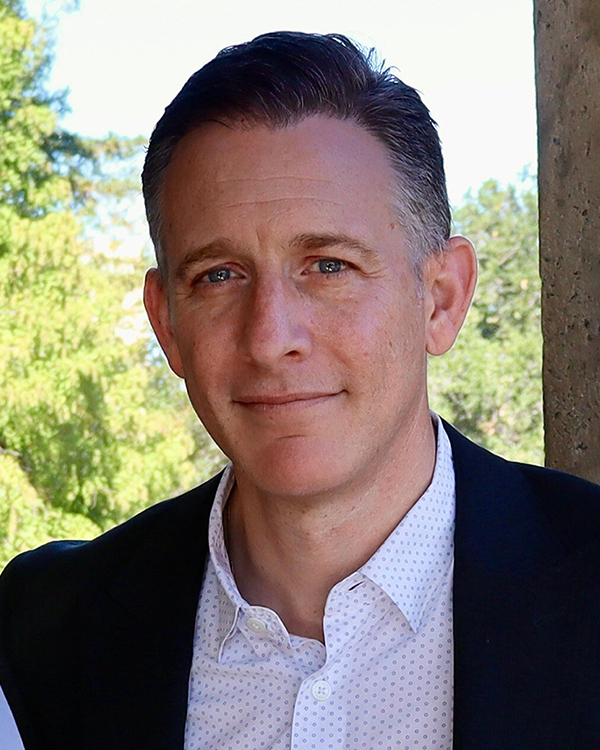
Jeremy Geffen
Executive and Artistic Director, Cal Performances