
Eco Ensemble
Saturday, February 7, 2026, 8pm
Hertz Hall
Special thanks to the University of California, Berkeley Department of Music, Meyer Sound, and CNMAT (Center for New Music and Audio Technology)
Cal Performances is committed to fostering a welcoming, inclusive, and safe environment for all one that honors our venues as places of respite, openness, and respect. Please see the Community Agreements section on our Policies page for more information.
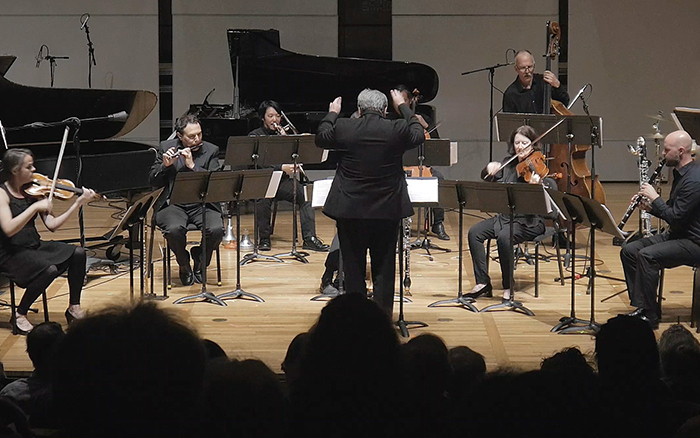
Matthew Evan Taylor
In this Moment 02072026
Dr. Matthew Evan Taylor is an AfroPnuematic composer, multi-instrumentalist, and improviser who has “…wrestled with the societal boundaries of Black artistry only to blast them apart….” (Dr. Kori Hill, I Care if You Listen) through creating music that is “insistent and defiant…envelopingly hypnotic” (Alan Young, Lucid Culture).
An artist at the intersection of concert music, free improvisation, and multi-disciplinary performance, Taylor has worked with leading artists and ensembles including the Metropolis Ensemble, Turtle Island String Quartet featuring Cyrus Chestnut, Elliott Sharp, dancer Laurel Jenkins, and visual artist Dannielle Tegeder, in front of audiences at the Metropolitan Museum of Art, the World Saxophone Congress 17, CineJazz Film Music Festival Paris, and the Perez Art Museum Miami.
A “risk taker” (Neil De La Flor, Huffington Post), Taylor’s latest work focuses on expression and liberation through breath. This music, AfroPneumaism, subverts Western aesthetics and philosophy by replacing chronometric and metronomic time with the human breath. Through this work, musicians are asked to listen inward as well as across the ensemble, as the audience joins in the collective act of deliberate breathing.
Taylor’s forthcoming album, Life Returns, will be released in May on Navona Records. He serves as Assistant Professor of Composition at UC Berkeley.
Myra Melford
and Matthew Monaco
Thrum
Thrum evokes, somewhat contradictorily, both the beating of drums and the idle strumming of a string instrument. The percussive nature of the piano, or “88 tuned drums” as Val Wilmer describes the playing of one of our shared musical influences, Cecil Taylor, fits somewhere in between.
Additionally, thrum can refer to the loose ends left on a loom after the fabric has been cut. These loose ends are continuously created by one musician playing and cutting off both the sound and intention of the other, who must respond in real-time to the changed musical situation.
—Myra Melford and Matthew Monaco
• • •
The pianist, composer, bandleader, and professor Myra Melford—whom the New Yorker called “a stalwart of the new-jazz movement”—has spent the last three decades making original music that is equally challenging and engaging. Culling inspiration from a wide range of sources that include the blues of her native Chicago, the poetry of Fernando Pessoa, literature by Eduardo Galeano, visual art and architecture, innovative jazz artists such as Cecil Taylor and the Association for the Advancement of Creative Musicians, yoga, and Eastern philosophy. She has explored an array of formats, among them solo-piano recitals, deeply interactive combos, and ambitious multidisciplinary programs.
Melford’s all-star ensemble project, Fire and Water, debuted its critically acclaimed release, For the Love of Fire and Water, in April 2022 on RogueArt Records and on a second release in November 2023, Hear the Light Singing. The Other Side of Air, the 2018 release by her quintet Snowy Egret, was named one of the best jazz recordings of 2018 by the New York Times and one of NPR Music’s 50 Best Albums of 2018. “This is music with an endless capacity for elasticity and surprise,” NPR wrote, “along with an
affirming spirit of coherence.”
A recording by Melford’s new trio, Splash, with Michael Formanek and Ches Smith, was released on Intakt Records in March 2025 to worldwide critical acclaim. Other current performing ensembles include Lux Quartet (co-led with Allison Miller, featuring Scott Colley and Dayna Stephens), the collectively led Tiger Trio (with Joelle Leandre and Nicole Mitchell), and Trio M (with Mark Dresser and Matt Wilson).
Two upcoming recordings in 2026 include Katarai, a two-piano duo with pianist Satoko Fujii and a third studio recording, Sure Grand Out, from her quintet Fire and Water, both on RogueArt Records, Paris.
Melford has received a Fulbright Scholarship (2000), the Alpert Award in the Arts for Music (2012) a Guggenheim Fellowship (2013), the Doris Duke Performing Artist Award (2013–16), and the Doris Duke Residency to Build Demand for the Arts (2013). She has appeared in the Down Beat Magazine and Jazz Journalists Association polls numerous times since 1990.
Since debuting on record as a bandleader in 1990, Melford has built a discography of more than 50 albums as a leader or co-leader, and side-person, and has collaborated with such luminary musicians as Nicole Mitchell, Joelle Leandre, Han Bennink, Miya Masaoka, Zeena Parkins, Lauren Newton, Stomu Takeishi, Rudy Royston, Fay Victor, Mary Halvorson, Tomeka Reid, Ingrid Laubrock, Susie Ibarra, Lesley Mok, Dave Douglas, Marty Ehrlich, Matana Roberts, Michael Formanek, Ches Smith, Liberty Ellman, Erik Friedlander, Fred Frith, Ben Goldberg, Joseph Jarman, Leroy Jenkins, Ron Miles, Tyshawn Sorey, Mary Oliver, Michael Sarin, Mark Dresser, Matt Wilson, Allison Miller, Scott Colley, Dayna Stephens, Jenny Scheinman, Chris Speed, Cuong Vu, Roscoe Mitchell, Francois Houle, the Jazz at Lincoln Center Orchestra, members of the Chicago Symphony Orchestra, The San Francisco Contemporary Music Players, and the Eco Ensemble. As a young musician in New York City, Melford worked with Lawrence D. “Butch’ Morris and Henry Threadgill.
—myramelford.com
Matthew Monaco (b. 1997) was immersed in jazz music from an early age, beginning his musical training improvising at the piano. Further studies in jazz were interrupted by his simultaneous encounter with the works of J.S. Bach and Stravinsky, leading to an instant fascination with notated classical music. Committed to maintaining jazz and classical as essential aspects of his musical identity, Monaco began his training and career as a composer of acoustic and electroacoustic music at the New England Conservatory in Boston, in the class of Stratis Minakakis.
After obtaining his bachelor’s degree in 2020, Monaco moved to Paris, studying with Stefano Gervasoni for two years at the Conservatoire National Supérieur de Musique et de Danse de Paris (CNSMDP) and earning his master’s degree in 2022. While at the Paris Conservatory, Monaco deepened his knowledge of electronic music through courses with Yan Maresz, Luis Naon, and Grégoire Lorieux. These years of study led to collaborations with groups including Ensemble intercontemporain, Ensemble Itinéraire, Ensemble Court-circuit, Ensemble Linea, the Callithumpian Consort, the Del Sol Quartet, the Brouwer Trio, Orchestre des lauréats at CNSMDP, and conductors including Hugh Wolff, Jean Deroyer, Jean-Philippe Wurtz, Stephen Drury, David Loebel, and Léo Margue.
Monaco continued his studies with another change of scene, entering the doctorate program in composition at UC Berkeley in 2022. In particular, he studied piano with Myra Melford, with whom he expanded and refined his improvisational skills, following in the heritage of American free jazz, a source from which much of his musical language draws inspiration.
Monaco’s research focuses on intersections of phenomenology and music theory, creating a space for work-specific methods in contemporary music analysis. Two current (separate) research projects focus on musico-grammatical paradigms in the solo performances of Cecil Taylor and rhythmic processes in Beat Furrer’s Konzert.
Mu-Xuan Lin
Concupiscentia Femina
Concupiscentia Femina is written for trumpet, trombone, bass clarinet, baritone singer, electronics, and video. The four instruments and voice that made up the ensemble are ones that were stereotypically associated with a hunky type of masculinity—the brass, the big bands, the military, the gusty and brash tones, and the macho operatic roles. And this piece does exactly that, except in an oddly introspective, self-aware, and fragmented manner. The optic is another oxymoron: the video projected behind the ensemble shows footages of female nude, figure or figurine, that would stereotypically be considered erotic, almost soft-porn-ish. The baritone vocalist, whose voice was captured and re-enunciated in the electronics, is performing squats, sit-ups, and push-ups onstage while vocalizing, with his vocalization contingent to the breathing patterns required for the workout, or to the obstructed cavity and curled up tongue due to a candy he places in his mouth. The effort of mediating between the score and the performance and, in the case of the vocalist, the physical effort, were intended to result in a crude, sloppy, high-testosterone musical montage that weirdly complements or even emboldens the expressivity and agency of the slowly pulsing, quietly breathing yet seemingly objectified female sexuality in the video.
Concupiscentia Femina is one of my most recent works that materializes, questions, ruminates, or contests the sensibilities surrounding female sexuality.
—Mu-Xuan Lin, 2025
Double Jeopardy (12-instrument version)
Certain deed, once done can never be done, at least not in the same way. That is the law of music. Walking the way of music one is both at the moment and through time; objects present themselves blunt and front, shaking off droplets when one is just making out the shape of them, and flee away with too much said and unsaid, leaving one at the mercy of recognition and recollection. Each object once appeared can never appear, and each presence is the compromise of its own possible double. Even déjà-vu entails the existence of a set of Anothers—another time, another presence, another experience. Therefore it is allowed for every musical gesture to exert its transgression over and over in repetition, in disguise, in reverse, in distortion, in magnitude; and it is therefore just for every counter-gesture to respond over and over in subversion, in annihilation, in coercion, in assimilation, in mergence. Hence the double jeopardy in multitude.
Double Jeopardy was originally commissioned, and subsequently premiered by, the Ensemble Proton Bern in Bern, Switzerland, in 2013. The 12-instrument version was created in 2014 and received its premiere performance by the International Contemporary Ensemble in Los Angeles in 2024.
—Mu-Xuan Lin, 2014
• • •
Composer (curator/writer/researcher) Mu-Xuan Lin (林慕萱) (Taiwan/USA) defines her life as a quest for an artistic autonomy poetically engendered by both its will and its vulnerability to one’s corporeal experience and to the world one lives in. Having extensive training in the visual arts and creative writing and frequent exposure to theater, dance, and literature from an early age, and profound influences from the cinema, Mu-Xuan is interested in the montage and the mise-en-scène of contemporary individuals’ fragmented yet interlaced truths, of the confusion of time and place, and of identities construed and broken. She creates with an emphasis on the kinetic formulation and transfer between various expressive art forms or matters with the sonic and temporal one.
Mu-Xuan enjoys an international career; her music has been heard on SOOND and ein_klang records, and on platforms such as Festival AFEKT (Estonia), Beijing Modern Music Festival (China), Donaueschinger Musiktage (Germany), Innovation Series (Taiwan), and Piano Spheres (Los Angeles). She has worked with Ensemble Proton Bern (Switzerland), International Contemporary Ensemble (USA), Ensemble Adapter (Germany), Avanti! Chamber Orchestra (Finland), and pianist Vicki Ray among others, and is currently working with 20º dans le noir (Paris), duo NéMeu (Paris/Tokyo), and sheng artist Li-Chin Li (Taiwan). As a writer, her article “The Erotic and the Melancholy of a Sincere Postmodern Identity—cinematic spaces and vulnerable time” will be published by Cambridge Scholars in the volume Crossing into Distance: Contemporary Composers on the Present and Future of Art Music. She has also conducted interviews with philosopher Klaus Theweleit and with composer and music theater director Heiner Goebbels (publications forthcoming). Since 2023, in addition to increased activities as a video artist, Mu-Xuan has ventured into the work of curation and direction and founded Studio Nekton with flutist Shao-Wei Chou.
Mu-Xuan received BM in composition from the New England Conservatory, MFA and PhD in music composition and theory from Brandeis University, and Certificate of Advanced Studies in Curating at Zürcher Hochschule der Künste. Previously she has taught at Brandeis University, California State University Long Beach, and Chapman University. Dr. Lin is the Assistant Professor of Composition at UC Berkeley.
—muxuanlin.com
Matthew Evan Taylor
pneuma iii: in response to MZH
This is a piece of starts and stops, textures, and extremes. This characterizes the first conversations I had with my friend, the
visual artist and writer Molly Zuckerman-Hartung (Professor of Art at UCLA). She captured this dynamic faithfully in her gift to me, Miami Coke Table (2015). (No cocaine was consumed!) When you look closely at the wooden palette, you see peaks and valleys, shocking juxtapositions of color, and surprising moments of calm. I think we were both startled by how much we understood each other, and how closely we saw the world through our art practices. She remains one of my most dynamic friends; it’s the sort of relationship where we are instantly back to our dynamic as soon as we’re in a room together.
—Matthew Evan Taylor
Ken Ueno
Bokuseki
This work is inspired by bokuseki—the calligraphic writings of Zen and Buddhist monks, valued not for refinement or legibility, but for the immediacy of the gesture and the trace of lived presence it leaves behind. In particular, the piece draws on the bokuseki of Nichiren, whose brushwork often privileges urgency, conviction, and force over formal balance or clarity.
Nichiren’s bokuseki, especially the Gohonzon, operates through a palimpsestual field logic in which meaning is distributed across space rather than unfolded through sequence. Radically heterogeneous scales of gestures coexist on a single surface: the monumental daimoku at the center; medium-sized names of Buddhas and bodhisattvas; smaller inscriptions orbiting the field. These scales do not form a narrative hierarchy. Scale itself becomes semantic pressure—large writing does not come “first,” and small writing does not “follow,” but both persist simultaneously.
This non-linear inscription anticipates later modernist experiments such as Mallarmé’s Un coup de dés, not in style but in structure. Where Mallarmé replaces grammar with typography and meter with spacing, Nichiren arrives at a similar spatialization of meaning through ritual cosmology rather than literary modernism. In both cases, the surface functions not as a line of discourse but as a field of forces.
Crucially, this is not collage. The surface behaves as a palimpsest—an accretion of doctrinal time, ritual time, and historical time that remains legible without synthesis. Reading becomes recursive, durational, and navigational. Meaning emerges from tension between scales rather than resolution.
The oboe functions here as a writing instrument without a reservoir. Breath replaces ink; embouchure becomes pressure and angle. Sound persists only as long as the body can sustain it, and each gesture risks thinning, cracking, or breaking altogether. Silence is not absence but the white of the page—an active space against which each sonic stroke becomes perceptible. Like Cy Twombly’s gestural marks, these sounds hover between the semantic and the non-semantic, suggesting language without resolving into it.
I would like to thank Juliana Gaona Villamizar, whose virtuosity and generosity were instrumental in the genesis of this piece. Her ongoing consultation on oboe techniques throughout the compositional process was invaluable.
—Ken Ueno
• • •
Ken Ueno, recipient of the Berlin Prize and Rome Prize, is a composer, performer, sound artist, and scholar. His works have been championed internationally, including Shiroi Ishi for the Hilliard Ensemble, which remained in that group’s repertoire for more than a decade. In 2011, MaerzMusik in Berlin presented a portrait concert of his music, and in 2024 the Arditti Quartet premiered his new string quartet at the Takefu International Music Festival, where he was guest composer. Ueno has performed his vocal concerto with major orchestras worldwide, including with the Boston Modern Orchestra Project, Warsaw Philharmonic, Thailand Philharmonic, and Lithuanian National Symphony. A professor at UC Berkeley, his writings have appeared in the Oxford Handbook, New York Times, and Drama Review. Ueno co-edited East Asian Voices of Resistance Against Racism in Music (Ethics Press) and recently guest-edited Sonic Ideas, contributing the lead article on AI and music.
Matthew Evan Taylor
Prayer Service for Earnestine
Prayer Service for Earnestine (2017) is the first of my African American Requiem pieces written in honor of my grandmother, Earnestine Colvin Taylor (Grandmamá), who passed away in 2017 at the age of 90. Written for large ensemble, this reverse theme-and-variations is based on Grandmamá’s favorite hymn, “Come Ye Disconsolate” (Thomas Moore, The United Methodist Hymnal, No. 500). Loosely inspired by her funeral service, I emulate sounds of growing up in her church such as hymn-lining, shouting, and whooping. For a final farewell, I conclude the piece with a faithful rendering of the hymn, as my grandmother would have sung it in church.
—Matthew Evan Taylor


Each year in February, as we move into our busiest time of the year, Cal Performances’ calendar becomes especially packed with a wide range of carefully curated events designed to appeal to the adventurous sensibilities and eclectic interests of Bay Area audiences. Over the coming months, we’ll see visits by an array of companies, ensembles, and soloists offering a remarkable set of opportunities to revisit old friends as well as discover marvelous and unfamiliar performers and artworks.
Our February programming alone features nearly two dozen presentations in our halls. You’ll find musical programs performed by world-class artists like baritone saxophonist Steven Banks and pianist Xak Bjerken (Feb 1, Hertz Hall [HH]), pianist Bruce Liu (Feb 10, Zellerbach Hall [ZH]), the beloved Takács Quartet (Feb 22, HH), and gifted jazz artists Cécile McLorin Salvant (Feb 5, ZH) and Somi (Feb 21, Zellerbach Playhouse [ZP]); enthralling contemporary dance programs with the great Martha Graham Dance Company, celebrating its 100th anniversary (Feb 14–15, ZH), and—in its highly anticipated Cal Performances debut—A.I.M by Kyle Abraham (Feb 21–22, ZH); cutting-edge new music from UC Berkeley’s own Eco Ensemble (Feb 7, HH), mezzo-soprano Joyce DiDonato with string trio Time for Three (Feb 7, ZH), and AMOC* and Sandbox Percussion in their mesmerizing co-production of Canto Ostinato, a hypnotic late-1970s minimalist work by Dutch composer Simeon ten Holt (Feb 22, ZP); and thrilling theater from Yaa Samar! Dance Theatre in the West Coast premiere of the company’s brilliant Gathering (Feb 27–Mar 1, ZP).
In the coming months, we’ll welcome a full spectrum of talent including Cal Performances’ 2025–26 Artist in Residence Víkingur Ólafsson; legendary soprano Renée Fleming; the virtuoso JACK Quartet; early-music superstars The English Concert, Jordi Savall, and The Tallis Scholars; and the phenomenally popular Silkroad Ensemble with Rhiannon Giddens.
And in April, our acclaimed dance series continues, distinguished by genre-defining artists and major new productions including The Joffrey Ballet in a bold new work set during Midsommar, the traditional Scandinavian summer solstice festival; and, of course, a return April engagement with the Alvin Ailey American Dance Theater.
As you explore the calendar, I recommend you pay particular attention to our Illuminations theme of “Exile & Sanctuary,” focusing on how issues of displacement can inform bold new explorations of identity and community; and how artistic expression can offer safe harbor during times of unrest or upheaval.
The opportunity to engage with diverse artistic perspectives and share the transformative power of the live performing arts is one of life’s greatest pleasures, and I look forward to encountering these profound and entertaining experiences with you in the months ahead.
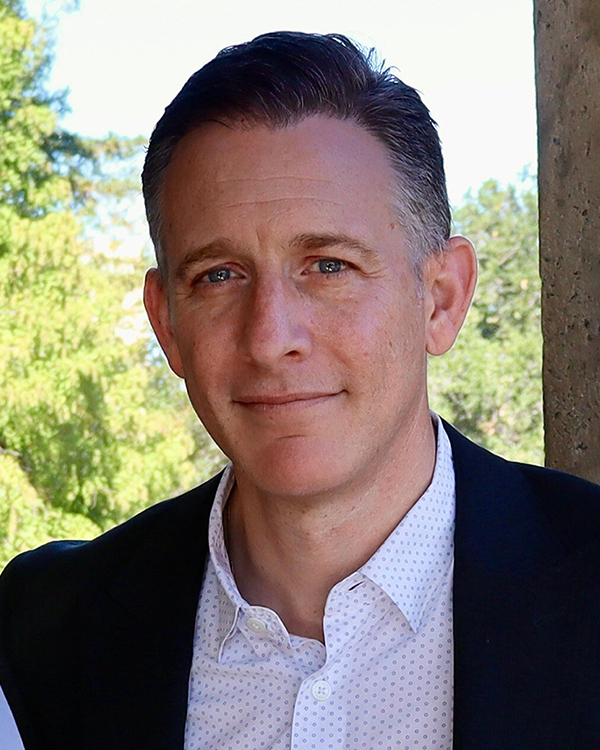
Jeremy Geffen
Executive and Artistic Director, Cal Performances