

Bruce Liu, piano
Tuesday, February 10, 2026, 7:30pm
Zellerbach Hall
Cal Performances is committed to fostering a welcoming, inclusive, and safe environment for all one that honors our venues as places of respite, openness, and respect. Please see the Community Agreements section on our Policies page for more information.
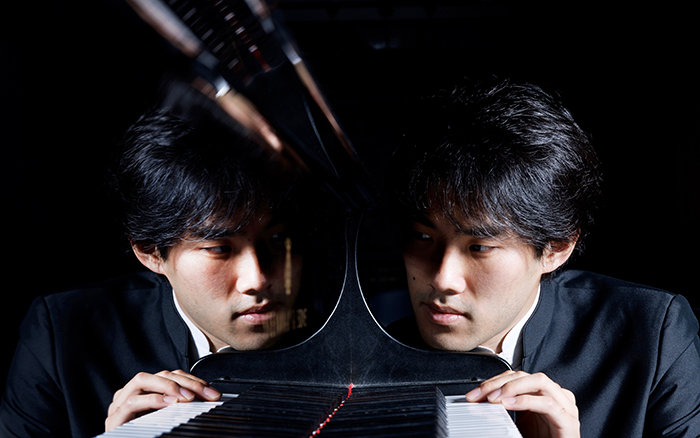
Mirror and Prism:
Reimagining the Piano
Bruce Liu has built a reputation for versatility, clarity, and wit—a rare balance of elegance and fire that has shaped his music-making since his breakthrough at the 2021 Chopin Competition. Tonight’s program reflects that range, tracing two centuries of piano invention—from Beethoven’s reinvention of the sonata and Chopin’s poetic intimacy to Liszt’s flamboyant virtuosity and the kinetic exuberance of his fellow Hungarian, Ligeti.
A thread of Spain runs through the program as well—Albéniz’s Cádiz, Ravel’s jester, Liszt’s rhapsody—while the Catalan-born Mompou turns northward to France, transforming a simple folk tune into quiet reflection. Together these works reveal the piano as both mirror and prism: a single instrument capable of expressing solitude, spectacle, and everything in between.
Fanfares for a New Century
One of the defining voices of postwar modernism, György Ligeti invented kaleidoscopic sound worlds that ranged from the eerie clusters of his Atmosphères (famous from its use in the 2001: A Space Odyssey soundtrack) to the intricate rhythmic lattices of his late piano music. Between 1985 and 2001, he composed 18 Études, a cycle that redefined what the piano could do—technically and imaginatively. Ligeti said that his impetus to enter the genre immortalized by Chopin and Debussy was simply “my own inadequate piano technique.” He compared the project to Cézanne’s lifelong struggle with perspective: “That’s what I would like to achieve—the transformation of inadequacy into professionalism.”
Ligeti dedicated specific Études to different pianists. Fanfares embodies that transformation. No. 4 from Book I, Fanfares is dedicated to Volker Banfield, a German pianist who was among the first to perform and record Ligeti’s piano music in the 1980s. Here Ligeti reinvents the traditional horn-call fanfare, turning it into a kinetic game of shifting pulses and accents. A rising scalar ostinato propels the piece forward, while offbeat rhythms mimic, distort, and multiply the sound of a jubilant fanfare.
From the Moonlight to the Waldstein:
The Piano Sonata Reimagined
It makes sense that the piano sonata is the genre to which Beethoven returned most frequently, from the mid-1790s until 1822. The keyboard served him as both laboratory and confessional—an instrument through which he could test compositional ideas and reveal his inner life. Even after deafness ended his public career as a performer, the piano remained the core of his creative identity, the medium through which he could continue to speak most directly. The 32 sonatas trace a path of continual experiment and self-renewal, a record of Beethoven’s evolving imagination that defies tidy period divisions and stands as one of the central monuments of Western music.
The Sonata in C-sharp minor, Op. 27, No. 2—nicknamed, though not by the composer, Moonlight—marks a pivotal point in that evolution. Beethoven composed it in 1801. The subtitle he did give it, Sonata quasi una fantasia (“in the manner of a fantasy”), signals a deliberate break from the standard mold. Its opening Adagio sostenuto, hushed and hypnotic, introduced a new kind of stillness to sonata form with its first movement, a structure built entirely on a single texture.
Romantic legend suggests that the piece is a portrait of unrequited love for its dedicatee, Countess Giulietta Guicciardi, yet such biographical readings can easily run wild. As the scholar Timothy Jones has suggested, this inward-turning sound world may instead mirror the anguish Beethoven felt in facing the prospect that his hearing loss was permanent. The turbulence familiar from the earlier Pathétique is transmuted in the opening movement into inward tension rather than open drama.
A brief Allegretto intermezzo, graceful but slightly restless in its quick turns of rhythm and harmony, provides a momentary clearing before the storm. Then, in the Presto agitato finale, Beethoven transforms the gentle rippling of the first movement into a torrent of arpeggios and syncopations, the whisper become a tormented cry. The Moonlight sustains the illusion of improvisation while concealing an iron control of pacing and form: the architecture of inevitability disguised as spontaneous fantasy. Few works of the early 19th century anticipate so vividly the Romantic fascination with interior life and emotional extremity.
Beethoven composed the Sonata in C major, Op. 53—known as the Waldstein—only two years later, but it belongs to another world entirely. Written around 1803–04, at the dawn of his so-called “heroic” middle period, it shares sketchbooks with the Eroica Symphony and reflects the same surge of creative renewal following the Heiligenstadt Testament—the 1802 letter in which Beethoven, confronting his encroaching deafness, confessed thoughts of suicide but resolved to persevere through his art.
Dedicated to Count Ferdinand Waldstein, one of Beethoven’s earliest patrons, the C major Sonata reimagines the piano as a kind of “veiled symphony”—to borrow the phrase Robert Schumann later used for Brahms’ youthful Piano Sonata No. 3. Composed soon after Beethoven received a new four-pedal piano from the Parisian maker Sébastien Érard, it exploits the instrument’s expanded sonority and coloristic range to unprecedented effect. Like the Eroica, the Waldstein enlarges its genre to symphonic scale.
The first movement’s ceaseless rhythmic drive is electrifying: a motoric current offset by teasing treble figures and chorale-like secondary themes. Beneath its brightness lies nervous tension, expressed through sudden dynamic shifts and harmonic detours. The long coda pushes the instrument’s resonance to its limits, with syncopations and tremolos that seem to reimagine the piano as an orchestra compressed into ten fingers.
Beethoven had originally written a substantial Andante to balance the outer movements but replaced it with the shorter Introduzione, an ethereal interlude that bridges worlds. Its recitative-like opening and bel canto phrasing convey a distinctly operatic sensibility, a pause before renewal. Out of its suspended harmonies arises the finale’s serene theme, played pianissimo and wrapped in pedal haze.
Gradually, this delicate opening swells into radiant C major, the music gathering energy as if emerging from darkness into light. Crossed-hand figures, shimmering textures, and subtle pedal effects conjure orchestral color and momentum, culminating in a prestissimo blaze of triumph. Biographer Jan Swafford aptly described the sonata as “a twenty-minute crescendo of intensity and excitement.”
Ballades in Miniature
The Nocturnes span nearly two decades of Frédéric Chopin’s career and embody his deep affinity for the lyrical bel canto style perfected in the operas of his contemporary, Vincenzo Bellini. Among the miniature forms most closely associated with Chopin, the Nocturnes reveal how he could transform the piano into an instrument of lyrical expression, capable of sustaining melodic line as if it were sung. He borrowed the genre name from the Irish composer John Field but made the nocturne his own: intimate, harmonically adventurous, and emotionally wide-ranging.
Chopin’s pianism here—its quasi-vocal inflection, its refined shadings of color, its imaginative pedaling—points toward the harmonic subtlety later explored by Debussy. His Nocturnes enact the paradox of control and freedom: their improvisatory surface concealing meticulous construction.
The pair published as Op. 27, from the mid-1830s, marks a turning point in Chopin’s treatment of the genre. The pianist David Dubal has called these works “ballades in miniature,” and the description fits their concentrated drama and symphonic breadth of feeling. The first, in C-sharp minor, unfolds as a dark, restless counterpart to its companion in D-flat major—keys that share the same anchor pitches on the keyboard yet contrast utterly in mood, minor and major reflections of the same tonal world.
In the Nocturne in C-sharp minor, Chopin’s sense of dramatic pacing, as the expert Victor Lederer has noted, is equal to that of any opera composer. Its opening melody moves with ambiguous hesitancy, lit by chromatic shadows, before giving way to a restless central episode where agitation and lyricism are held in delicate equilibrium. When the opening Larghetto theme returns, Chopin thins the texture and softens the dynamic, giving it a more introspective, almost tremulous quality. The music feels changed by what’s passed—not dramatically recast, but inwardly altered, as if touched by memory.
The D-flat major Nocturne, by contrast, opens with the illusion of radiant calm. Its right-hand melody floats ecstatically over an undulating left-hand accompaniment, evolving into what James Huneker famously described as “a song of the sweet summer of two souls.” Yet this serenity is edged with wistfulness: the melody bends under the weight of its own yearning, suggesting that joy and longing are inseparable.
Ravel and the Art of Reflection
Maurice Ravel’s Miroirs (1904–05) began as a five-movement suite for solo piano—a pivotal work in his harmonic and coloristic evolution. “The change in my style,” he later wrote, “was pronounced enough to have upset those musicians who till then had had the least trouble in appreciating my music.” Each movement is dedicated to a member of Les Apaches, the circle of artists and writers who shared Ravel’s modernist sensibility and adopted their name—Parisian slang for street hooligans—as a defiant badge of avant-garde identity.
Rather than straightforward portraits, the Miroirs pieces, as the title suggests, act as reflections: Ravel’s impressions of his friends blend with glimpses of himself. A recurring interval of a falling fourth threads through the suite, uniting its diverse sound worlds.
“Alborada del gracioso” (“The Jester’s Morning Song”) channels Ravel’s lifelong fascination with Spain—a legacy of his Basque mother and his childhood near the Spanish border. The gracioso, a witty and irreverent clown from Spanish Golden Age theater, awakens at dawn to sing, taunt, and dance in quicksilver bursts of rhythm and color. Guitar-like strumming, sharp rhythmic accents, and dizzying repeated notes evoke both laughter and swagger, while a languid central serenade hints at unexpected tenderness. The music demands split-second precision and extraordinary control, its play of irony and brilliance epitomizing Ravel’s style.
The composer later orchestrated Alborada del gracioso in 1918, expanding its Spanish wit into one of his most dazzling orchestral showpieces.
Mompou’s Music of Evaporation
Federico Mompou’s piano miniatures have recently enjoyed a revival among audiences and performers drawn to their extreme economy of means and meditative clarity. Born in Barcelona to a Catalan father and French mother, Mompou drew on both sides of his heritage, blending the modal color of Iberian song with the harmonic refinement of Debussy and Fauré, who led the Paris Conservatoire when he was a student there.
While he is not known to have met Ravel in person, Mompou absorbed the harmonic delicacy and timbral sensitivity of Ravel and other French contemporaries, blending these with a mystical inwardness entirely his own. His quiet economy of means often invites comparison with Erik Satie, though Mompou’s lyricism tends toward the contemplative rather than the ironic. The pianist Stephen Hough, an eloquent interpreter, has called Mompou’s work “the music of evaporation” and notes that its “simplicity of expression—elusive, evasive, and shy—is strangely disarming.”
In his fantasy on “Au clair de la lune,” Mompou turns the familiar French folk tune into a piece of inward lyricism. The melody remains close to its simple form, framed by spare harmonies and understated color. What might have been a sentimental paraphrase becomes instead a study in clarity and calm—a kind of reverie rather than a variation.
Spain Remembered from Afar
Isaac Albéniz stands as a central figure in the formation of a modern Spanish musical language, though he spent much of his career abroad. A Catalan prodigy turned cosmopolitan artist, he settled in London and later Paris, where his exchanges with Ernest Chausson, Gabriel Fauré, Paul Dukas, and others—he held contradictory opinions regarding Debussy—deepened his harmonic imagination. Out of this cross-pollination came Iberia (1905–08), a monumental four-volume cycle for piano he completed before his premature death from Bright’s disease. Olivier Messiaen deemed it “the wonder of the piano, the masterpiece of Spanish music….”
Distance sharpened Albéniz’s vision of Spain. In “El Puerto” (“The Port”), from Book I, he evokes the bustle of Cádiz through lively gestures and intricate keyboard textures. Its fiendishly complex rhythmic structures and crossing of hands call for extreme virtuosity. Marked “always joyous,” the piece fuses Andalusian dance patterns with French harmonic color. Beneath the sparkle lies a sense of affectionate nostalgia—a Spaniard abroad recalling the sound and light of home.
Spain through the Lisztian Prism
Franz Liszt’s Rhapsodie espagnole, composed in 1858, distills his lifelong fascination with national color and the idea of virtuosity as theater. Written well after his glory years as a touring pianist, it revisits the glittering brilliance of his earlier style through a more reflective, harmonically adventurous lens. The piece draws on memories of Liszt’s 1845 tour of Spain and Portugal. Its subtitle points to the well-known Iberian tunes that serve as the scaffolding for Liszt’s exhilarating variations: Folies d’Espagne et Jota Aragonesa.
The first of these, the Folies d’Espagne, refers to a 15th-century dance, likely from Portugal, whose insistent rhythm and haunting harmonic pattern have made the tune an earworm for centuries. Known across Europe as La Folia, it evolved into one of the Baroque era’s most recognizable variation themes, treated by Corelli, Marais, and Rameau before Liszt gave it new pianistic life. Its allure has persisted into modern times in such works as Rachmaninoff’s Variations on a Theme by Corelli. The second tune Liszt enlists, the Jota aragonesa, was a popular Aragonese melody that had become emblematic of Spanish folk style in 19th-century Europe. Its quick triple meter and percussive syncopations evoke the dance rhythms of northern Spain, complete with castanet-like accents.
A rhapsodic introduction—half fantasy, half cadenza—leads to the statement of the Folies d’Espagne theme, which Liszt subjects to nine striking variations. In the final two, he fuses the ancient melody with the sensuous rhythm of the bolero before turning to variations on the Jota aragonesa, transforming the folk tune into a whirlwind of textural sparkle and rhythmic fire. Liszt combines the two melodies near the end, crafting a triumphant synthesis that feels both spontaneous and inevitable. The final pages ignite in dazzling bravura that brings the Rhapsodie to a resounding close.
Thomas May is a writer, critic, educator, and translator. Along with essays regularly commissioned by the San Francisco Symphony, the Juilliard School, the Ojai Festival, and other leading institutions, he contributes to the New York Times and Musical America and blogs about the arts at www.memeteria.com
About the Artists

Each year in February, as we move into our busiest time of the year, Cal Performances’ calendar becomes especially packed with a wide range of carefully curated events designed to appeal to the adventurous sensibilities and eclectic interests of Bay Area audiences. Over the coming months, we’ll see visits by an array of companies, ensembles, and soloists offering a remarkable set of opportunities to revisit old friends as well as discover marvelous and unfamiliar performers and artworks.
Our February programming alone features nearly two dozen presentations in our halls. You’ll find musical programs performed by world-class artists like baritone saxophonist Steven Banks and pianist Xak Bjerken (Feb 1, Hertz Hall [HH]), pianist Bruce Liu (Feb 10, Zellerbach Hall [ZH]), the beloved Takács Quartet (Feb 22, HH), and gifted jazz artists Cécile McLorin Salvant (Feb 5, ZH) and Somi (Feb 21, Zellerbach Playhouse [ZP]); enthralling contemporary dance programs with the great Martha Graham Dance Company, celebrating its 100th anniversary (Feb 14–15, ZH), and—in its highly anticipated Cal Performances debut—A.I.M by Kyle Abraham (Feb 21–22, ZH); cutting-edge new music from UC Berkeley’s own Eco Ensemble (Feb 7, HH), mezzo-soprano Joyce DiDonato with string trio Time for Three (Feb 7, ZH), and AMOC* and Sandbox Percussion in their mesmerizing co-production of Canto Ostinato, a hypnotic late-1970s minimalist work by Dutch composer Simeon ten Holt (Feb 22, ZP); and thrilling theater from Yaa Samar! Dance Theatre in the West Coast premiere of the company’s brilliant Gathering (Feb 27–Mar 1, ZP).
In the coming months, we’ll welcome a full spectrum of talent including Cal Performances’ 2025–26 Artist in Residence Víkingur Ólafsson; legendary soprano Renée Fleming; the virtuoso JACK Quartet; early-music superstars The English Concert, Jordi Savall, and The Tallis Scholars; and the phenomenally popular Silkroad Ensemble with Rhiannon Giddens.
And in April, our acclaimed dance series continues, distinguished by genre-defining artists and major new productions including The Joffrey Ballet in a bold new work set during Midsommar, the traditional Scandinavian summer solstice festival; and, of course, a return April engagement with the Alvin Ailey American Dance Theater.
As you explore the calendar, I recommend you pay particular attention to our Illuminations theme of “Exile & Sanctuary,” focusing on how issues of displacement can inform bold new explorations of identity and community; and how artistic expression can offer safe harbor during times of unrest or upheaval.
The opportunity to engage with diverse artistic perspectives and share the transformative power of the live performing arts is one of life’s greatest pleasures, and I look forward to encountering these profound and entertaining experiences with you in the months ahead.

Jeremy Geffen
Executive and Artistic Director, Cal Performances