

Martha Graham Dance Company
Saturday, February 14, 2026, 8pm
Sunday, February 15, 2026, 3pm
Zellerbach Hall
Major support for the Martha Graham Dance Company is provided by The Arnhold Foundation, Barbara and Rodgin Cohen, Geoffrey D. Fallon, Noah and Kyle Hawley, The Hayes Foundation, Howard Gilman Foundation, Christopher Jones and Deb McAlister, Christine Jowers and Rob Friedman, National Endowment for the Arts, New York City Department of Cultural Affairs, New York State Council on the Arts with the support of the Office of the Governor and the New York State Legislature, Dr. M. Felicity Rogers-Chapman, Judith G. Schlosser, The Shubert Foundation, Lawrence Stein, Thompson Family Foundation, Inger K. Witter, Nadia Zilkha.
The February 15th performance is made possible in part by Beth DeAtley.
Cal Performances is committed to fostering a welcoming, inclusive, and safe environment for all one that honors our venues as places of respite, openness, and respect. Please see the Community Agreements section on our Policies page for more information.
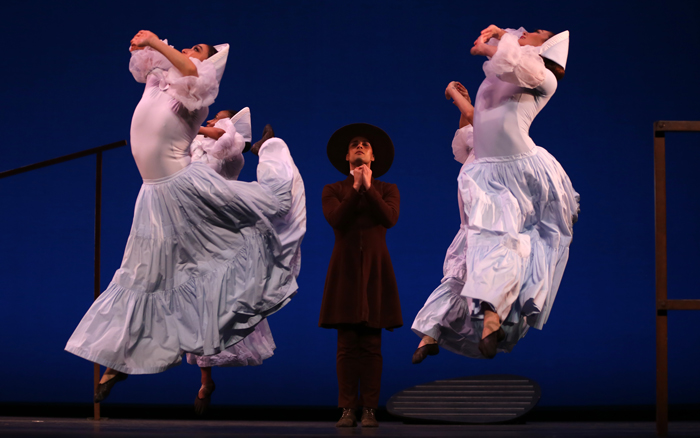
Appalachian Spring (1944)
In 1942, Martha Graham received a commission from the Elizabeth Sprague Coolidge Foundation for a new ballet to be premiered at the Library of Congress. Aaron Copland was to compose the score. Graham called the new dance Appalachian Spring, after a poem by Hart Crane, but for Copland it always remained Ballet for Martha. Choreographed as the war in Europe was drawing to end, it captured the imagination of Americans who were beginning to believe in a more prosperous future, a future in which men and women would be united again. With its simple tale of a new life in a new land, the dance embodied hope. Critics called Appalachian Spring “shining and joyous,” “a testimony to the simple fineness of the human spirit.” The ballet tells the story of a young couple and their wedding day; there is a Husbandman, his Bride, a Pioneering Woman, a Preacher, and his Followers.
In a letter to Aaron Copland, Graham wrote that she wanted the dance to be “a legend of American living, like a bone structure, the inner frame that holds together a people.” As Copland later recalled, “After Martha gave me this bare outline, I knew certain crucial things—that it had to do with the pioneer American spirit, with youth and spring, with optimism and hope. I thought about that in combination with the special quality of Martha’s own personality, her talents as a dancer, what she gave off and the basic simplicity of her art. Nobody else seems anything like Martha, and she’s unquestionably very American.” Themes from American folk culture can be found throughout the dance. Copland uses a Shaker tune, “Simple Gifts,” in the second half of his luminous score, while Graham’s choreography includes square dance patterns, skips and paddle turns and curtsies, even a grand right and left. The set by Isamu Noguchi features a Shaker rocking chair. Appalachian Spring is perhaps Martha Graham’s most optimistic ballet, yet it does contain a dark side. The fire and brimstone Preacher and his condemnation of earthly pleasures recalls the repressive weight of our Puritan heritage, while the solemn presence of the Pioneering Woman hints at the problems of raising families in remote and isolated communities. In this newly cleared land life was not simple, and Graham’s vision pays homage to that as well.
—Ellen Graff
Chronicle (1936)
Chronicle premiered at the Guild Theater in New York City on December 20, 1936. The dance was a response to the menace of fascism in Europe; earlier that year, Graham had refused an invitation to take part in the 1936 Olympic Games in Germany, stating: “I would find it impossible to dance in Germany at the present time. So many artists whom I respect and admire have been persecuted, have been deprived of the right to work for ridiculous and unsatisfactory reasons, that I should consider it impossible to identify myself, by accepting the invitation, with the regime that has made such things possible. In addition, some of my concert group would not be welcomed in Germany” (a reference to the fact that many members of her group were Jewish). “Chronicle does not attempt to show the actualities of war; rather does it, by evoking war’s images, set forth the fateful prelude to war, portray the devastation of spirit which it leaves in its wake, and suggest an answer.” This is one of the very few dances Martha Graham made that can be said to express explicitly political ideas, but, unlike Immediate Tragedy (1937) and Deep Song (1937), dances she made in response to the Spanish Civil War, this dance is not a realistic depiction of events. The intent is to universalize the tragedy of war. The original dance, with a score by Wallingford Riegger, was 40 minutes in length, divided into five sections: “Dances before Catastrophe: Spectre–1914 and Masque,” “Dances after Catastrophe: Steps in the Street and Tragic Holiday,” and “Prelude to Action.” The dance disappeared from the repertory in 1937 and was thought to be lost. In 1985, Barry Fischer discovered a film by Julien Bryan of the original cast of “Steps in the Street,” which he reconstructed at NYU as part of his doctoral research. Since that discovery, the company has reconstructed and now performs “Spectre–1914,” “Steps in the Street” and “Prelude to Action.”
—Ellen Graff
Cortege (2024)
Drawing inspiration from Martha Graham’s Cortege of Eagles, Baye & Asa focus on Charon, the ferryman who shepherds souls to the underworld. In Graham’s work, the Trojan Empire is crumbling, and Charon is the conductor of its inevitable fall. Baye & Asa’s Cortege removes this central figure of mythological predestination, and instead places the burden of fate on the ensemble. Together, they generate the cyclical momentum of war.
En Masse (2025)
En Masse (2025) was commissioned to celebrate GRAHAM100, the 100th anniversary of the Martha Graham Dance Company. This momentous occasion aligns with the 250th anniversary of the country, and we wanted a new work that would resonate with our past, present, and future. We returned to a collaboration from the late 1980s between two iconic American artists—Martha Graham and Leonard Bernstein. Archival records show that these remarkable artists were inspired by a wide range of American social issues, but in the end, that project did not come to fruition. However, in the course of our research, the Leonard Bernstein Organization uncovered a very short, unknown piece of music titled Vivace that they believe Bernstein composed for Martha Graham.
The score for En Masse is an expansion of Vivace by Christopher Rountree. It is joined by a new arrangement of excerpts from Bernstein’s Mass, also by Rountree. For the choreography, we turned to Hope Boykin who has danced and created to Bernstein’s music on many occasions. She offers these thoughts about En Masse:
Together we try, we fall, we restart, and grow. Together we make change, learn, and build. Alone, however, our failures scream and endurance is tested. In community, we thrive, lean and depend on one another. En Masse shares how we are often bound by our limitations; the process toward release is not easy, but worth it.
—Hope Boykin
Immediate Tragedy (1937)
Martha Graham created this solo in 1937 in reaction to the atrocities of the Spanish Civil War. We see the woman in Immediate Tragedy as a universal figure of determination and finally, resilience. The dance was notable and well received, but when Graham stopped performing it in the late 1930s, the solo was forgotten and considered lost. In 2020, Janet Eilber reimagined the choreography for Immediate Tragedy using recently discovered photos of Graham in a 1937 performance, and many other archival references. A new score was created by Christopher Rountree, inspired by pages of music hand-written by composer Henry Cowell, which were found in the Graham archives. Graham described her inspiration for this dance in a letter to Cowell: “…whether the desperation lies in Spain or in a memory in our own hearts, it is the same. I felt in that dance I was dedicating myself anew to space, that in spite of violation I was upright and that I was going to stay upright at all costs….”
Night Journey (1947)
Commissioned by the Elizabeth Sprague Coolidge Foundation, Night Journey was first performed in Cambridge MA, as part of Harvard University’s Symposium on Music Criticism. The dance is part of Graham’s Greek cycle and like Cave of the Heart (1946), based upon Medea, and Clytemnestra (1958), inspired by the Orestia, Graham’s interpretation makes the woman’s experience central. When the dance premiered in New York City, Walter Terry wrote that Graham had succeeded in “transfer[ing] the action to the area where only Jocasta’s heart and mind are real.”
According to the myth, Oedipus was the son of King Laius of Thebes and Queen Jocasta. At his birth, an oracle prophesied that he would murder his father and so he was abandoned on a desolate mountainside. He was found there and protected by a Corinthian shepherd and grew to manhood as the adopted son of the King of Corinth. Once again, an oracle predicted that Oedipus would slay his father and marry his mother. Thinking the King of Corinth his true father, he fled the city, and in his wanderings met, quarreled with, and finally killed a stranger who was King Laius of Thebes, his real father. Oedipus traveled on to Thebes, solved the riddle of the Sphinx, and was rewarded with the throne and the murdered king’s widow, Queen Jocasta. He reigned nobly until a plague ravaged Thebes and the oracle declared that only banishment of the murderer of Laius would save the city. When the truth was discovered and the incestuous relationship revealed, Jocasta took her own life. Oedipus blinded himself and wandered the earth an outcast.
In her retelling of the Oedipus myth, Graham was almost certainly influenced by contemporary interest in psychology and the emerging (in America) theories of Freud and Jung, theories that explored the darker recesses of the human psyche, including erotic passion and the powerful sexual dynamics operating within the family. In Sophocles’ Oedipus Rex, Jocasta’s experience is largely unexamined. But in Night Journey, the complex interweaving of emotions between mother and son, between mother and lover are paramount; in the central duet between Oedipus and Jocasta, passionate lovemaking is interrupted by maternal memories; the infant suckling at Jocasta’s breast, the child cradled in her arms. And Graham’s command of symbolic language is never more powerfully expressed; the rope that is the instrument of her death evokes both the marriage vows that tie Jocasta to Oedipus the King and the umbilical cord that once bound her to her son.
We the People (2024)
Premiered in February 2024, this dance of 21st-century Americana references andreverberates with our history. Its new score by Rhiannon Giddens, as arranged by Gabe Witcher, offers the historic sound of American folk music. While the choreography by Jamar Roberts is very much of today and in counterpoint to the music. The choreographer has said, “We the People is equal parts protest and lament, speculating on the ways in which America does not always live up to its promise. Against the backdrop of traditional American music, We the People hopes to serve as a reminder that the power for collective change belongs to the people.”


Each year in February, as we move into our busiest time of the year, Cal Performances’ calendar becomes especially packed with a wide range of carefully curated events designed to appeal to the adventurous sensibilities and eclectic interests of Bay Area audiences. Over the coming months, we’ll see visits by an array of companies, ensembles, and soloists offering a remarkable set of opportunities to revisit old friends as well as discover marvelous and unfamiliar performers and artworks.
Our February programming alone features nearly two dozen presentations in our halls. You’ll find musical programs performed by world-class artists like baritone saxophonist Steven Banks and pianist Xak Bjerken (Feb 1, Hertz Hall [HH]), pianist Bruce Liu (Feb 10, Zellerbach Hall [ZH]), the beloved Takács Quartet (Feb 22, HH), and gifted jazz artists Cécile McLorin Salvant (Feb 5, ZH) and Somi (Feb 21, Zellerbach Playhouse [ZP]); enthralling contemporary dance programs with the great Martha Graham Dance Company, celebrating its 100th anniversary (Feb 14–15, ZH), and—in its highly anticipated Cal Performances debut—A.I.M by Kyle Abraham (Feb 21–22, ZH); cutting-edge new music from UC Berkeley’s own Eco Ensemble (Feb 7, HH), mezzo-soprano Joyce DiDonato with string trio Time for Three (Feb 7, ZH), and AMOC* and Sandbox Percussion in their mesmerizing co-production of Canto Ostinato, a hypnotic late-1970s minimalist work by Dutch composer Simeon ten Holt (Feb 22, ZP); and thrilling theater from Yaa Samar! Dance Theatre in the West Coast premiere of the company’s brilliant Gathering (Feb 27–Mar 1, ZP).
In the coming months, we’ll welcome a full spectrum of talent including Cal Performances’ 2025–26 Artist in Residence Víkingur Ólafsson; legendary soprano Renée Fleming; the virtuoso JACK Quartet; early-music superstars The English Concert, Jordi Savall, and The Tallis Scholars; and the phenomenally popular Silkroad Ensemble with Rhiannon Giddens.
And in April, our acclaimed dance series continues, distinguished by genre-defining artists and major new productions including The Joffrey Ballet in a bold new work set during Midsommar, the traditional Scandinavian summer solstice festival; and, of course, a return April engagement with the Alvin Ailey American Dance Theater.
As you explore the calendar, I recommend you pay particular attention to our Illuminations theme of “Exile & Sanctuary,” focusing on how issues of displacement can inform bold new explorations of identity and community; and how artistic expression can offer safe harbor during times of unrest or upheaval.
The opportunity to engage with diverse artistic perspectives and share the transformative power of the live performing arts is one of life’s greatest pleasures, and I look forward to encountering these profound and entertaining experiences with you in the months ahead.
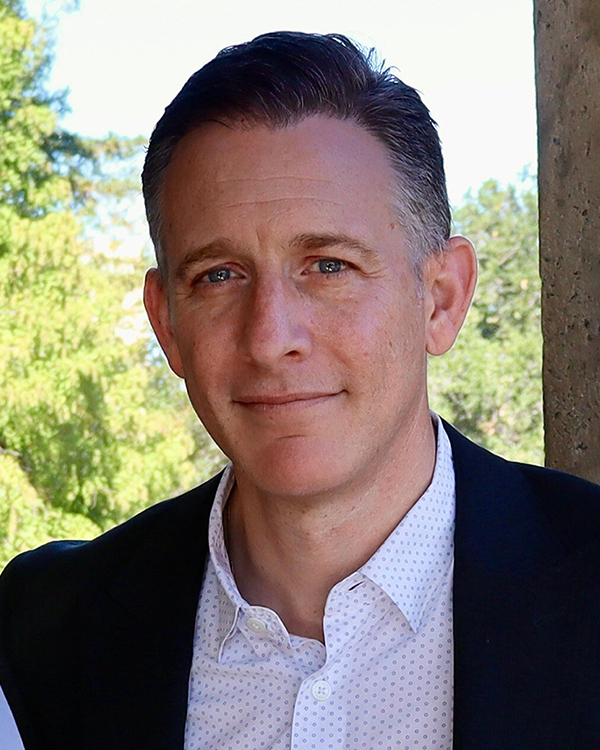
Jeremy Geffen
Executive and Artistic Director, Cal Performances