

Takács Quartet
Sunday, February 22, 2026, 3pm
Hertz Hall
Edward Dusinberre, violin
Harumi Rhodes, violin
Richard O’Neill, viola
András Fejér, cello
Cal Performances is committed to fostering a welcoming, inclusive, and safe environment for all one that honors our venues as places of respite, openness, and respect. Please see the Community Agreements section on our Policies page for more information.
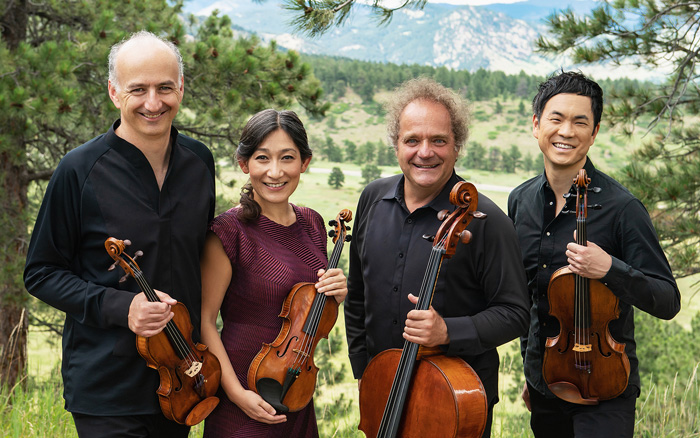
From the Takács Quartet, on this afternoon’s program—
“We fell in love with Clarice Assad’s music when we toured her quintet CLASH for the Takács and accordionist Julian Labro. Her diverse stylistic range and perceptive understanding of string quartet sonorities made us want to commission a new string quartet from her. Clarice’s music inspires interactive spirit and theatrical energy. We feel liberated by her limitless imagination and can’t wait to dive into her new string quartet for us. Debussy’s string quartet immediately came to mind to pair with Assad: the range of colors and textures in combination with its adventurous spirit reminds us of Assad. Similarly, Haydn’s Op. 74, No. 3 creates contrasting moods. The music is humorous, ethereal, and virtuosic. We are excited to spark a conversation between these unique musical voices.”
Franz Joseph Haydn
String Quartet in G minor, Op. 74, No. 3, Rider (Hob. III: 74)
Haydn is often called the father of the symphony, but he helped birth the string quartet, too, with a total of 68 quartets in his worklist when he died. Between his first quartets, from the mid-1750s, and the three quartets of Opus 74, from 1793, he had thought long and hard about the genre. Along with Mozart, he ensured its growth beyond rough-and-ready music for four string players, the starring role often given to the first violin. In Haydn’s hands, the string quartet became a tightly argued essay for four equals.
Haydn composed the three quartets of Opus 71 and the three of Opus 74 for Count Anton Georg Apponyi, who paid for the dedication, putting him in the company of latter-day public figures who appoint themselves to prominent posts or lobby for honors. Haydn had just returned from a London sojourn so successful that he was about to embark on another. He composed this music not just for an intimate chamber setting, but with a London concert hall in mind.
The quartet purports to be in G minor, yet so ebullient is the music that you may come away convinced that the key designation is wrong. The Allegro opens with a figure that might remind you of the braying Mendelssohn wrote into his Midsummer Night’s Dream music. From there, Haydn introduces the swaying, amiable first theme, which gives way to a delightful second subject, the braying transformed into the first turns of a folksy dance, like a reel in the square on market day. This short exposition is reprised. The last gestures of the “dance” music are turned into the first gestures of the development, which, despite venturing into the minor mode, retains a bright-eyed character—reaffirmed when the dance returns to conclude the Allegro.
The Largo that follows, cast in a distant key, sounds bright and fresh. Its first tentative gestures lead to a long-lined song, its character that of a prayerful petition. A short contrasting section, calm but faster-paced, leads back to the prayerful opening.
The minuet, danceable and generous in spirit, again suggests something folk-like, though the central section adds a touch of urbane elegance.
Some listeners heard the rhythm and thumping of the finale as a gallop, hence the quartet’s nickname, which attached to the work after Haydn’s death, any onomatopoeia in this music being purely accidental. And even though Haydn meant to give equal weight to the quartet’s four voices, he assigned the first violinist a genuine virtuoso role.
Clarice Assad
NEXUS
Clarice Assad writes a rhythmically captivating, elegantly magical music influenced by jazz, classics of the Romantic era, and pop music of her native Brazil. Born in Rio de Janeiro and named after the great Brazilian novelist Clarice Lispector, Assad holds degrees from Roosevelt University in Chicago and the University of Michigan School of Music. Among her honors are an Aaron Copland Award, several composition awards from the American Society of Composers, Authors and Publishers, and a McKnight Visiting Composer Award. She formed Bay Area connections in 2008, as composer in residence with San Francisco’s New Century Chamber Orchestra.
Assad’s more than 90 works have been performed around the world by such ensembles as the Philadelphia Orchestra, Tokyo Symphony, and Orquestra Sinfônica de São Paulo and include commissions from Carnegie Hall, the Chamber Music Society of Lincoln Center, and Los Angeles Philharmonic. Her Danças Nativas was nominated for a Latin Grammy for best contemporary composition in 2009, and her music has been recorded by such artists as percussionist Evelyn Glennie, cellist Yo-Yo Ma, violinist Nadja Salerno-Sonnenberg, and oboist Liang Wang. Assad is also a pianist and singer and has given master classes and workshops throughout the United States, Europe, and the Middle East. She has developed an award-winning music education program, VOXploration, for participants of all ages, encouraging them to use their bodies and voices in creating music.
Clarice Assad has provided these comments on NEXUS:
NEXUS was inspired by watching the Takács Quartet’s visceral, whole-body approach to musical expression. NEXUS amplifies the natural physicality of chamber music performance into choreographed symbolism.
The work explores the magnetic forces that draw us together and apart in our modern physical and virtual worlds—the invisible threads of influence, the seductive pull of belonging, and the courage required to maintain an authentic and diverse voice within a collective. It achieves this by theatrically incorporating metaphorical scenes of systems that demand uniformity, mining the essence of those who want to exist authentically, and concludes with a message about being fully oneself while contributing to collective harmony—a task that requires both individual courage and collective wisdom.
The journey begins with Movement I, “(Dis)connection,” where four musicians enter a sonic landscape where individual voices seem to find each other organically. Slowly, people begin to recognize each other and form groups until a grounded gravitational force, portrayed by the cello, emerges, drawing everyone into its hypnotic orbit. In Movement II, “Connection,” the controlling force orchestrates traditional togetherness, uniting in quartet formation and creating music through subtle nods and careful invitations. It is structured and feels familiar, but the harmony is soon dispersed by an individual’s need for control and rigidity. In the final movement, “Synchronization,” the exchange gradually transforms into rigid conformity and trend-following; individual gestures become collective commands, portrayed by choreographed head movements and bodies that mirror each other and fall into lockstep. As synchronization intensifies, it becomes mechanical and routine. For a while, there seems to be flow in this new setting, and all players seem to go along. But at some point, towards the end, in a somewhat unusual move, some choose withdrawal—stopping the pattern and fading into the background. Others choose transformation—remaining to reclaim the space for authentic expression. Both are acts of liberation with costs and gifts. A final gesture from the shadows offers support across the divide between those who leave and those who stay.
Claude Debussy
String Quartet in G minor, Op. 10
Claude Debussy was 31 when his string quartet was premiered, in December 1893, and although music had occupied exactly two thirds of his life, he had not yet attracted much attention. He had entered the Paris Conservatory at age 10, and in the next 11 years there he learned what he needed to learn, became an excellent pianist, cut classes, wrangled with his teachers about what made for “proper” composition, and proved himself equipped with so much of the right stuff that in 1884 he won France’s highest musical award, the Prix de Rome. Even so, among Debussy’s works that predate the quartet, we would likely be most familiar only with “Claire de lune,” from his Suite bergamasque of 1891. Things were about to change.
In 1887, Debussy encountered Wagner’s Tristan und Isolde and was mesmerized. He traveled to Bayreuth over the next two years to immerse himself in Wagner, but the infatuation ended when Debussy realized he had to go his own way, not Wagner’s. His second Bayreuth pilgrimage coincided with the Paris Exposition of 1889, and in a visit to the world’s fair he first heard a Javanese gamelan ensemble. His growing anti-Wagnerism, his discovery of non-Western music, his already unconventional ideas about composition, and a cultural atmosphere saturated with the work of symbolist poets and impressionist painters—all this gelled into the need to create music as he wished to create it, a need spurred by his growing conviction that Germanic musical models confined composers to an artistic mold that allowed for nothing new. Those models, he believed, were made to be ignored. He would create a French music.
We associate the mature Debussy with atmospheric, tonally ambiguous, suggestive sounds built from washes of color and rhythm, progressing as light shifts from dawn to evening. This quartet harbors hints of that Debussy, though he has not yet made a radical break with tradition here. You would not mistake this music for anything by a German composer, but in his own way Debussy packs his quartet with late-Romantic, heart-on-sleeve drama.
The work opens with a thrusting phrase that in its shape and rhythm will be present throughout the movement, and this motto and its variants will dominate much of what ensues in the entire piece. In this Allegro, constructed as a kind of sonata form, the motto hovers in the background even as a lyrical second subject is introduced. Debussy plays with that lyrical phrase, slow in its first appearance, then examined from various angles, now increasingly intense, now reflective, finally driving the music to its conclusion.
Strumming, plucking strings over a variant of the motto—some commentators have traced the genesis of the scherzo to Debussy’s encounter with a Javanese gamelan, one of those percussion ensembles that ignite the sonic atmosphere with the chiming of metal on metal, like an array of high-pitched bells. The ever-present motto is subtly disguised. Dominated by hammering, obsessive repetitions, this scherzo is an essay in rhythmic momentum.
To open the gorgeous third movement, the second violin sings a lament based on the motto, the plucking cello punctuates it, the viola repeats the lament, and the others join in an aria. A long pause suggests that all this has been an introduction. Then the viola introduces a theme that might have come from a Scottish ballad. In the keening elaboration on this ballad, you will hear hints of the Debussy to come. Slowly, the music fades.
The finale opens with the motto, transformed. The pace is agitated. We hear suggestions of the lyrical second subject from the opening movement, and the motto returns in more familiar form. The interweaving lines create the sense that a far larger ensemble is playing, and a big moment seems imminent. For all Debussy’s inclination toward the new, the ending is what his audience would have expected. It is fast. It is grand.
A year after the quartet came the Prélude à l’après-midi d’un faune, which demonstrated how much music could evoke and how much music could be, and which opened music’s way to the future.
—Larry Rothe
Larry Rothe writes about music for Cal Performances and San Francisco Opera. His books include For the Love of Music and Music for a City, Music for the World. Visit larryrothe.com.
About the Artists

Each year in February, as we move into our busiest time of the year, Cal Performances’ calendar becomes especially packed with a wide range of carefully curated events designed to appeal to the adventurous sensibilities and eclectic interests of Bay Area audiences. Over the coming months, we’ll see visits by an array of companies, ensembles, and soloists offering a remarkable set of opportunities to revisit old friends as well as discover marvelous and unfamiliar performers and artworks.
Our February programming alone features nearly two dozen presentations in our halls. You’ll find musical programs performed by world-class artists like baritone saxophonist Steven Banks and pianist Xak Bjerken (Feb 1, Hertz Hall [HH]), pianist Bruce Liu (Feb 10, Zellerbach Hall [ZH]), the beloved Takács Quartet (Feb 22, HH), and gifted jazz artists Cécile McLorin Salvant (Feb 5, ZH) and Somi (Feb 21, Zellerbach Playhouse [ZP]); enthralling contemporary dance programs with the great Martha Graham Dance Company, celebrating its 100th anniversary (Feb 14–15, ZH), and—in its highly anticipated Cal Performances debut—A.I.M by Kyle Abraham (Feb 21–22, ZH); cutting-edge new music from UC Berkeley’s own Eco Ensemble (Feb 7, HH), mezzo-soprano Joyce DiDonato with string trio Time for Three (Feb 7, ZH), and AMOC* and Sandbox Percussion in their mesmerizing co-production of Canto Ostinato, a hypnotic late-1970s minimalist work by Dutch composer Simeon ten Holt (Feb 22, ZP); and thrilling theater from Yaa Samar! Dance Theatre in the West Coast premiere of the company’s brilliant Gathering (Feb 27–Mar 1, ZP).
In the coming months, we’ll welcome a full spectrum of talent including Cal Performances’ 2025–26 Artist in Residence Víkingur Ólafsson; legendary soprano Renée Fleming; the virtuoso JACK Quartet; early-music superstars The English Concert, Jordi Savall, and The Tallis Scholars; and the phenomenally popular Silkroad Ensemble with Rhiannon Giddens.
And in April, our acclaimed dance series continues, distinguished by genre-defining artists and major new productions including The Joffrey Ballet in a bold new work set during Midsommar, the traditional Scandinavian summer solstice festival; and, of course, a return April engagement with the Alvin Ailey American Dance Theater.
As you explore the calendar, I recommend you pay particular attention to our Illuminations theme of “Exile & Sanctuary,” focusing on how issues of displacement can inform bold new explorations of identity and community; and how artistic expression can offer safe harbor during times of unrest or upheaval.
The opportunity to engage with diverse artistic perspectives and share the transformative power of the live performing arts is one of life’s greatest pleasures, and I look forward to encountering these profound and entertaining experiences with you in the months ahead.
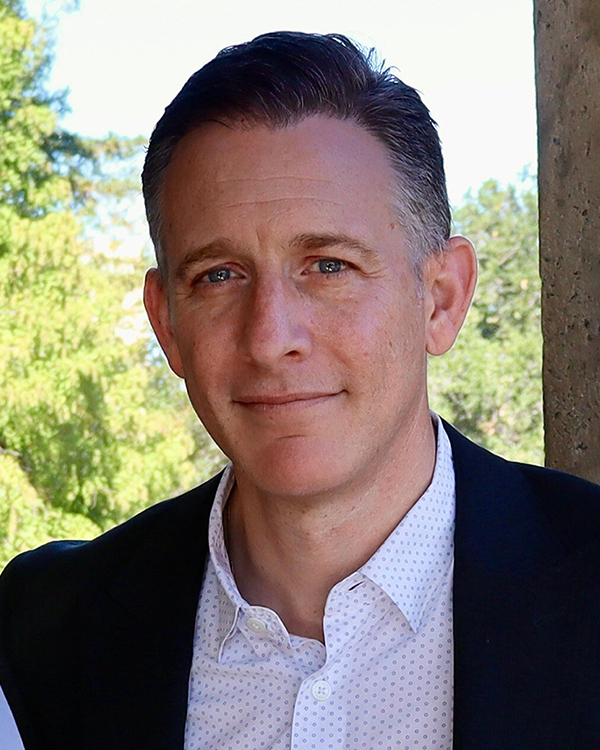
Jeremy Geffen
Executive and Artistic Director, Cal Performances