
Steven Banks, baritone saxophone
Xak Bjerken, piano
Golden Silhouettes
Sunday, February 1, 2026, 3pm
Hertz Hall
This performance is made possible in part by Joe W. Laymon, Kiese Laymon, Jeanne Laymon, Thomas Laymon, and Eve Dunbar and Cade Catherine Dunbar-Laymona.
Cal Performances is committed to fostering a welcoming, inclusive, and safe environment for all one that honors our venues as places of respite, openness, and respect. Please see the Community Agreements section on our Policies page for more information.
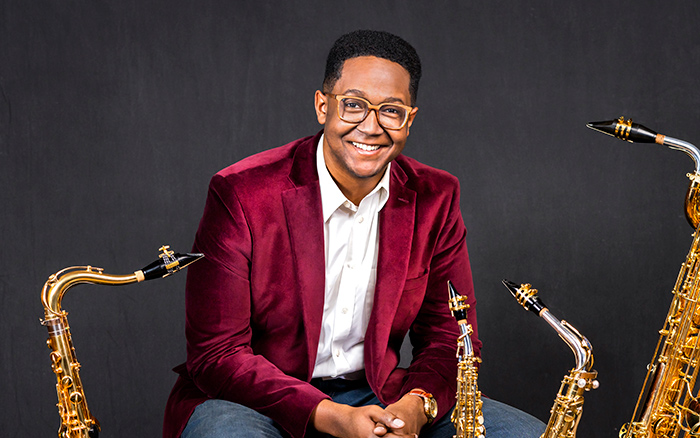
Golden Silhouettes
Steven Banks’ recital today brings together music spanning more than 225 years, from Beethoven and Saint-Saëns to works by contemporary American composers Carlos Simon and John Musto, all heard through the distinctive lens of the baritone saxophone. Joined by longtime collaborator Xak Bjerken at the piano, Banks places the instrument at the center of a repertory not originally conceived for it, inviting listeners to hear familiar music from a different instrumental perspective.
As Jeremy Geffen, Executive Director of Cal Performances, has observed, Banks’ playing is marked by a “striking sonic imagination and musicality”—qualities he recalls encountering early on, including in what he has described as “one of the finest performances I have heard of Mozart’s Oboe Quartet, played on the saxophone.”
Long associated with jazz and popular idioms, the saxophone has continued to stake an expanding claim within classical chamber music. This program reflects both the instrument’s expressive range and the collaborative depth Banks has developed through working closely with Bjerken.
In conversation with Thomas May, longtime Cal Performances annotator and feature writer, Banks speaks about each work on the program in turn, describing how the repertoire takes on new meaning through the baritone saxophone.
Thomas May: This program feels both newly minted and deeply personal. Is this something you’ve been touring with, or is it a fresh creation?
Steven Banks: It’s a brand-new program, and this is only the second time we’ve performed it. We have played Carlos Simon’s hear them before, but everything else on the program is new for us as a set. There’s still a sense of discovery happening for both of us.
TM: Your partnership with pianist Xak Bjerken has been evolving for several years now. How did that collaboration begin?
SB: I was teaching at Ithaca College for three years, starting in 2019—and soon the pandemic hit. During that time, Xak and I were essentially each other’s only musical collaborators. I had just won the Young Concert Artists Auditions, and we were preparing my debut recital. I had also written a large new piece for that program, so we were collaborating very closely on its creation. Carlos Simon’s hear them was written for that same debut recital.
Because of the pandemic shutdown, we spent a lot of time working together in a focused way, and we got to know each other musically at a deep level. Xak has had such a rich and varied career, and for a young musician like me, that perspective is invaluable.
That also ties directly into this program: I’d never played the Beethoven or the Barber before, but Xak has performed both many times. Being able to approach these composers alongside someone who has lived with their music for decades has been an invaluable learning experience.
TM: The program’s juxtapositions are striking: very recent music written specifically for you alongside canonical works by Beethoven and Barber, and then Saint-Saëns and John Musto. What holds it all together for you?
SB: I don’t know that there’s a single anchor in the traditional sense. I think of this program as a kind of tasting. Most people who come to a saxophone recital don’t know quite what to expect. Part of what excites me about this program is that it offers multiple perspectives on what the saxophone can do—specifically, the baritone saxophone. That’s where the title Golden Silhouettes comes from. We’re taking the shadows of these pieces and putting them through the lens of this instrument.
Camille Saint-Saëns
Sonata for Bassoon and Piano in G major, Op. 168
The Bassoon Sonata dates from the final year of Saint-Saëns’ long life and belongs to a late trilogy of sonatas for wind instruments. It reflects a period in which Saint-Saëns, who had come of age as an adventurous and insatiably curious musical figure, turned toward clarity, concision, and finely honed instrumental character as he grew increasingly skeptical of Modernist aesthetics.
Light on its feet yet meticulously crafted, the Bassoon Sonata balances wit and lyricism, exploiting the instrument’s agile articulation and its capacity for warm, singing lines. Cast in three movements, it alternates playful irony with moments of unexpected introspection—qualities that have made it a staple of the bassoon repertoire.
Saint-Saëns had experienced the early decades of the saxophone’s existence—the instrument having been invented by Adolphe Sax in the 1840s—and he was among the composers who wrote for it in both chamber and larger ensemble contexts, including a passage for saxophone quartet in his early choral setting of Psalm 137, Super flumina Babylonis (On the Waters of Babylon) from 1854. That historical overlap lends a certain legitimacy to hearing this music through a different reed voice.
TM: The bassoon is often associated with a sly, tongue-in-cheek personality. What happens to this piece when it’s heard through the baritone saxophone instead?
SB: One thing I notice right away is that pianists often feel liberated when they play with a saxophone. I certainly don’t think of this as taking anything away from the bassoon, but it does mean they can play more fully without constantly worrying about balance.
What I hope comes across is that the singing quality of the melodies, the playful humor, and even the delicacy—especially in the opening of the third movement—are all heightened a bit. Everything feels turned up a few notches. I play quite a bit of oboe repertoire on soprano saxophone, and people often describe that transition in a similar way: it’s everything they loved before, but somehow amplified.
TM: Is this an arrangement you created, or are you essentially playing the original score?
SB: I don’t think of these as arrangements. I’m literally playing the bassoon part and making the necessary transpositions. The same is true throughout the program, whether it’s the Beethoven, the Musto, or the Barber. There are occasional octave adjustments, but structurally nothing has been altered. It’s in the same key; the notes are the notes.
In that sense, maybe the real through-line of this program is simply that it’s all featuring baritone saxophone.
John Musto
Shadow of the Blues (excerpts from
the song cycle for voice and piano)
Born in Brooklyn in 1954, John Musto is a composer, pianist, and conductor known especially for his operas and vocal music. His stage works, including Volpone and The Man Who Mistook His Wife for a Hat, are admired for their dramatic clarity and idiomatic vocal writing. Across his output, Musto combines classical forms with harmonic and rhythmic inflections drawn from jazz, an approach that has made his music particularly compelling in theatrical and song-based contexts.
Musto’s song cycle Shadow of the Blues (1987) sets four poems by Langston Hughes—“Silhouette,” “Litany,” “Island,” and “Could Be” [see sidebar]—drawn from the poet’s early period. The cycle engages Hughes’ language with directness and musical sensitivity, adopting a vocal style shaped by both classical art song and blues-inflected idioms.
Banks performs the original vocal lines of selected songs from the cycle on baritone saxophone, allowing Hughes’ poetry to be heard through the instrument’s vocal timbre. The selections approach the blues as an expressive framework rather than a fixed genre—a framework that aligns closely with the saxophone’s capacity for speech-like inflection and tonal nuance.
TM: How did you first encounter John Musto’s music, and what drew you to this piece in particular?
SB: I hadn’t known Musto’s music before I encountered the “Litany” movement on a vocal recital in North Carolina and fell in love with it. There’s something in that movement that reminds me of Ravel, to whom I’m generally very drawn. The connection solidified when I read all of the poetry. These poems by Langston Hughes are powerful.
TM: You’re playing the original vocal lines rather than a newly composed instrumental part. How does that shape your approach?
SB: That’s right: I’m just playing the vocal line from the original songs. The piece gives the saxophone a chance to do a little bit of the jazzy thing that people might be expecting in a saxophone recital, especially in “Could Be.”
But the text is central. “Silhouette,” in particular, is very stark. The poetry doesn’t soften what it’s saying, and I think the saxophone can carry that directness in a very particular way.
Carlos Simon
hear them
Commissioned by Young Concert Artists and Washington Performing Arts for Steven Banks, hear them was composed in 2020 and takes its inspiration directly from Simon’s sense of ancestral presence. “I have been constantly aware of the presence of my ancestors in my life,” the composer writes. “The benevolent forefathers and foremothers are there to help, guide, and assist.”
hear them is inspired by a poem by Nayyirah Waheed, an American poet whose spare, aphoristic writing has reached a wide readership. The poem appears in her 2013 collection salt., a book composed largely of brief, minimalistic texts addressing identity and emotional survival with striking economy of language.
communication
if you cannot
hear
them.
ask the ancestors
to speak louder.
they only whisper
so
as not to frighten you.
they know
they have been convinced.
coerced.
spooked.
from your skin.
—Nayyirah Waheed, from salt. (2013)
TM: This piece was written specifically for you. How did the collaboration with Carlos Simon come about?
SB: For my Young Concert Artists debut, I put out a call for scores from Black composers. I received a lot, and I really enjoyed Carlos’ music. I had met him slightly before he became as widely known as he is now. At the time, I knew him more from the band world, where he was doing a lot of the work he’s now known for, but at the wind ensemble level.
We had a conversation during COVID about how it would have been nice to be in the same room and improvise together, but that wasn’t possible. So Carlos recorded some improvisations at the piano and sent them to me. I overdubbed improvisations of my own in reaction to them and sent those back. The piece is essentially an amalgamation of those improvisations that he then composed into a more formal structure. It was a different kind of collaboration.
TM: What does the title signify?
SB: The title comes from a phrase in the poem by Nayyirah Waheed, which I recite before the piece begins. The piece is meant as a reminder to listen to the cautionary tales of those who came before us. Some sounds in the piece represent what Carlos calls “ancestral cries.” You can almost imagine people shrieking and trying to warn you from far away—but you’re not exactly sure what they’re trying to say.
Ludwig van Beethoven
Seven Variations on “Bei Männern,
welche Liebe fühlen,” WoO 46
Beethoven composed this set of variations in 1801 on a famous tune from Mozart’s Die Zauberflöte, an opera he deeply admired. The original number is a duet sung by Pamina and Papageno in Act I, as the two characters reflect—simply and sincerely—on the consolations of love and companionship. Set in an unadorned, folk-like vein, the duet embodies the opera’s humane idealism, shared across differences of class and temperament.
Written originally for cello and piano, Beethoven’s variations retain the duet’s melodic clarity while subjecting it to a wide range of transformations. Rather than obscure the theme, he tests its resilience, exploring contrasts of lyricism and humor with virtuosity.
TM: This piece is new to your repertoire. What led you to include it in the program?
SB: Beethoven in general is pretty new to me as a performer—which is an odd thing to say as a classical musician, but not so much as a saxophonist. I’ve wanted to engage with his music more, since I’m also a composer, and there are certain things about the way Beethoven writes that I admire. Xak and I came to this piece together, and we’re enjoying the sheer beauty and the florid ways in which he varies the theme.
TM: In a way, the piece in this format almost feels like a metaphor for the saxophone itself—its ever-changing identity, built from variations on a simple idea.
SB: Yes, exactly. There’s something about having this very straightforward tune and then watching it spin off in all these directions. That sense of transformation really resonates with the saxophone for me.
TM: Beethoven takes his theme from an opera. How does that influence how the saxophone functions here?
SB: The saxophone is a very vocal instrument—in some ways, it’s even more operatic than strings, and that opens up a different way of approaching this music that works particularly well on the saxophone. It’s about having a different way of playing within a vocal tradition.
Samuel Barber
Sonata for Cello and Piano, Op. 6
Samuel Barber composed the Cello Sonata in 1932, during the remarkable early phase of his career that quickly established him as one of the most distinctive American composers of his generation. A prodigy student at the Curtis Institute of Music in Philadelphia, Barber moved with striking assurance into professional life, producing a series of works in his twenties that brought him international attention. Even at this early stage, his music revealed the qualities that would remain central to his voice: an intense, unabashed lyricism and a strong sense of formal control.
Cast in three movements, the Cello Sonata belongs to this formative period, alongside works such as the Overture to The School for Scandal (1931), and already displays the long-breathed melodic writing and distinctive harmonic language that would define his mature style.
TM: What drew you to Barber’s Cello Sonata, and how has working on it shaped your thinking?
SB: Similarly to the Beethoven, Barber’s musical language is deeply compelling to me, and I’ve been excited to spend time letting it settle in, both as a musician and as a composer. He has such a distinct harmonic voice, and we’ve been having a great time digging into the language of the piece.
There are a lot of things that have become performance practice on the cello that feel extraneous to what’s actually in the score—like taking time in certain places because it feels right on the instrument. We’re trying to think more about the form underneath and make sure it remains clear.
TM: Does the saxophone change the expressive character of the piece?
SB: I think sometimes when I hear it played by cellists, it feels like the piece is about the cello. We’re trying to approach it in a way where it’s more about Samuel Barber. The saxophone can’t sustain a note forever, and that changes how the piece feels. It’s very different from any recordings I’ve heard.
From The Collected Poems of Langston Hughes
Silhouette
Southern gentle lady,
Do not swoon.
They’ve just hung a black man
In the dark of the moon.
They’ve hung a black man
To a roadside tree
In the dark of the moon
For the world to see
How Dixie protects
Its white womanhood.
Southern gentle lady,
Be good!
Be good!
Prayer
Gather up
In the arms of your pity
The sick, the depraved,
The desperate, the tired,
All the scum
Of our weary city.
Gather up
In the arms of your pity.
Gather up
In the arms of your love–
Those who expect
No love from above.
Island
Wave of sorrow,
Do not drown me now:
I see the island
Still ahead somehow.
I see the island
And its sands are fair:
Wave of sorrow,
Take me there.
Could Be
Could be Hastings Street,
Or Lenox Avenue,
Could be 18th & Vine
And still be true.
Could be 5th & Mound,
Could be Rampart:
When you pawned my watch
You pawned my heart.
Could be you love me,
Could be that you don’t.
Might be that you’ll come back,
Like as not you won’t.
Hastings Street is weary,
Also Lenox Avenue.
Any place is dreary
Without my watch and you.
About the Artists


Each year in February, as we move into our busiest time of the year, Cal Performances’ calendar becomes especially packed with a wide range of carefully curated events designed to appeal to the adventurous sensibilities and eclectic interests of Bay Area audiences. Over the coming months, we’ll see visits by an array of companies, ensembles, and soloists offering a remarkable set of opportunities to revisit old friends as well as discover marvelous and unfamiliar performers and artworks.
Our February programming alone features nearly two dozen presentations in our halls. You’ll find musical programs performed by world-class artists like baritone saxophonist Steven Banks and pianist Xak Bjerken (Feb 1, Hertz Hall [HH]), pianist Bruce Liu (Feb 10, Zellerbach Hall [ZH]), the beloved Takács Quartet (Feb 22, HH), and gifted jazz artists Cécile McLorin Salvant (Feb 5, ZH) and Somi (Feb 21, Zellerbach Playhouse [ZP]); enthralling contemporary dance programs with the great Martha Graham Dance Company, celebrating its 100th anniversary (Feb 14–15, ZH), and—in its highly anticipated Cal Performances debut—A.I.M by Kyle Abraham (Feb 21–22, ZH); cutting-edge new music from UC Berkeley’s own Eco Ensemble (Feb 7, HH), mezzo-soprano Joyce DiDonato with string trio Time for Three (Feb 7, ZH), and AMOC* and Sandbox Percussion in their mesmerizing co-production of Canto Ostinato, a hypnotic late-1970s minimalist work by Dutch composer Simeon ten Holt (Feb 22, ZP); and thrilling theater from Yaa Samar! Dance Theatre in the West Coast premiere of the company’s brilliant Gathering (Feb 27–Mar 1, ZP).
In the coming months, we’ll welcome a full spectrum of talent including Cal Performances’ 2025–26 Artist in Residence Víkingur Ólafsson; legendary soprano Renée Fleming; the virtuoso JACK Quartet; early-music superstars The English Concert, Jordi Savall, and The Tallis Scholars; and the phenomenally popular Silkroad Ensemble with Rhiannon Giddens.
And in April, our acclaimed dance series continues, distinguished by genre-defining artists and major new productions including The Joffrey Ballet in a bold new work set during Midsommar, the traditional Scandinavian summer solstice festival; and, of course, a return April engagement with the Alvin Ailey American Dance Theater.
As you explore the calendar, I recommend you pay particular attention to our Illuminations theme of “Exile & Sanctuary,” focusing on how issues of displacement can inform bold new explorations of identity and community; and how artistic expression can offer safe harbor during times of unrest or upheaval.
The opportunity to engage with diverse artistic perspectives and share the transformative power of the live performing arts is one of life’s greatest pleasures, and I look forward to encountering these profound and entertaining experiences with you in the months ahead.
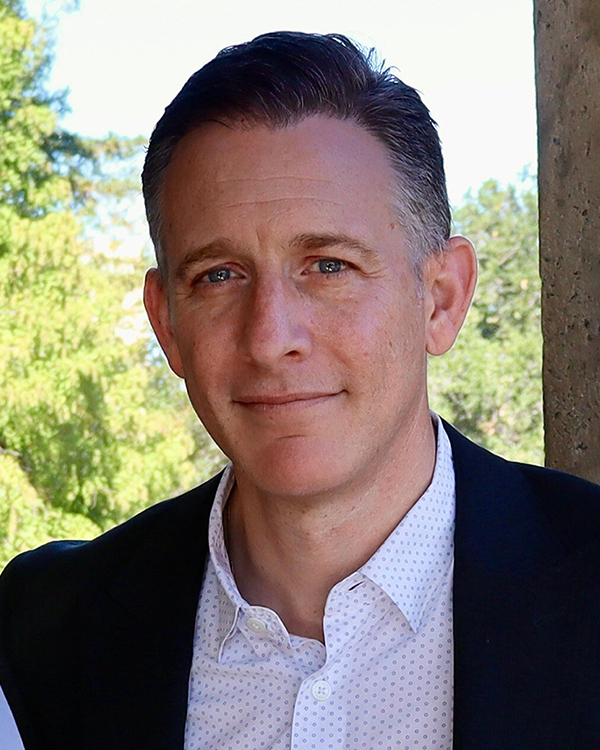
Jeremy Geffen
Executive and Artistic Director, Cal Performances