

Joyce DiDonato, mezzo-soprano
Time for Three, string trio
Emily – No Prisoner Be
A Cal Performances Co-commission
Saturday, February 7, 2026, 8pm
Zellerbach Hall
The creation of Emily – No Prisoner Be was made possible by the lead commissioner, Bregenzer Festspiele, and co-commissioners Cal Performances at the University of California, Berkeley and University of California, Santa Barbara Arts & Lectures.
Emily – No Prisoner Be has been generously supported by Mary Ellen Clark, Helen Berggruen for Five Arts Foundation, and Gordon P. Getty.
This performance is made possible in part by Helen Berggruen for Five Arts Foundation.
This project is supported in part by the National Endowment for the Arts.
This evening’s performance will last approximately 75 minutes and be performed without intermission.
Cal Performances is committed to fostering a welcoming, inclusive, and safe environment for all one that honors our venues as places of respite, openness, and respect. Please see the Community Agreements section on our Policies page for more information.
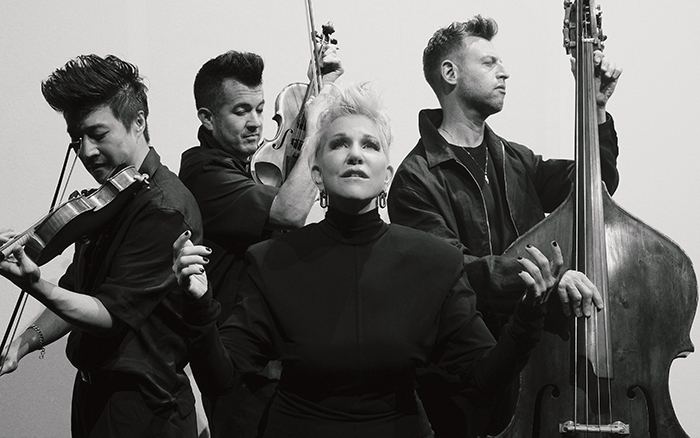
Emily No Prisoner Be emerged through my collaboration with great performers from two different realms. The Hours—an opera based on the novel by Michael Cunningham with a libretto by Greg Pierce—was commissioned by the Metropolitan Opera and featured a trio of stars including Joyce DiDonato, who created the role of Virginia Woolf to rapturous acclaim. My creative work during the Covid-19 pandemic toggled between this mammoth project and another: a triple concerto called Contact for the dynamic string trio Time for Three. At some point during our work on Contact, the members of Time for Three (Nicolas Kendall, violin and vocals; Charles Yang, violin and vocals; Ranaan Meyer, bass and vocals) and I realized we were having too much fun and needed to look ahead to another project in the near future. When the idea of an album of songs arose, I had just the singer in mind! I had a strong feeling the deep musical intuition, larger-than-life personalities and fiercely creative minds of all four of these powerhouse artists might gel in a very special way. I wasn’t wrong.
But an album of songs based on what text? I stumbled upon this poem of Emily Dickinson and had the answer:
They shut me up in Prose—
As when a little Girl
They put me in the Closet—
Because they liked me “still”—
They shut me up in Prose—
Still! Could themself have peeped—
And seen my Brain—go round—
They might as wise have lodged a Bird
For Treason—in the Pound—
Himself has but to will
And easy as a Star
Look down upon Captivity—
And laugh—No more have I—
Though Juilliard- and Curtis Institute-trained musicians of the highest caliber, Time for Three exudes the energy of a rock/pop concert at its most exhilarating. I could imagine this energy right from the start, with “shredding” violin virtuosity ushering in Joyce’s first lines. The trio could even sing back her lines in counterpoint and provide harmonic support in the manner of Aretha Franklin’s backup singers. In short, I could see from the start this wasn’t going to be your grandmother’s Emily Dickinson song cycle.
The breadth of the entire work became vaguely apparent in my mind, a rather massive journey through Dickinson’s poetry framed by her refusal to be contained in “prose”, or—put less poetically—within the confines of conventional religious ideology, societal norms of the era, traditional social conventions, or even sexual identity. Though she famously cloistered herself in a room in her father’s house for much of her life, she would be a prisoner of nothing and no one.
To be sure, there is nothing groundbreaking in the choice to set Emily Dickinson’s poetry to music, and admittedly my mention of it caused a few eyes to roll in the early stages. In fact, according to David Nirenberg, Director of Princeton’s Institute for Advanced Studies, who graciously hosted the five of us for two immensely productive workshops, there have been more than 3,000 musical settings of Emily Dickinson’s poetry. It positively cries out to be sung. There is music in every line, every word, and in the spaces between the words. It inspires rhythm, harmony, melody, musical atmosphere; it leaps off the page in a way composers have been unable to resist.
So I simply began to set poems—some well-known, some more obscure—as I discovered them, writing quickly and with little sense of where each song might eventually appear sequentially in the cycle. This approach to form represented a departure from the way I normally work, and frankly it made me nervous. Not until I began workshopping the various songs with Joyce and Time for Three did I discover we could allow the music to dictate the course of things. Historians have relied on Dickinson’s handwriting to make rough guesses as to when in her life a poem was written, but we do not know the precise order. It seems she wrote them as the spirit moved her. So once I released myself any obligation to preserve chronology or give the work a sequential thematic structure, isolated songs began to coalesce into small groups of songs.
Dickinson enjoyed a particular fascination with bees, judging from the number of poems written about them, so I found myself composing “bee scherzos” that serve the dual function of showcasing Time for Three’s virtuosity and giving Joyce’s voice a much-needed rest during this rather colossal cycle. In fact, I was delighted to find that, in her indispensable book Dickinson, Helen Vendler fittingly describes the following as a “winsomely playful scherzo”:
Bee! I’m expecting you!
Was saying Yesterday
To Somebody you know
That you were due—
The Frogs got Home last Week—
Are settled, and at work—
Birds, mostly back—
The Clover warm and thick—
You’ll get my Letter by
The seventeenth; Reply
Or better, be with me—Yours, Fly.
These scherzos also serve as connective material between clusters of songs. Sometimes I even found myself flipping through Dickinson’s 1,800 poems to find one whose musical setting might close a “gap” in a similar way within the arc of the whole piece.
Though the intention of a poem like the wonderful “I Dwell in Possibility” is clear enough, others are more resistant to interpretation, at least for this composer. Again to quote Vendler, “like all capacious writers, she baffles complete understanding,” yet these more enigmatic offerings often create the most alluring space for musical setting. For example, the following:
So set its Sun in Thee
What Day be dark to me—
What distance—far—
So I the Ships may see
That touch—how seldomly—
Thy Shore?
There is the sense of longing for something just out of reach, and there is the setting sun and the gentle rhythm of the tide. And for me, that is enough.
In my program note for The Hours, I described a rather metaphysical experience after spending so much time considering the predicaments and motivations of Virginia Woolf, albeit through a second-hand incarnation of the great writer formed in the mind of Michael Cunningham. It truly began to feel as if she was in the room with me as I grafted melodies and harmonies onto her story. I experienced something similar with the ghost of Georgia O’Keeffe as I mined hundreds of her letters to create The Brightness of Light for Renée Fleming. Emily Dickinson also stopped by my little third-floor office in Yonkers, New York (it’s getting crowded up here!). And when I visited Dickinson’s house in Amherst, Massachusetts during the summer of 2024, I felt an odd familiarity and sense of recognition, though undoubtedly one formed by my own projecting and romanticizing. But this is, after all, what we do with our heroes.
—Kevin Puts


Each year in February, as we move into our busiest time of the year, Cal Performances’ calendar becomes especially packed with a wide range of carefully curated events designed to appeal to the adventurous sensibilities and eclectic interests of Bay Area audiences. Over the coming months, we’ll see visits by an array of companies, ensembles, and soloists offering a remarkable set of opportunities to revisit old friends as well as discover marvelous and unfamiliar performers and artworks.
Our February programming alone features nearly two dozen presentations in our halls. You’ll find musical programs performed by world-class artists like baritone saxophonist Steven Banks and pianist Xak Bjerken (Feb 1, Hertz Hall [HH]), pianist Bruce Liu (Feb 10, Zellerbach Hall [ZH]), the beloved Takács Quartet (Feb 22, HH), and gifted jazz artists Cécile McLorin Salvant (Feb 5, ZH) and Somi (Feb 21, Zellerbach Playhouse [ZP]); enthralling contemporary dance programs with the great Martha Graham Dance Company, celebrating its 100th anniversary (Feb 14–15, ZH), and—in its highly anticipated Cal Performances debut—A.I.M by Kyle Abraham (Feb 21–22, ZH); cutting-edge new music from UC Berkeley’s own Eco Ensemble (Feb 7, HH), mezzo-soprano Joyce DiDonato with string trio Time for Three (Feb 7, ZH), and AMOC* and Sandbox Percussion in their mesmerizing co-production of Canto Ostinato, a hypnotic late-1970s minimalist work by Dutch composer Simeon ten Holt (Feb 22, ZP); and thrilling theater from Yaa Samar! Dance Theatre in the West Coast premiere of the company’s brilliant Gathering (Feb 27–Mar 1, ZP).
In the coming months, we’ll welcome a full spectrum of talent including Cal Performances’ 2025–26 Artist in Residence Víkingur Ólafsson; legendary soprano Renée Fleming; the virtuoso JACK Quartet; early-music superstars The English Concert, Jordi Savall, and The Tallis Scholars; and the phenomenally popular Silkroad Ensemble with Rhiannon Giddens.
And in April, our acclaimed dance series continues, distinguished by genre-defining artists and major new productions including The Joffrey Ballet in a bold new work set during Midsommar, the traditional Scandinavian summer solstice festival; and, of course, a return April engagement with the Alvin Ailey American Dance Theater.
As you explore the calendar, I recommend you pay particular attention to our Illuminations theme of “Exile & Sanctuary,” focusing on how issues of displacement can inform bold new explorations of identity and community; and how artistic expression can offer safe harbor during times of unrest or upheaval.
The opportunity to engage with diverse artistic perspectives and share the transformative power of the live performing arts is one of life’s greatest pleasures, and I look forward to encountering these profound and entertaining experiences with you in the months ahead.
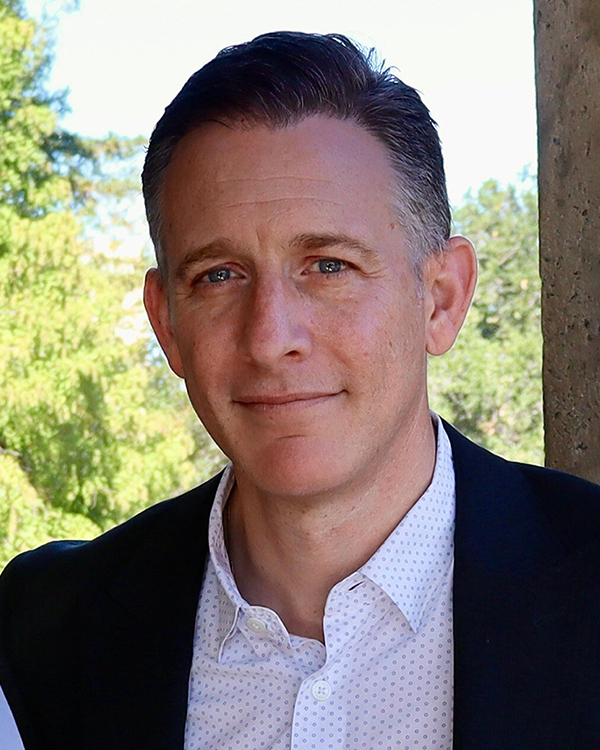
Jeremy Geffen
Executive and Artistic Director, Cal Performances